

Afterglow: A Subterranean Monument That Folds Mughal Geometry into Agra's Urban Future
A shortlisted Black Taj entry buries crystalline galleries beneath the earth, coupling Mughal spatial logic with a waste-to-energy urban strategy.


What if the sequel to the Taj Mahal were not a building that rises but one that descends? Afterglow answers the myth of the Black Taj by folding its monument into the ground, creating cavernous galleries where perforated ceilings scatter light like celestial constellations and suspended crystalline fragments hold the memory of Mughal ornament in mid-air. The proposal refuses the idea of a static monument entirely. Instead, it operates as a living urban organism: part cultural hub, part waste-to-energy plant, part subterranean cathedral.
Shortlisted in the The Black Taj competition, the project is the work of Narendra, Vikram, Smaran, and Sandesh. Sited in Agra and responding to the city's infrastructural deficits as much as its heritage, Afterglow treats the competition brief not as a prompt for a memorial object but as an invitation to rethink how monumental architecture can participate in contemporary urban life.
Suspended Fragments: Interior Galleries as Mughal Memory
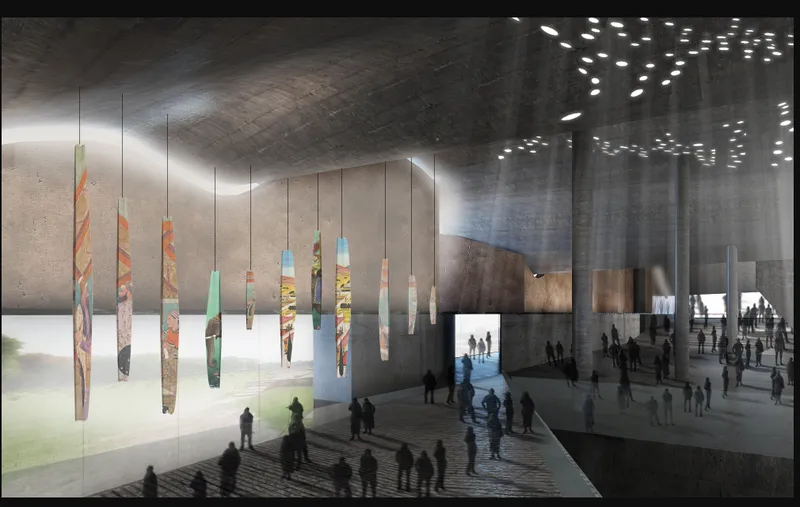
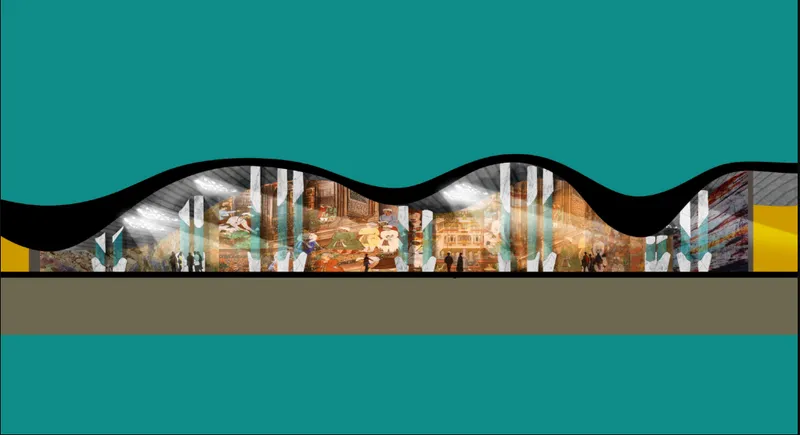
The interior gallery is the project's most arresting space. Suspended panels of colored stone hang from a perforated concrete ceiling, catching filtered daylight and casting it across the floor in shifting compositions. Visitors below move through pools of illumination that feel less like artificial lighting effects and more like weather. The section drawing reveals how this works architecturally: an undulating roof profile shelters a transparent gallery volume, its interior lined with historic murals that establish a continuous dialogue between Mughal narrative art and the abstracted structural geometry overhead.
The designers describe the experience as "walking through the afterlife of architecture," and the spatial sequence supports that claim. These are not conventional exhibition halls. Light operates as the primary narrative element, carving out zones that shift between sacred quiet and communal openness. The suspended fragments, derived from abstracted Quranic scripts, arches, and dome geometries of the Mughal period, read simultaneously as structural ornament and as cultural artifacts floating free of their original context.
Carved Darkness: Multi-Level Halls Punctured by Light
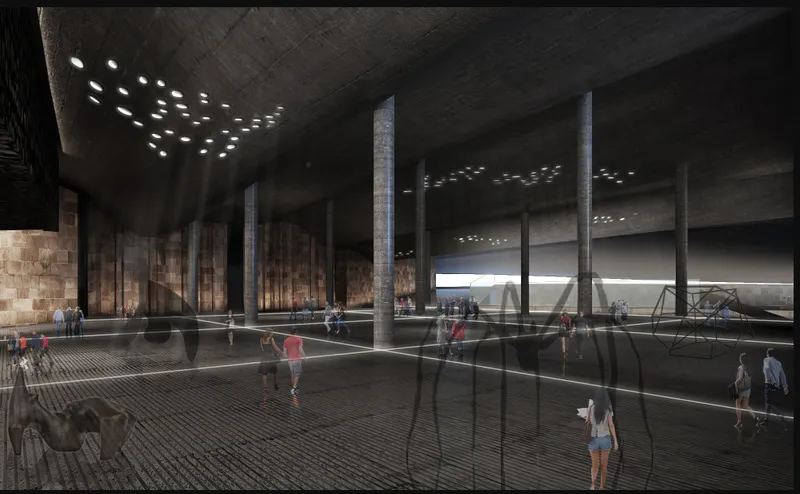
Descending deeper into the monument, the material palette shifts. Stone-clad columns and glass railings define a multi-level exhibition hall where circular perforations puncture a dark ceiling, producing controlled shafts of light that move across the interior over the course of the day. The effect is deliberate: the architects used cosmic geometry as a generative principle, so the ceiling reads as a map of constellations rather than a functional soffit. The darkness is not a limitation; it is the design's medium.
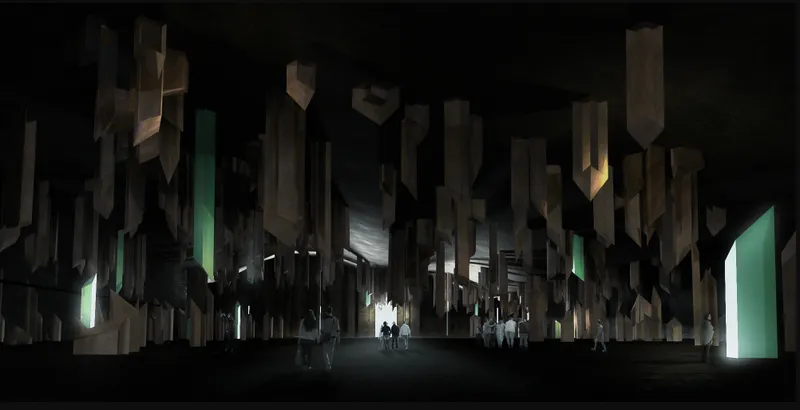
At the gallery entrance, hundreds of hanging angular metal fragments form a threshold between the outer world and the subterranean interior. Visitors pass through pools of green light filtered by the overhead canopy, a moment of transition that collapses the distance between landscape and architecture. The hanging elements abstract Mughal decorative motifs into a kinetic field, one that responds to air movement and shifts in ambient light. It is a generous gesture: monumental in scale, intimate in encounter.
Urban Metabolism: Embedding a Monument in Agra's Infrastructure
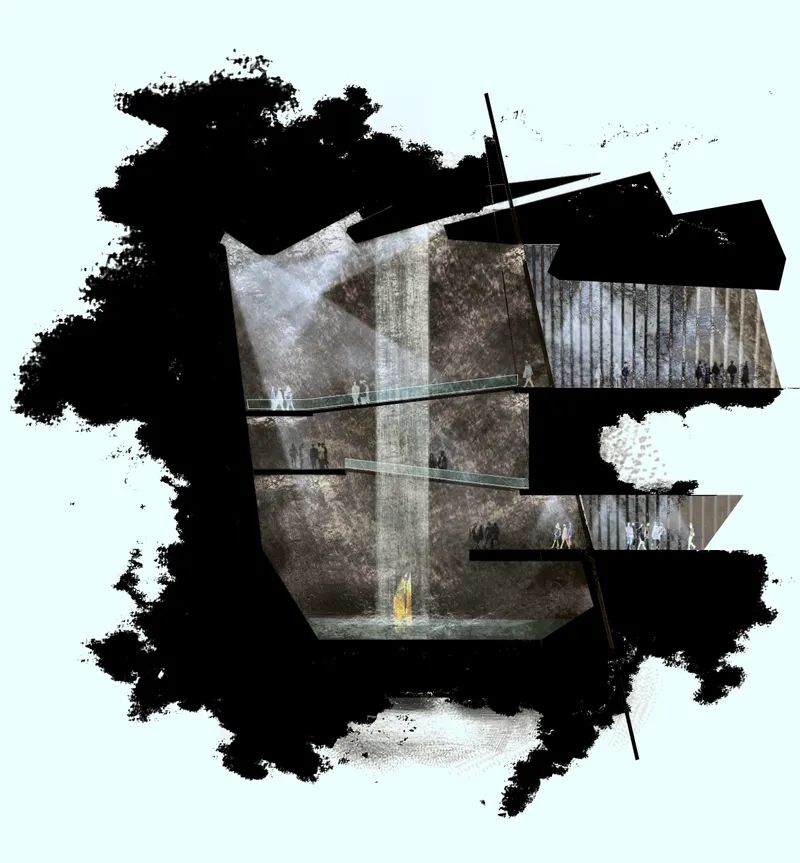
The collage drawing of stacked concrete levels, figures moving between tree-framed spaces and black-painted structural elements, reveals Afterglow's ambition beyond the gallery. The team embedded the monument within Agra's urban metabolism, integrating a Waste-to-Energy plant alongside the cultural program. This is a pointed decision: the site was chosen precisely because it sits on a neglected periphery, and the project's dual function as energy infrastructure and public destination converts that neglect into civic value.
Rather than isolating a heritage object behind a ticket counter, the designers connected waste management, mobility, and energy production to the cultural hub. The result is a rare proposition where sustainability is not a checklist item appended to a monument but the operational logic that justifies the monument's existence. Open courtyards for public gatherings, contemplative halls, and gallery circuits are organized around this infrastructural spine, ensuring that the site participates in Agra's daily rhythms rather than sitting apart from them.
Why This Project Matters
Most responses to heritage competitions oscillate between faithful reproduction and theatrical abstraction. Afterglow sidesteps both traps. By grounding its formal language in the actual geometric principles of Islamic architecture, then coupling those principles to a functional urban program, the proposal earns its monumental ambition. The subterranean strategy is especially convincing: it allows the landscape to remain visually continuous while creating vast interior volumes that rival any above-ground gallery in spatial intensity.
What Narendra, Vikram, Smaran, and Sandesh demonstrate is that the myth of the Black Taj does not need another white marble counterpart. It needs architecture willing to go underground, to weave cultural memory into infrastructure, and to treat light, geometry, and sustainability not as separate ambitions but as a single coherent project. Afterglow does precisely that, and it makes a compelling case that the most resonant monuments of the future may be the ones you descend into rather than look up at.
View the Full Project
About the Designers
Designers: Narendra, Vikram, Smaran, Sandesh
Enter a Design Competition on uni.xyz
uni.xyz runs architecture and design competitions year-round that reward proposals with spatial conviction and real site intelligence.
Project credits: The Black Taj Afterglow by Narendra, Vikram, Smaran, Sandesh The Black Taj (uni.xyz).



Popular Articles
Popular articles from the community


Riyadh For All: Intergenerational Urban Design for Active Aging in Rabat
Riyadh For All reimagines urban design in Rabat with intergenerational co-living, adaptive courtyards, and Moroccan cultural exchange today.

Co-life: Sustainable Architecture for Age-Friendly Community Living
Co-life reimagines sustainable architecture for seniors through courtyards, rammed earth, shared gardens, and spaces designed for belonging.

Co-Life: Senior Housing Design That Reconnects Older Adults With the City
Co-Life reimagines senior housing design through healing gardens, shared streets, workshops, and a sustainable community across generations.

The Earth Pod: 3D Printed Homes for Resilient Refugee Communities
The Earth Pod reimagines refugee housing through 3D printed homes made from clay, combining resilience, self-sufficiency, and rapid shelter.


Similar Reads
You might also enjoy these articles

Lunar Spiral: Space Architecture Shaped by the Mathematics of the Universe
Lunar Spiral reimagines space architecture through Fibonacci geometry, lunar regolith, levitating habitats, and self-sustaining Moon living.
The Main Dream: Modular Architecture for Play, Learning, and Community
A modular playground turns recycled plastic into adaptable spaces where refugee children can play, build, learn, and reconnect.

Play: Fragments of Their World
Familiar architecture becomes modular playground design, creating safe spaces where displaced children can learn, connect, imagine and play.

Wadi Rum Observatory: Desert Architecture Designed for the Night Sky
Wadi Rum Observatory turns desert architecture into a quiet instrument for astronomy, hiding research spaces under Jordan's starlit terrain.

Explore The Black Taj Competitions
Discover active competitions in this discipline



Challenge to reimagine the Iron Throne


Photograph architecture without architects


Illustrate the lost glory of Angkor Wat - Render Challenge


Bring back Drive In's
Comments (0)
Please login or sign up to add comments
No comments yet. Be the first to comment!