THE CIRCLE OF KNOWLEDGE - LIBRARY OF THE FUTURE
A new outlook for a library, for the people and not only for books.


A new outlook on a library as a place for people, not books. The goal of this project was to create a design that would be an answer to the growing lack of interest in libraries.
Library as the well-know point on the cityscape
The Circle of Knowledge is a place where a library becomes not only a storage facility but also a community center, suited to the needs of its users. It's meant to be a well-known point on the cityscape, that prides itself on its interesting initiatives and events.

Prior to the development of the project, a social survey was created and collected from the students all over Poland via social networks.
ANSWERS
According to their answers, the following conclusions could be drawn:
1) Most of the respondents prefer studying individually or in a group of friends, often eating or drinking while doing so.
2) Libraries are gloomy, overwhelming, have no electronic equipment, number of physical books is insufficient.
3) Libraries have low popularity, often lacking needed items, especially new ones. Many books are available only on the spot and there is no way to borrow them.
4) Libraries should be bright and open, young people want to be able to prepare school group projects in them. The option of combining a cafeteria with a reading room, introducing computer rooms are welcome.
The information collected contributed to outlining the design problem and inspired the creation of The Circle of Knowledge project. Essential turned out to be interpersonal relations and good learning conditions - more people-friendly than those to which we have gotten used to as users of common libraries. For that reason, the main assumptions were an introduction of gastronomy in this space and its sufficient lighting and ventilation.

The form itself can eliminate some of the problems, therefore the decision was to create a project that is oriented according to the four directions of the world, consistent in its layout, with multifaceted illumination and ventilation. In shaping the functional layout, notable was also the decision to forego the large-area library hall in lieu of smaller, categorized rooms that gather smaller groups of people with similar interests, thus encouraging free discussion and exchange of views. This approach supports small communities – clubs of interest. Establishing such structures is crucial for communities, providing a sense of belonging, integrity, acceptance.
Enormous library loads, reading fatigue and technological development provoke reflection of the building’s mode of functioning and the services it provides. For that reason, this concept was based on the idea of knowledge digitalization and cataloguing. Spaces for books were given back to the people and the building itself additionally equipped with necessary modern technology.
SPACES FOR BOOKS WERE GIVEN BACK TO THE PEOPLE
This project constitutes an apotheosis of the essence of knowledge acquisition. The building is based on circles and divided into four parts (corners of the world). It constitutes a sort of city compass and informs the user of its function - gaining the ability to interpret the world around us. As one moves away from the center, the reinforcement of this idea becomes apparent, as the building is divided further by months and days of the week. The labyrinth-like layout of the corridors evokes the complexity of knowledge discovery and the intricacy of science itself.

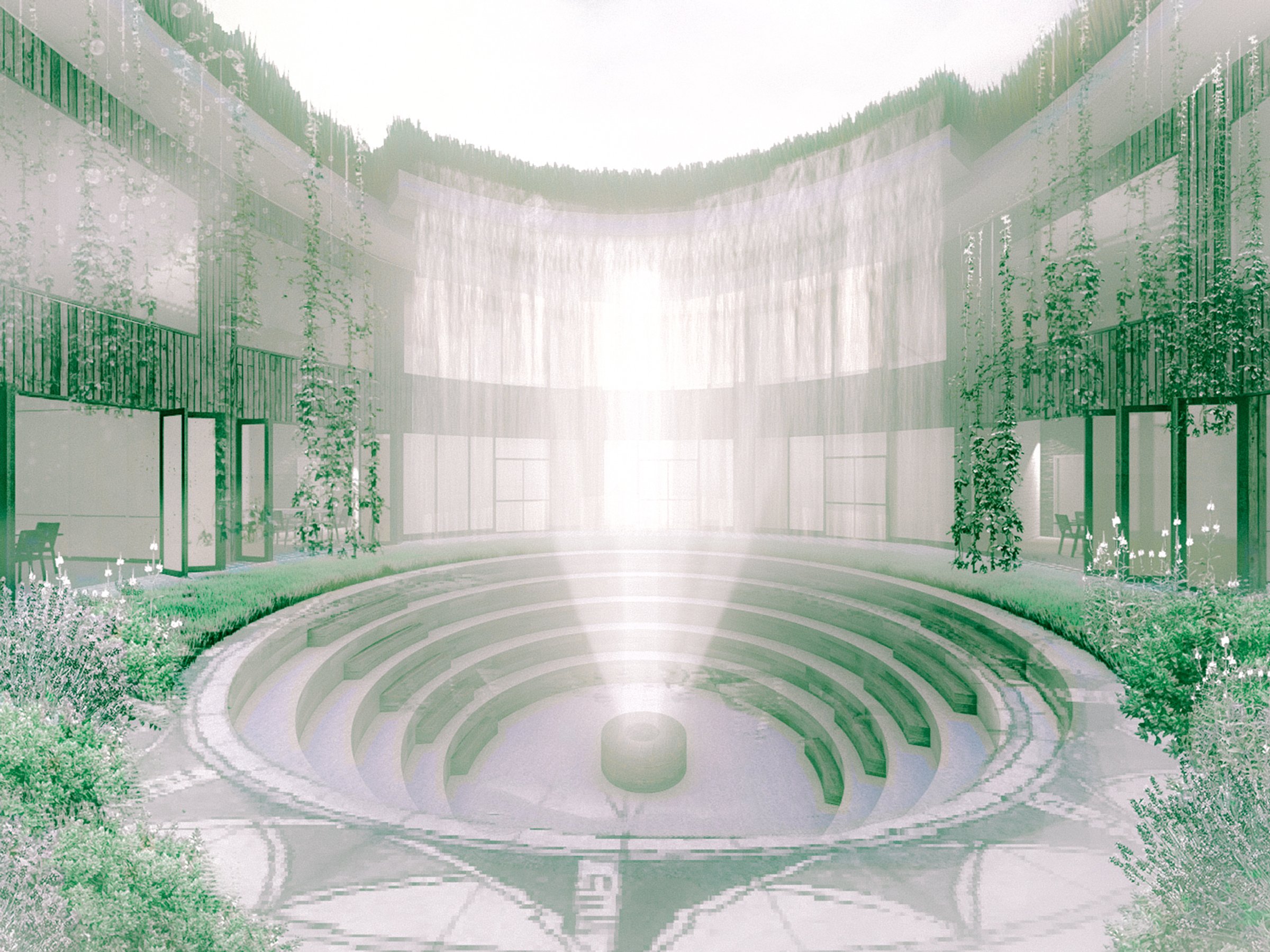
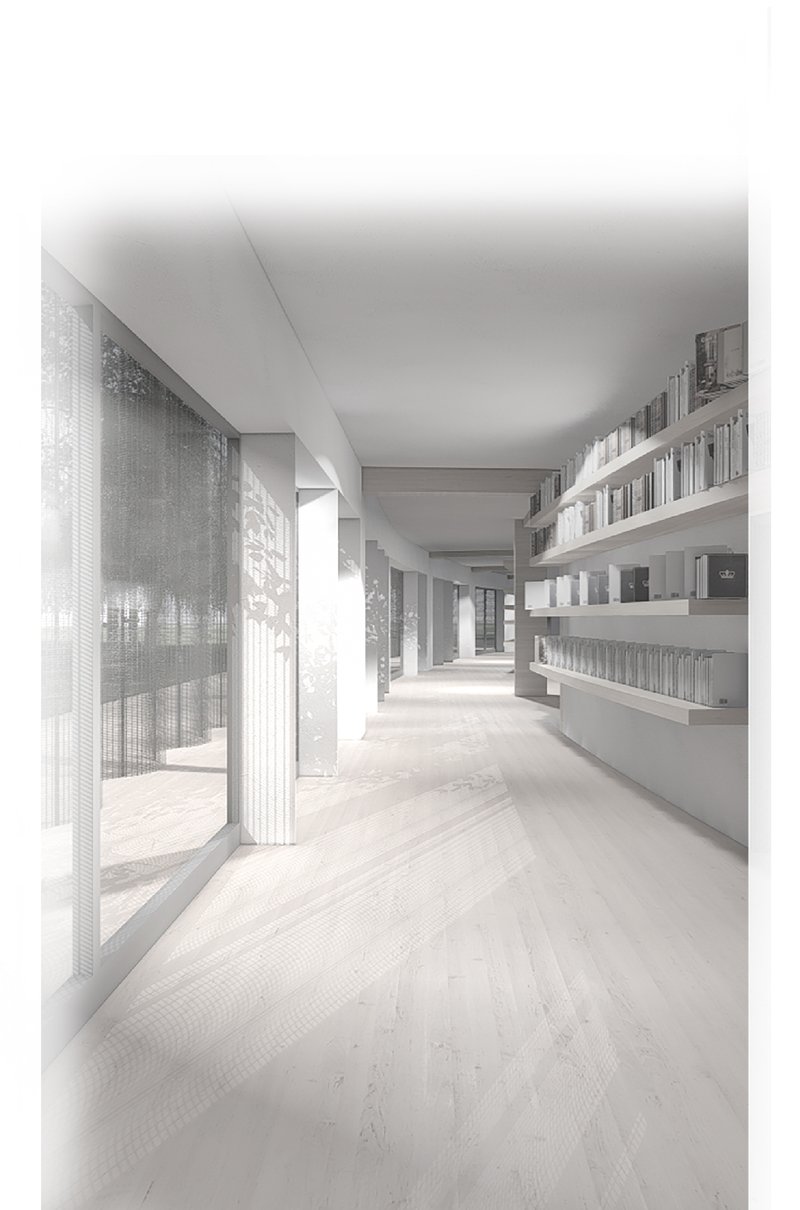
The proximity of plants, a green roof and intertwining circles of the construction with green belts are supposed to alleviate the pressure off the reader and create a sense of a continuous walk on park alleys. Sliding doors that connect the learning spaces with courtyards, allow us to give up partitions and freely modify the space. This allows for the organization of educational events inside the building as well as outside, in the fresh air. This modifiability allows the users to give the space a new meaning. The building may host poetry nights, courses, lectures, vernissages or, simply, be used as a library.
The form of the building is a sort of nod to history, because it was inspired by antique temples and medieval monasteries, which can be seen in the central circle-based layout and amphitheater that acts as a metaphorical beginning - with its beam of light and cascading water

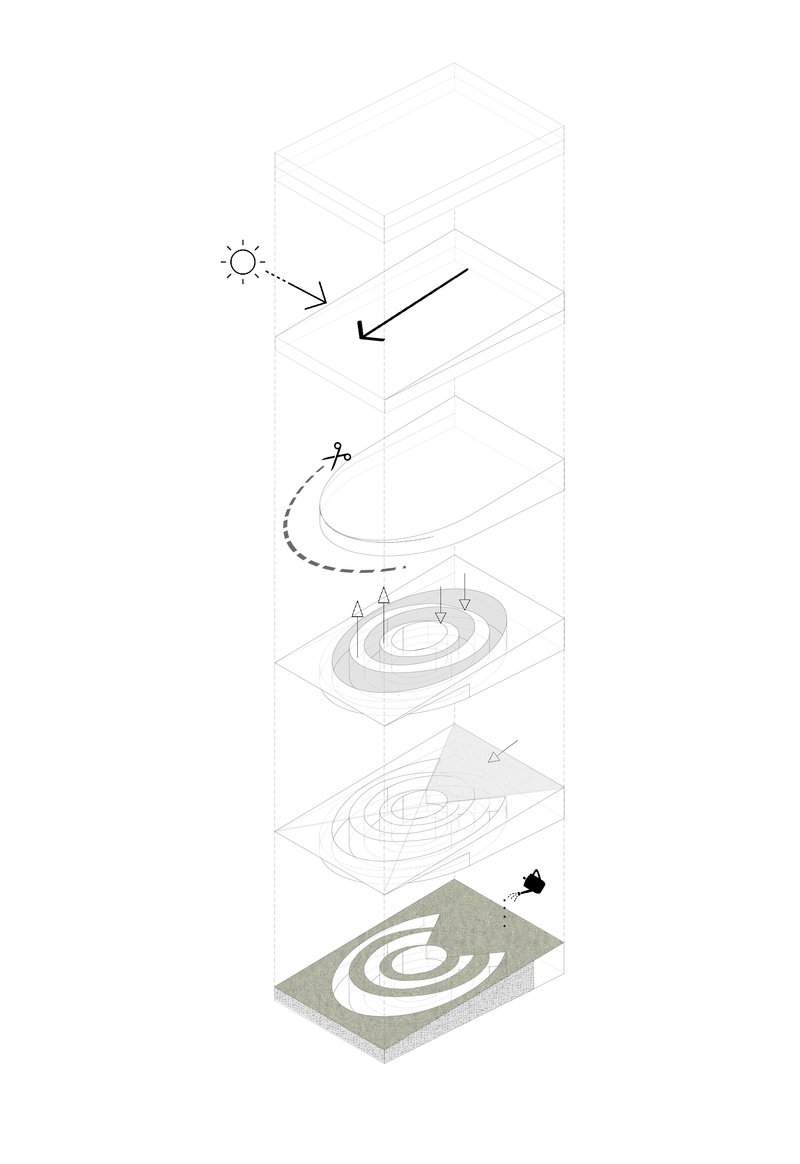
The library consists of three concentric circles – each 8m of diameter. They are modular, composed of two segments: education halls and communication areas, supplemented with bookcases (when walking we follow a designated path with greenery on one side and books on the other), at any moment we can walk into an educational hall which also opens into a green plaza. The entirety is completely transparent. Inside is located the center – visible from the entrance area, connected with a café. From each circle emerges a separate staircase to the upper floor – rid of the typical library load. On the second floor, we can use the open or closed audiovisual rooms and conference spaces.
SECOND SKIN
The future and knowledge are joined by awareness of change. Wherefor it was important to take care of the harmony of the building and its surroundings and the choice of materials. The construction was thought of as glued timber and partitions as CLT. The cubature of the building was created with environmental conditions in mind. The outline of the building is enclosed in a tight block, thus limiting the loss of heating. Additionally, it is covered by an azure elevation, that functions as “a second skin”. On the north-south line, there is a variation of heights with an opening to the north, covering this way the business area.
Green courtyards intersect the building on the east-west line, the direction of the winds in that region, allowing for ventilation. Additionally, a solution to rainwater management and filtration is proposed. A green roof and omnipresent greenery allow the building to blend in with the surroundings and not disturb the natural biodiversity nor change the proportion of the biologically active area to the built-up space. The ubiquitous greenery further constitutes the sun and pollution protective barrier.
The Circle of Knowledge is an answer to social problems, an alternative mode of usage for a library space and a shift in its perception.