

Black Hole: A Floating Megastructure for the Post-Physical Era
Emiliano Mazzarotto envisions a spherical, self-scaling arena where e-sports, digital hotels, and holographic stadiums replace traditional public space.


What happens when architecture stops asking people to show up? The Black Hole, a speculative megastructure conceived by Emiliano Mazzarotto, proposes a floating, autonomous sphere that expands and contracts in real time to absorb its users, whether they number in the hundreds or the millions. It is not a building in any conventional sense. It is a self-scaling digital organism: part e-sports colosseum, part immersive hotel, part cultural venue, designed for a future where physical presence is optional and spatial boundaries are governed by data rather than walls.
Shortlisted in the Digital Colosseum 2020 competition, the project situates itself within a speculative timeline that traces the evolution of competitive gaming spaces, from the first e-sports stadium built in Santa Ana, California in 2015 to an anticipated digital hotel in 2035, and finally to what Mazzarotto calls a "break point" around 2050, the moment when physical social interaction becomes economically and socially unsustainable. The Black Hole is architecture designed not merely to accommodate that rupture but to accelerate it.
Charting the Break Point Between Physical and Digital Space

The project opens with a diagram that functions more like a provocation than a technical drawing. Cost curves and population flows are layered over a bridge structure with crowds massing beneath graphed lines, mapping the economic logic of the break point. Mazzarotto argues that a threshold exists where maintaining traditional social infrastructure costs more than replacing it entirely with digital environments. The graph makes that argument spatial: the crowd beneath the curve is the population caught between two eras, and the architecture above them is the bridge forward.
It is a deliberately speculative move, grounding what could easily become science fiction in quantifiable trends. The timeline anchors the design in observable trajectories of e-sports viewership, remote interaction, and the declining relevance of physical gathering, giving the floating sphere a rationale that goes beyond formal ambition.
Corridors of Light and Immersive Workspaces
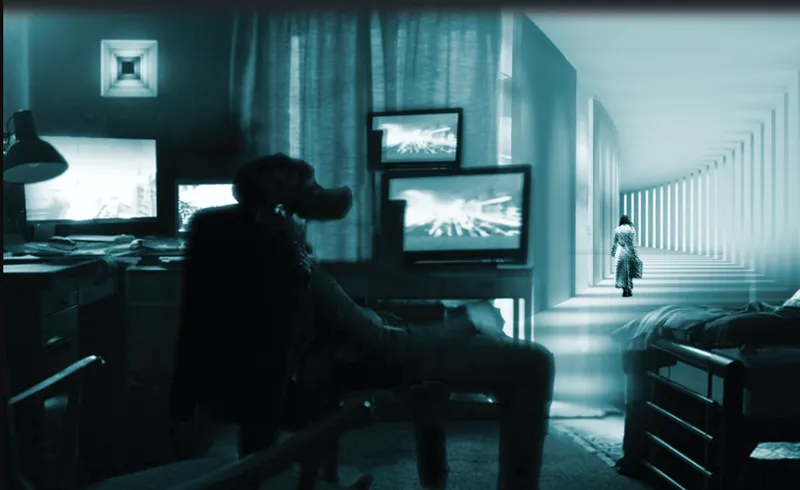
Inside the Black Hole, the spatial character oscillates between intimate digital pods and expansive corridors pulsing with rhythmic vertical light bands. One view shows a solitary figure seated at a multi-screen workstation, a setting that reads as part gaming cockpit, part command center. Adjacent to it, a corridor stretches into depth with bands of illumination that create a cadence almost musical in its regularity. These are not decorative choices; they suggest an architecture tuned to sensory immersion, where light, sound, and spatial rhythm are calibrated to sustain prolonged digital engagement.
The interior program includes what Mazzarotto labels "Vintage Rooms" and cafés, spaces that retain traces of traditional architecture within a fully digitized environment. It is a telling decision: even in a building designed to obsolete physical interaction, there remains an acknowledgment that users might need moments of analogue comfort, however simulated.
A Sphere Organized by Access and Hierarchy
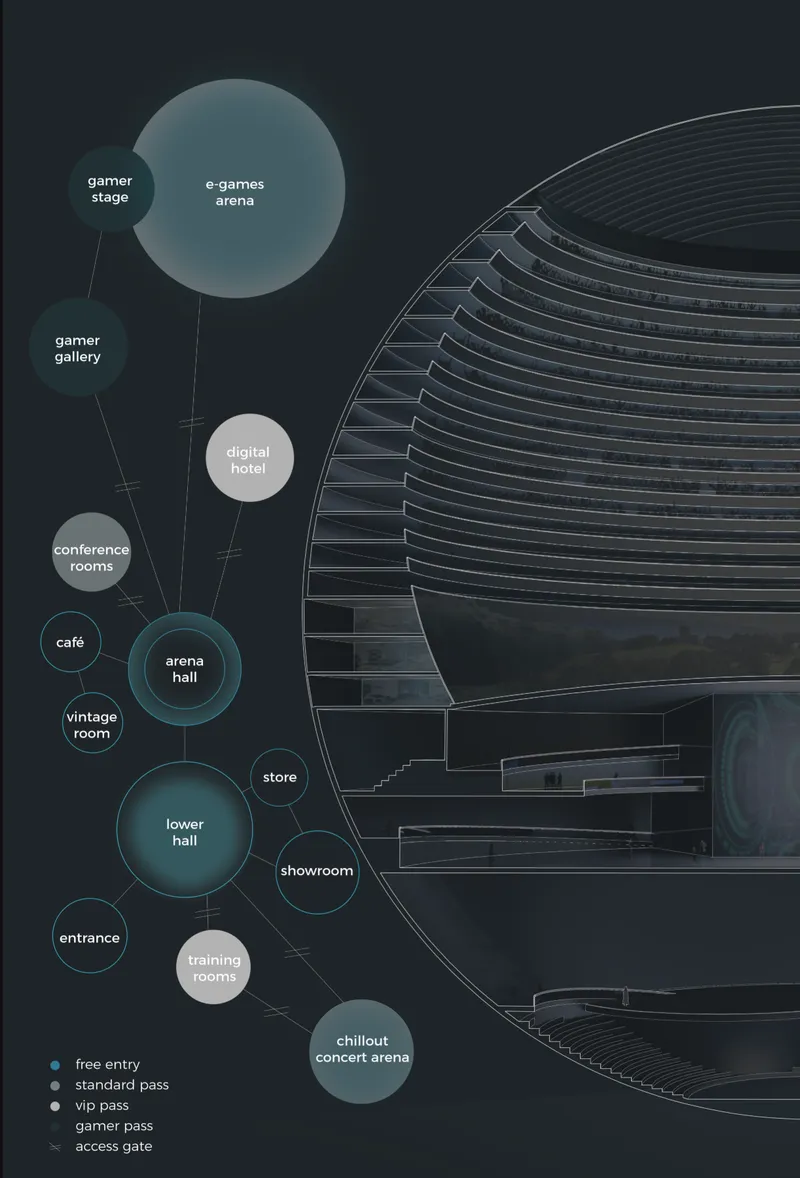
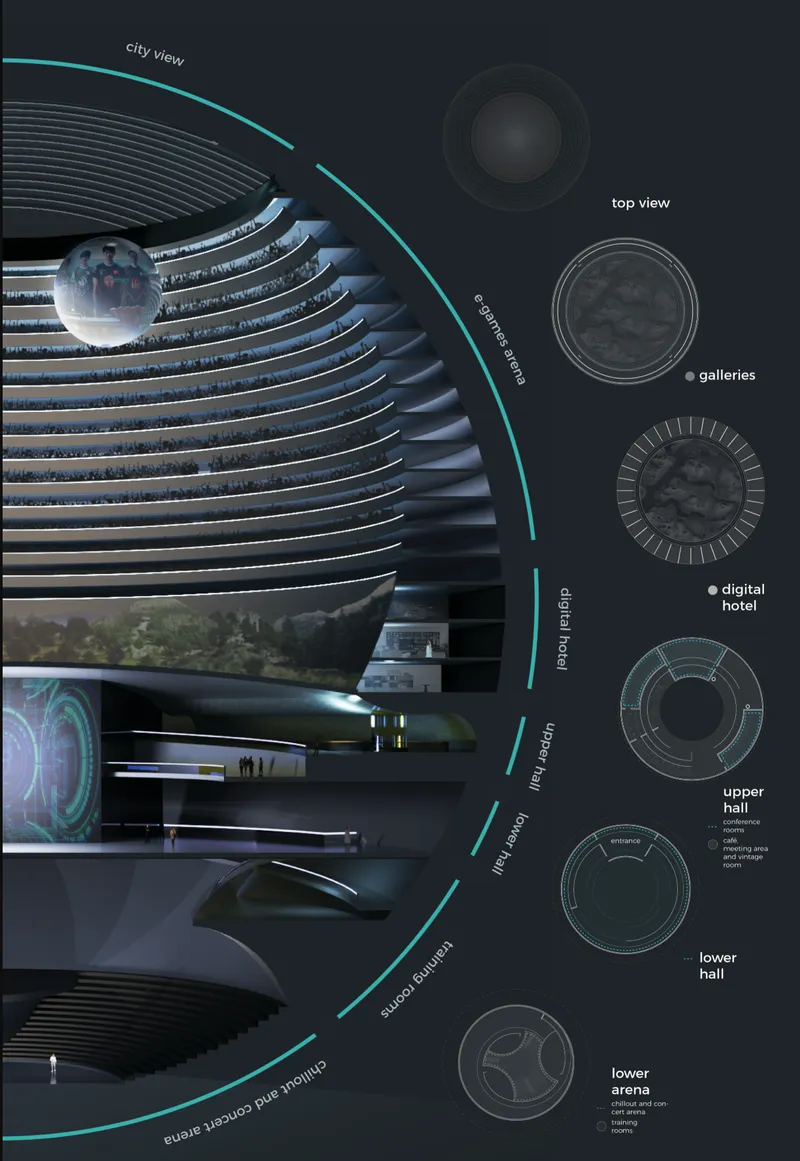
The sectional drawing and exploded axonometric reveal the internal logic of the sphere with striking clarity. Circular floor plates stack vertically within the volume, each hosting distinct programmatic zones: a 15,000 square metre holographic e-games arena at its core, flanked by a digital hotel, a concert and chillout arena, conference rooms, and orbiting "Gamer Gallery" pods for elite viewing and commentary. The section cuts through the sphere to expose these layers as bubbles of program, each labeled and spatially differentiated, while the axonometric peels them apart to show how they coexist within the same envelope.
Access follows a tiered hierarchy. Free entry areas include plazas, showroom corridors, and open lounges. Standard passes unlock the central arena, conference hubs, and cafés. VIP and gamer exclusive zones offer isolated pods, digital hotel suites, and elite training facilities. This modular stratification is key to the project's spatial thesis: form follows interaction. The architecture is not fixed but programmed, its walls bending to the will of data and user flow, expanding or contracting as population demands.
A Cylinder Between Worlds
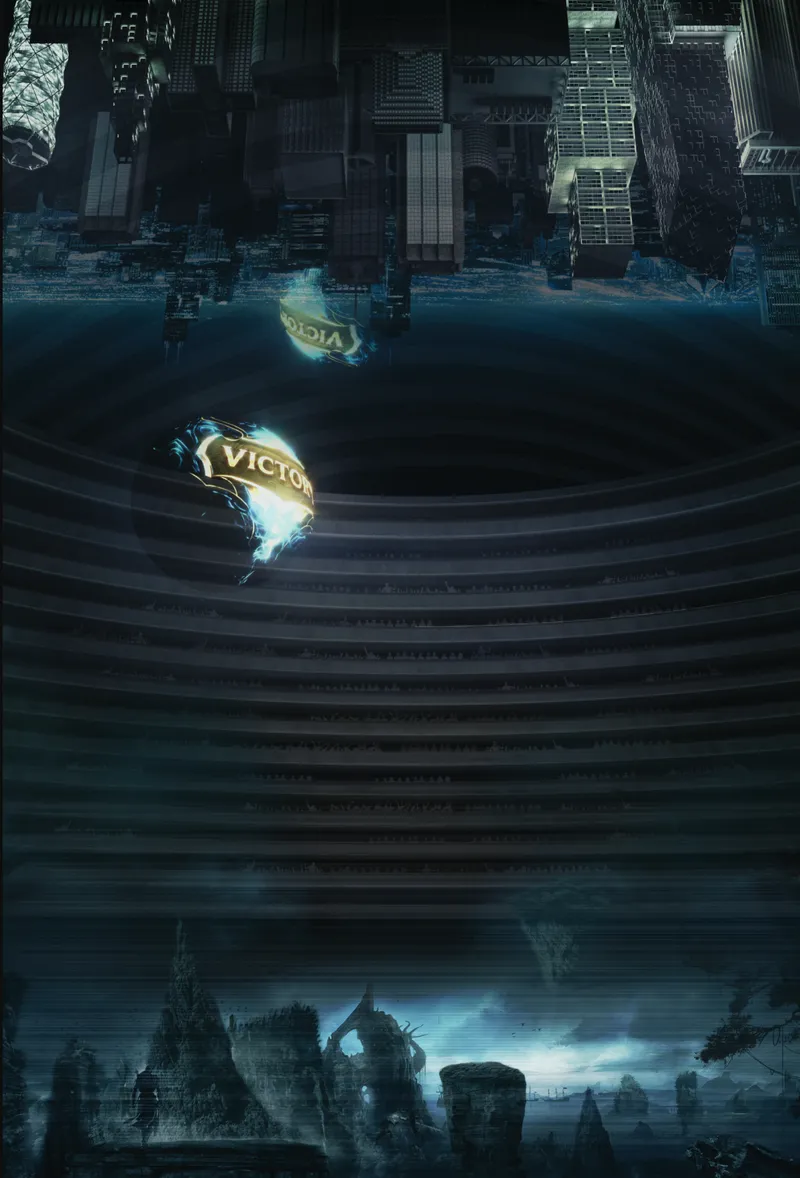
The final rendering places the structure in water, a cylindrical tower submerged halfway with illuminated signage reflected on the dark surface. It is a powerful compositional choice. The half-submersion suggests liminality: the structure belongs neither fully to the physical world nor entirely to the digital one. Its glowing signage, mirrored in the water, doubles the presence of the object, making it appear larger and more monumental than its actual form. The image reads as part architectural rendering, part film still, which suits a project whose primary audience may never experience it in person.
Mazzarotto's own description captures the ambition: "The Black Hole will absorb everyone willing to enter. Hundreds, thousands or millions, the sphere will increase or decrease in volume, a database will store safely your conscience." The building is framed not as a container but as a gravitational force, pulling users into a reality where citizenship is digital and memory is archived centrally.
Why This Project Matters
The Black Hole is easy to dismiss as science fiction, and that would be a mistake. Its value lies not in the plausibility of a floating sphere but in the questions it forces architects to confront. How do we design for populations that may never physically gather? What happens to the spatial contract between building and body when presence is optional? Mazzarotto does not offer definitive answers, but the project frames these questions with enough specificity, through programmatic breakdowns, access hierarchies, and a speculative timeline rooted in real data, to make them architecturally productive rather than merely rhetorical.
As a shortlisted entry in the Digital Colosseum 2020 competition, the project represents a generation of designers whose spatial imagination is shaped as much by gaming platforms and virtual communities as by cities and buildings. The Black Hole is a mirror held up to that condition: an architecture that takes hyper-connectivity seriously enough to build for it, even if the building itself may never exist in any material sense.
View the Full Project
About the Designers
Designer: Emiliano Mazzarotto's
Enter a Design Competition on uni.xyz
uni.xyz runs architecture and design competitions year-round that reward proposals with spatial conviction and real site intelligence.
Project credits: Black Hole by Emiliano Mazzarotto's The Digital Colosseum 2020 (uni.xyz).


Popular Articles
Popular articles from the community


Manzana Morphosis: Stretching Barcelona's Grid into a Living Landscape for 2050
A radical reworking of the Eixample manzana turns density into a tool for generous public space, vertical ecology, and environmental performance.

Singing Woman: Contemporary Architecture Inspired by Estonia’s Voice and the Sea
Singing Woman turns Estonia’s song culture into flowing opera house architecture, blending public life, landscape, sea, and national memory.

Opera by the Sea Estonia: Three Shells Dissolving Architecture into Tallinn's Coastline
A winning opera house proposal replaces monumental form with interconnected shells that blur the boundary between building, park and Baltic Sea.
Temporary Home for Dogs: A Reversed Zoo Rethinks Animal Shelter Architecture
In Bucharest, a sinuous corridor and freed landscape flip the logic of containment, designing a shelter that works to make itself unnecessary.

Similar Reads
You might also enjoy these articles

Day and Night Park: A Time-Based Urban Newsstand in Beijing
A temporary urban newsstand in Beijing blending travel, light, and reading through poetic colors, compact form, and community-focused design.

Modernist Patio Renovation in El Masnou, Barcelona by Oliver Segura Arquitectura + Cebrià Arquitectura
Modernist patio renovation blending tradition and innovation with a movable pool, leveled floors, and Catalan materials in El Masnou.

Alto Residencial Coop: Cooperative Housing Development in Santiago de Compostela by Carbajo Barrios Arquitectos
A linear cooperative housing complex blending white volumes and perforated metal façades, enhancing community living, natural light, privacy, and urban integration.

Vil Genis School by BPA ARCHITECTURE – Massy, France
Vil Genis School in Massy, France, features sustainable design, south-facing classrooms, community integration, accessible spaces, and modern educational architecture.

Explore Digital Colosseum Competitions
Discover active competitions in this discipline

Challenge to reimagine the Iron Throne

Photograph architecture without architects

Illustrate the lost glory of Angkor Wat - Render Challenge

Design challenge to reuse E-waste
Comments (0)
Please login or sign up to add comments
No comments yet. Be the first to comment!