
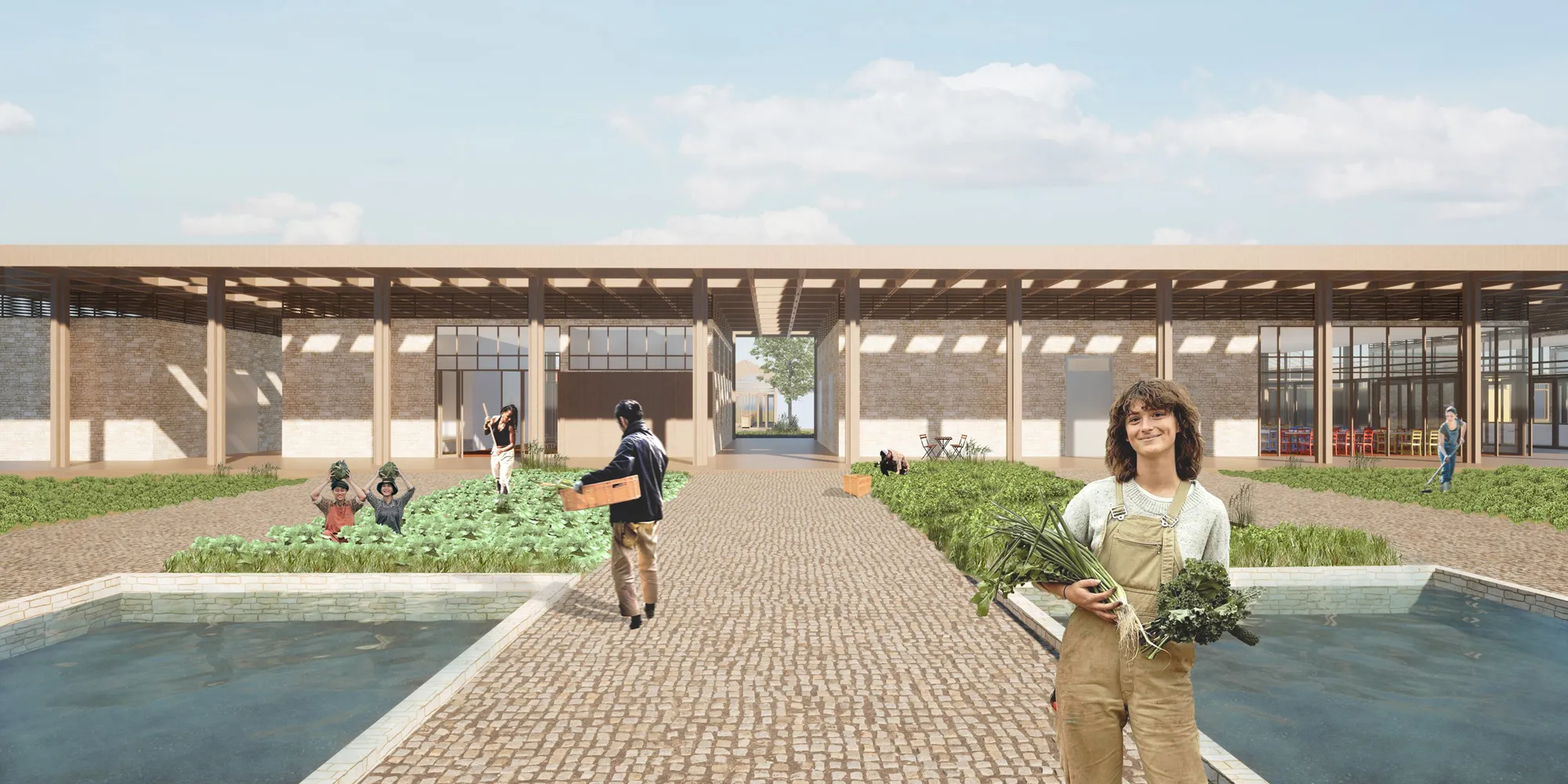
The Gardeners' Shelter
Conceptual design of a rehabilitative refuge for people in crisis of homelessness in Oklahoma City.
Introduction
This project centers around creating a facility for individuals experiencing homelessness crises in Oklahoma City, Oklahoma. The plan was to accommodate 80 people, not only as a shelter but also to provide educational and cultural services for the local community.
Location Analysis
The site is in the northwestern part of Oklahoma City, specifically within Camelot Estates. It takes about 1 hour by public transport or less than 40 minutes by car to reach the site from downtown. The surrounding area is a suburban community with single-family homes, and John Marshall Elementary School is close by.
Data from [https://worldpopulationreview.com/state-rankings/homeless-population-by-state] reveals that Oklahoma's homelessness rate is 9.40 per 10,000 residents, relatively favorable compared to 31 other states. However, the real issue lies in the lack of shelter despite the various assistance programs highlighted on Oklahoma City's website. Given the average homelessness rate, the proposed center might not always be fully occupied and should offer more functions. We suggest expanding the center's offerings to include social and cultural activities tied to its rehabilitation efforts.
Ideas Overview
In our analysis of research materials on homelessness, certain characteristics and ideas emerged for the proposed center to effectively help individuals transition back into society. Our goal is for their stay to be a gradual empowerment process, involving assigning responsibilities over time and increasing engagement in the center's activities.
Research on homelessness consistently highlights the genuine desire of individuals to return to healthy functioning in society. Given the site's location and the required travel, we assume center guests genuinely want to improve their situation, are ready to cooperate, and view their stay as an opportunity.
Studies indicate that individuals in homelessness crises often lack faith in their creative abilities, resulting in a lack of self-belief and a reluctance to attempt anything. Therefore, a crucial aspect will be involving center guests in various workshops and hobby activities.
Integration of center guests with the local community is also crucial. Leveraging the intimate nature of the neighborhood, we aim to allocate about half of the site for cultural and social functions for the residents, enhancing interactions. The proximity to the elementary school is advantageous, allowing this proposal to naturally expand the school's extracurricular offerings.
To improve self-efficacy and facilitate integration, we plan to design social gardens within the center. We anticipate that part of the local community may be interested in participating, aiding in the integration of the local community with homeless individuals.
Technologies
In this project, our aim is to propose the most sustainable and eco-friendly solution, which at the same time would be aesthetically pleasing and user-friendly. Primarily, we suggest a rainwater harvesting system and the reuse of greywater for irrigating social gardens. The planned roofing of pavilions in the central part of the site is intended to positively impact the facility's energy efficiency during the summer, when excessive sunlight is undesirable.
The structure is envisioned as a frame construction, with the central segment covered by a canopy made of CLT (cross-laminated timber), and the residential part made from environmentally friendly wood. Localized use of reinforced concrete ensures fire compartmentation and compliance with FEMA guidelines for a safe room, addressing Oklahoma's tornado-related concerns. Additionally, the residential part for center guests is to be constructed, whenever possible, from recycled materials.
The power demand is expected to be met through the use of a photovoltaic installation, including organic dye-sensitized photovoltaic cells in the greenhouses. This, coupled with a ground-source heat pump, will significantly fulfill the building's energy needs.
Conclusion
The project's main objectives are to serve both the local community and homeless individuals, fostering interaction and reintegration. By opening up to the neighborhood, we encourage interaction between rehabilitated individuals and renewed integration into society. We assume that center guests genuinely express a desire to improve their situation and are willing to collaborate.
A significant portion of the site will be dedicated to social gardens, open to the local community. This form of activity, located at the front elevation, aims to become a hallmark of the facility. Activities and workshops will be designed for both center guests and the local community, leveraging the proximity to the elementary school to expand its extracurricular offerings. We envision that the designed center will allow for a comfortable stay and a genuine return to healthy functioning for homeless individuals, serving as added value for the local community.
Sources
„Społecznik 6” - Modele pomocy bezdomnym – prof. Danuta Zalewska Małgorzata Kostrzyńska – „Instytucjonalne próby „udomowienia” bezdomnego – analiza relacji bezdomny – instytucja z perspektywy przebmiotów badanych” FormatE1 – „Otwartość”, Jan 4, 2023 feantsa_handbook – „Rozwiązanie problemu bezdomności: podręcznik dla twórców polityki społecznej”



Popular Articles
Popular articles from the community


Riyadh For All: Intergenerational Urban Design for Active Aging in Rabat
Riyadh For All reimagines urban design in Rabat with intergenerational co-living, adaptive courtyards, and Moroccan cultural exchange today.

The Ocean Hive: Sustainable Architecture for a Self-Sufficient Civilization at Sea
The Ocean Hive imagines sustainable architecture at sea, where modular habitats, algae, wave power and ocean waste sustain a growing colony.

Hill & Cross Opera: Sculptural Opera House Architecture Shaped by Tallinn’s Landscape and Identity
Hill & Cross Opera reimagines opera house architecture in Tallinn through its sculptural hill, civic plaza, glass wave and a luminous cross.
AL-JANNAH: Sustainable Architecture and Permaculture for Afghan Widows
AL-JANNAH uses sustainable architecture and permaculture to create resilient oasis of housing, learning, work and renewal for Afghan widows.


Similar Reads
You might also enjoy these articles

The Rhythm of Seasons
A Farmers' Market Connecting Nature and the City

More Than a Building-Designing a Living System
More Than a Building-Designing a Living System
Base Beyond
DESERT COMPOUND ARID: TOURISM OF ABSENCE AND ABUNDANCE


Explore Emergency Shelter Competitions
Discover active competitions in this discipline




Challenge to reimagine the Iron Throne


Photograph architecture without architects


Illustrate the lost glory of Angkor Wat - Render Challenge


Design challenge to reuse E-waste
Comments (0)
Please login or sign up to add comments
No comments yet. Be the first to comment!