
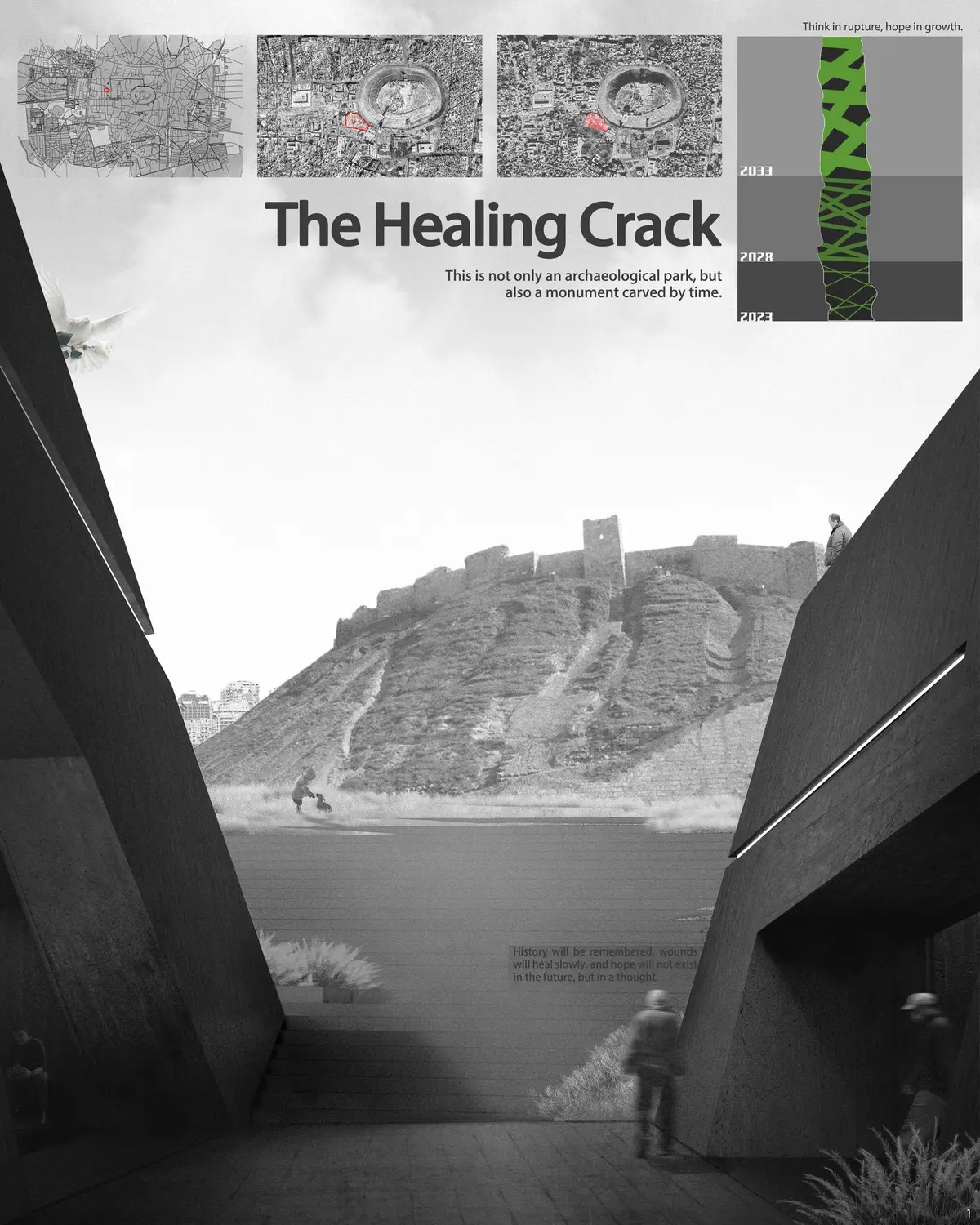
The Healing Crack: Memorial Architecture That Embeds Itself in Aleppo's Wounded Terrain
A three-phase spatial journey through trauma, conflict, and hope, carved into the landscape beside Aleppo Castle as an archaeological park.


A crack in the earth is both wound and record. It tells you something broke, and it tells you the ground is still there. At the foot of Aleppo Castle, where a decade of civil war has pulverized centuries of cultural heritage and displaced millions, Jiaxin Li, Shiqi Liu, and Zhou Zhou propose an archaeological park that refuses to smooth over that rupture. Instead, their project literalizes it: a building conceived as a fissure in the terrain, guiding visitors through compressed darkness into luminous openness, turning the act of walking through architecture into a confrontation with memory, grief, and the stubborn possibility of renewal.
The Healing Crack is structured around three thematic zones that map an emotional arc from oppression to hope. The journey begins in a narrow, dark corridor evoking the confinement of wartime, transitions through a dramatic middle segment where light and shadow collide in spatial representations of upheaval, and concludes in a transparent, light-filled space symbolizing clarity and forward motion. Sited adjacent to Aleppo Castle, the intervention embeds itself into the existing topography rather than rising above it, treating the landscape as a collaborator rather than a platform.
Concrete Corridors as Compression Chambers
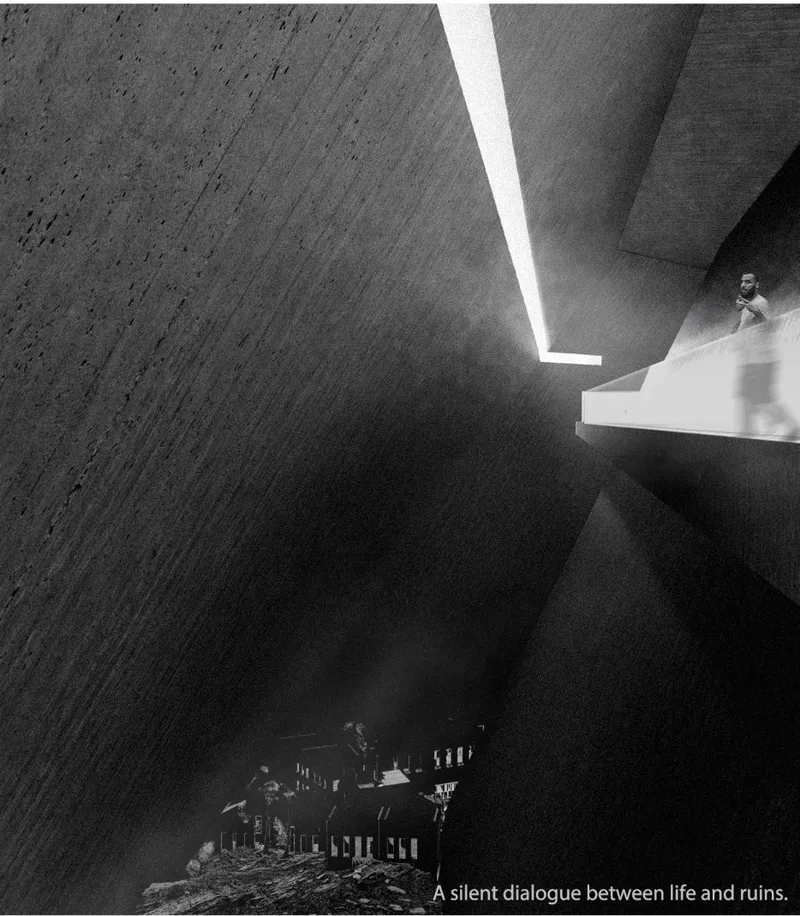
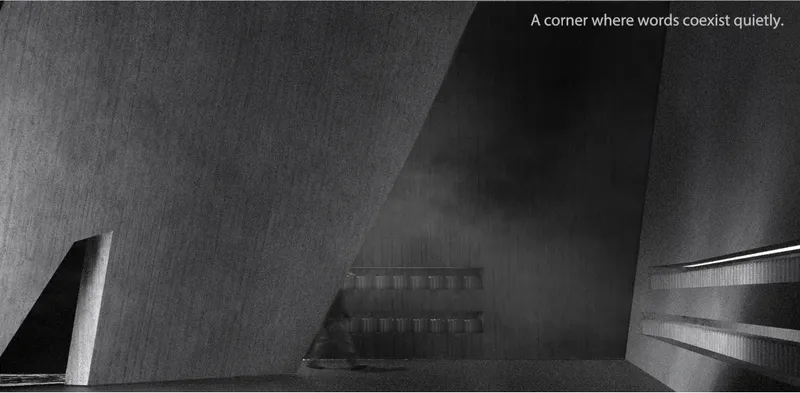
The opening sequence of the building does exactly what memorial architecture should do but rarely commits to: it makes you physically uncomfortable. Angled concrete walls press inward, narrowing the visitor's field of vision and restricting lateral movement. A clerestory skylight above admits only a controlled sliver of light, enough to orient but not enough to comfort. In the first image, a solitary figure stands on an upper landing, dwarfed by the converging planes of raw concrete, the geometry directing the eye upward toward that single luminous seam. The second view reveals a deeper, more shadowed interior where recessed bookshelves line the walls of a reading and reflection zone. Acoustical sensitivity and material warmth define these sunken spaces, offering contemplation without escape from the weight of the surrounding mass.
The material palette reinforces this emotional compression. Raw concrete and natural stone convey permanence; scorched stone references destruction directly. Semi-transparent grey glass appears at moments of transition, introducing ambiguity between interior and exterior, between containment and release. These are not decorative choices. They are calibrated to make the body register what the mind already knows about conflict: that it confines, dislocates, and strips away the familiar.
Light as Protagonist in the Meditation Room
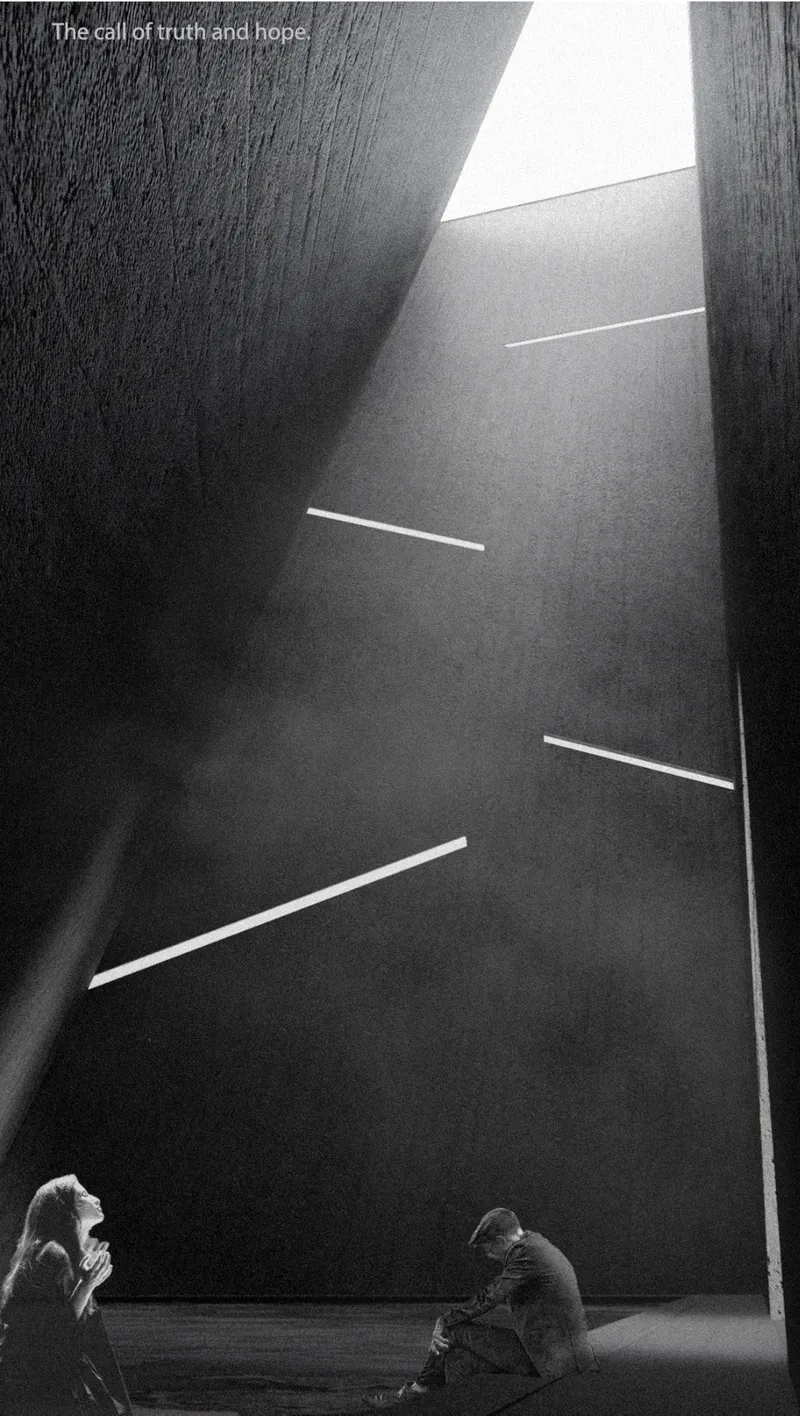
Deep within the building mass sits a meditation room defined by a single gesture: a shaft of light descending through a triangular aperture. The tall interior space shown here, with its textured concrete walls and narrow horizontal slot windows, makes the visitor acutely aware of enclosure before that central beam breaks through. The architects choreograph lighting throughout the project with narrow skylights, angular openings, and fractured beams, but here the choreography reaches its most concentrated moment. One shaft of illumination piercing solid stone becomes the entire argument of the building: that clarity can exist inside confusion, that hope does not require the absence of despair but can emerge directly from within it.
An Angular Form Carved Into Contested Ground
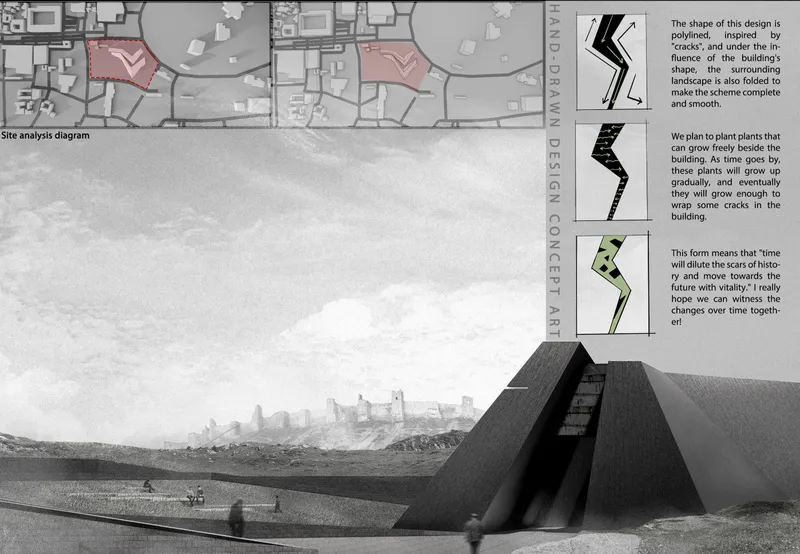
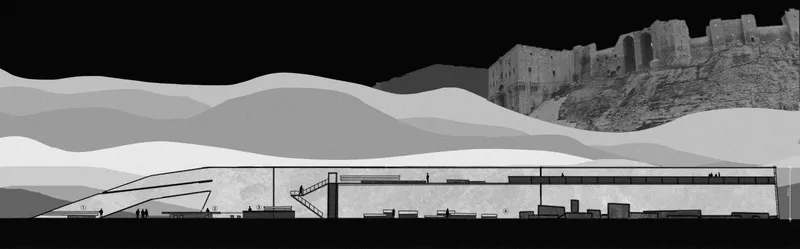
The site analysis diagram reveals how the angular building form negotiates the terrain adjacent to Aleppo Castle. Rather than asserting a new geometry onto the landscape, the plan view shows the structure embedding itself like a geological event, a crack that follows rather than contradicts the topographic logic of the hillside. Annotated explanations map the three thematic zones across the plan, making visible the narrative progression from dark to light, from compression to expansion. The section drawing below completes the picture: interior spaces are layered against the existing landscape and the silhouettes of ruins in the background, establishing that the building is not a standalone monument but a continuation of the terrain's own scarred biography.
The surrounding landscape design uses native plants and materials to maintain ecological harmony. More compellingly, time is an active design element: cracks in the structure are lined with slow-growing vegetation intended to evolve over decades, gradually softening the sharp geometries into organic forms. The building will not look the same in fifty years. It will carry the evidence of its own aging alongside the evidence of the conflict it commemorates. That decision, to let the architecture participate in the same temporal processes as the wounds it marks, is one of the project's most quietly powerful moves.
Why This Project Matters
Memorial architecture faces a persistent tension: how to honor suffering without aestheticizing it, how to offer hope without minimizing pain. The Healing Crack navigates this tension through spatial sequence rather than symbolic gesture. It does not place a monument in a plaza and ask visitors to feel something. It constructs a physical journey that compresses, disorients, and then releases the body, trusting that architectural experience can carry emotional content more honestly than any inscription or figurative sculpture. The three-zone progression from darkness through upheaval into light is not subtle, but it does not need to be. The subject matter demands directness.
What distinguishes this work from many memorial proposals is its insistence on site specificity and temporal depth. The decision to embed the structure into the terrain beside Aleppo Castle, to use scorched stone and vegetation that will transform the building over decades, grounds the project in a particular place and a particular history rather than in universal abstraction. Li, Liu, and Zhou demonstrate that young designers can engage with the heaviest human subjects when they commit to material honesty, spatial rigor, and the discipline to let architecture do what it does best: shape the way a body moves through space, and in doing so, shape what that body feels and remembers.
View the Full Project
About the Designers
Designers: Jiaxin Li, Shiqi Liu, Zhou Zhou
Enter a Design Competition on uni.xyz
uni.xyz runs architecture and design competitions year-round that reward proposals with spatial conviction and real site intelligence.
Project credits: The Healing Crack by Jiaxin Li, Shiqi Liu, Zhou Zhou.


Popular Articles
Popular articles from the community


LT2A and OPEN Architectes Thread a Brick and Glass High School Through a Wooded Belgian Campus
In Braine-l'Alleud, a 3,000 m² wing for Collège Cardinal Mercier pairs pale brick with a glazed colonnade, deferring to a small chapel and a dense wood.

David Ortega Stacks a Two-Story Mexico City Penthouse Around a Steel Stair and a Pergola-Shaded Roof Terrace
In Colonia Roma, a 300 m² penthouse uses oak joinery, a planted steel stair and a slatted roof pergola to make a new-build apartment feel like a house.

GROUP A Strips a 1969 Rotterdam Harbor Headquarters to Its Frame and Wraps It in Timber Louvers
In Rotterdam's M4H harbor district, Ferro Offices reuses a 1969 frame, adds one timber storey and reaches BREEAM-NL Outstanding.

U.GA Architects Wraps an Oval Rooftop Pool in Curved Board-Formed Concrete on Busan's Jeollidan-gil
In Busan's Jeonpo-dong, a 454 m² mixed-use block stacks a neighborhood facility, guest rooms and an oval rooftop pool inside spiraling concrete walls.

Similar Reads
You might also enjoy these articles


Vereda Arquitetos Renovates a 40-Square-Meter Apartment Inside Niemeyer's Copan Building
A compact unit in São Paulo's most iconic residential tower gets a material overhaul that pairs exposed concrete with bold blue Formica.

Shakur's House: Exposed Brick as an Interior Organiser in a 168 m² Mashhad Residence
Brick moves indoors in this Mashhad residence, where masonry walls, glass partitions and teal planes sequence a compact home without closing it off.

Day and Night Park: A Time-Based Urban Newsstand in Beijing
A temporary urban newsstand in Beijing blending travel, light, and reading through poetic colors, compact form, and community-focused design.

Modernist Patio Renovation in El Masnou, Barcelona by Oliver Segura Arquitectura + Cebrià Arquitectura
Modernist patio renovation blending tradition and innovation with a movable pool, leveled floors, and Catalan materials in El Masnou.

Explore Cultural Architecture Competitions
Discover active competitions in this discipline

Challenge to reimagine the Iron Throne

Photograph architecture without architects

Illustrate the lost glory of Angkor Wat - Render Challenge

Bring back Drive In's
Comments (0)
Please login or sign up to add comments
No comments yet. Be the first to comment!