

The Nexus Urban Farm: Closed-Loop Agriculture Woven into City Infrastructure
Hetvi Patel's proposal fuses aquaponics, vertical gardening, and geodesic domes into a self-sustaining urban food ecosystem at Nine Elms.


What if a building could feed a neighborhood? The Nexus Urban Farm takes that question seriously, proposing an architecture that functions less like a container and more like an organism. Aquaponics ponds supply nutrients to vertical gardens, processing centers convert harvests into consumable goods, and waste cycles back into the system rather than leaving it. The result is a closed-loop food network housed within a single architectural complex, one where geodesic domes, lotus gardens, and open farming patches coexist with cafeterias, classrooms, and residential quarters.
Designed by Hetvi Patel, the project is rooted in a philosophy she calls the "Circle of Life," treating buildings not as static objects but as participants in cycles of growth, decay, and renewal. Sited at Nine Elms, the proposal directly confronts the tension between urbanization and food security, arguing that cities can produce food at a meaningful scale without sacrificing density or cultural life. The scheme layers education, commerce, recreation, and agriculture into a single programmatic framework, making the act of farming visible and collective rather than hidden and industrial.
Geodesic Domes and Circular Systems as Spatial Generators
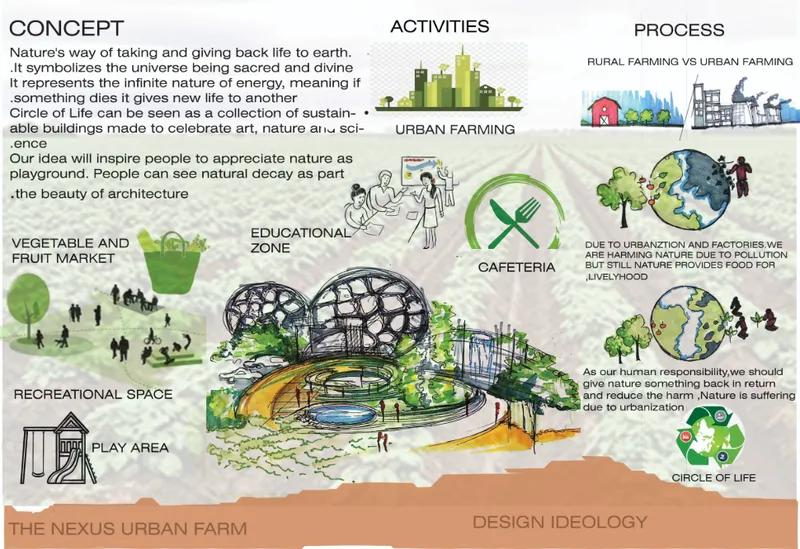
The conceptual diagram reveals the project's organizational logic: geodesic domes anchor the processing center, where administration, workshops, and vertical gardening converge under a single enclosure. Surrounding these domes, circular agricultural systems radiate outward, connecting recreational spaces with productive landscapes. The geometry is deliberate. Circles echo the project's cyclical philosophy while also minimizing edge conditions, keeping pathways continuous and encouraging movement between zones. Recreational areas sit alongside farming patches rather than being segregated, collapsing the boundary between leisure and labor.
A Site Plan That Layers Ecology, Housing, and Public Life
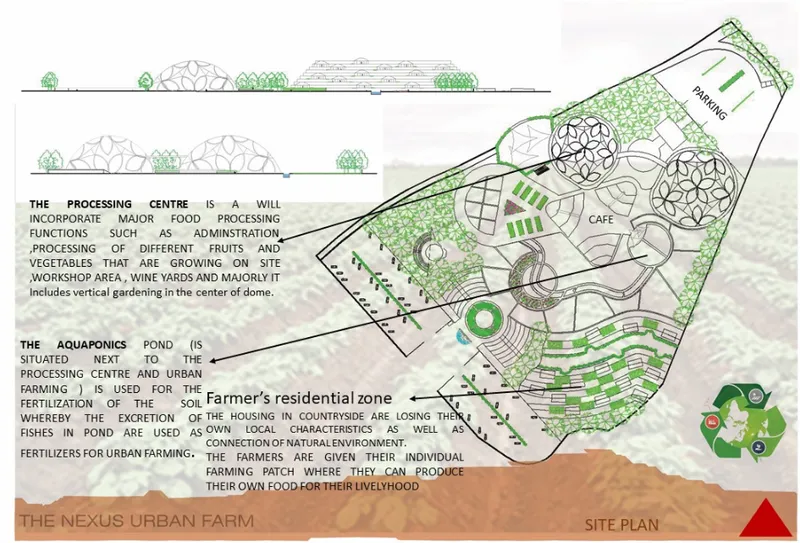
The site plan drawing maps out the full scope of the program. The aquaponics pond occupies a central position: fish waste fertilizes crops, creating a natural soil enrichment loop that eliminates the need for synthetic inputs. A farmer's residential zone surrounds individual farming patches, giving growers direct stewardship over their plots while integrating housing into the agricultural landscape. Public farming spaces open outward, inviting visitors to engage with cultivation firsthand. Cafeteria and market facilities connect directly to the harvest zones, enabling what Patel describes as a direct-to-table model.
The elevation sections above the plan hint at how these programs stack vertically. Vertical gardening units rise within the domed processing center, while lotus gardens provide both aesthetic relief and ecological function. The plan reads as a small village rather than a single building, with clear pedestrian routes linking each zone. What makes this layout compelling is its refusal to treat farming as background infrastructure. Every productive element faces the public realm.
Education and Production as a Single Experience
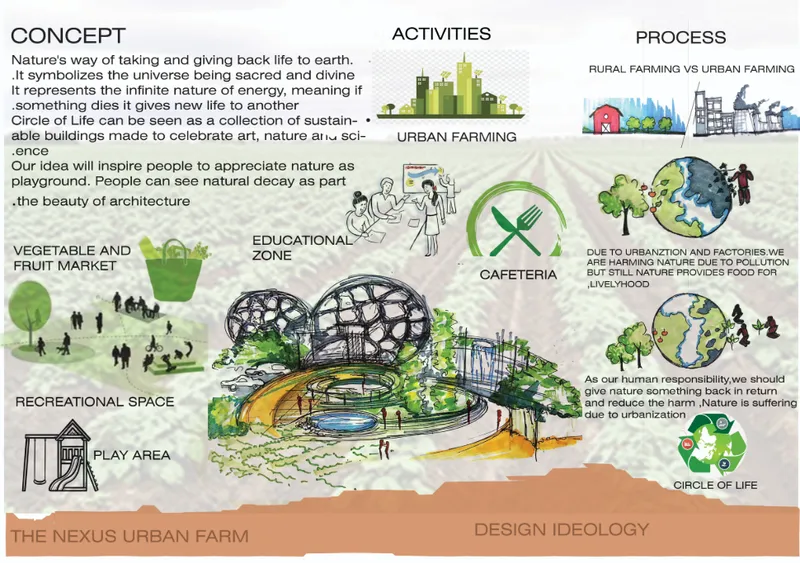
The illustrated concept diagram ties the project's various strands together, showing how educational zones, food production cycles, and sustainable systems operate as one integrated network. Workshops teach visitors the difference between hybrid and organic produce. Classrooms promote ecological awareness. Processing centers demonstrate how raw harvests become consumable goods. Rather than isolating education in a lecture hall, the design distributes learning throughout the complex. You understand composting because you walk past the composting station on your way to buy tomatoes.
Patel's approach treats food literacy as an architectural problem. By making every stage of the food cycle spatially legible, from aquaponics to vertical farming to market stall, the project turns a mundane supply chain into a public spectacle. The architecture does not just house these functions; it choreographs the sequence in which you encounter them.
Why This Project Matters
The Nexus Urban Farm challenges a persistent assumption in urban design: that agriculture belongs outside the city. Patel's proposal demonstrates that a closed-loop food system, complete with aquaponics, vertical gardens, processing facilities, and direct-to-consumer markets, can be embedded within the fabric of a dense urban neighborhood. The project does not romanticize rural life; it translates its productive logic into spatial terms that make sense for a city like London.
What distinguishes the scheme is its insistence on legibility. Every system is exposed, every cycle is walkable, every productive act is framed as a public event. In a moment when food security and environmental resilience dominate urban policy debates, Patel's design offers a concrete architectural argument: cities that grow food within their own boundaries are not utopian fantasies but achievable design problems. The Nexus Urban Farm is a persuasive sketch of what solving that problem could look like.
View the Full Project
About the Designers
Designer: Hetvi Patel
Enter a Design Competition on uni.xyz
uni.xyz runs architecture and design competitions year-round that reward proposals with spatial conviction and real site intelligence.
Project credits: The Nexus Urban Farm, by Hetvi Patel.



Popular Articles
Popular articles from the community


The Earth Pod: 3D Printed Homes for Resilient Refugee Communities
The Earth Pod reimagines refugee housing through 3D printed homes made from clay, combining resilience, self-sufficiency, and rapid shelter.

Conexión: Biophilic Design Reimagines High-Rise Living in Hong Kong
Conexión reimagines high-rise living in Hong Kong through biophilic design, green facades, shared spaces, daylight, water and nature within.

Play: Fragments of Their World
Familiar architecture becomes modular playground design, creating safe spaces where displaced children can learn, connect, imagine and play.

Lunar Spiral: Space Architecture Shaped by the Mathematics of the Universe
Lunar Spiral reimagines space architecture through Fibonacci geometry, lunar regolith, levitating habitats, and self-sustaining Moon living.


Similar Reads
You might also enjoy these articles

Bao Huynh Watercolor Atelier: A Serene Art Retreat in Hội An
Bao Huynh Watercolor Atelier in Hội An blends multifunctional art spaces, sustainable design, local materials, and family-friendly living in a serene environment.

Atelier Macri Concept Store Interior Design by CASE-REAL
Atelier Macri store features a "ko" counter, walnut wood details, cork displays, blending retail, gallery, and seamless customer experiences.

Manuel Vargas Izquierdo Stadium and High-Performance Sports Center: Architectural Excellence in Jalpa de Méndez
The Manuel Vargas Izquierdo Stadium blends sustainable design, inclusive sports facilities, and cultural-inspired architecture, revitalizing Jalpa de Méndez’s public spaces.

KAKR Buluh Awar Hall: Revitalizing Community and Ecology Through Bamboo Architecture
Community built bamboo hall revitalizes Buluh Awar village, empowering youth, restoring ecology, celebrating vernacular craftsmanship through sustainable architecture and culture.





Comments (0)
Please login or sign up to add comments
No comments yet. Be the first to comment!