
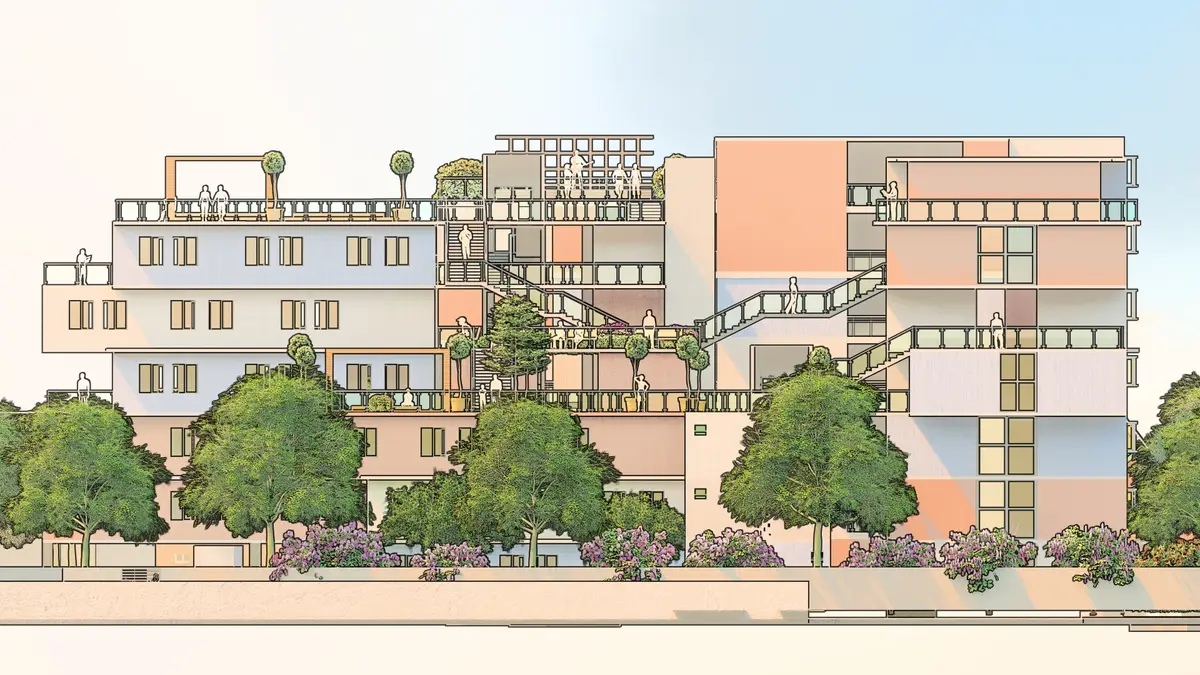
"The Study Hamlet"
The Study Hamlet is an attempt to make the student's life in Phillipines better in all aspects especially to convalescent their mental health. "For a student, enjoying the learning is more important than just studying in four closed walls

Student housing project is designed to foster "Connection with Interaction". Students are a valuable asset to every nation. Academic spaces must promote their development in a cheerful, open, creative, and problem-solving manner. In the same way, student accommodations should provide a comfortable living environment. The pandemic has made us realize the importance of socializing and interacting with people and the environment. Socializing promotes our physical and mental health. Interaction with nature leads to positive emotions, improved behavioral patterns, and enhanced academic performance, and reduction of stress. Such spaces being available in the vicinity is a benefit for students.
Creating a sustainable and comfortable environment was the main aim of the design. This is achieved through integrating the residential modules with green/recreational spaces that are built into the structure to maximize interaction between students and the outdoors. To break away from the typical student living space design, each room is designed with the idea of bringing outdoors indoors and interaction into the structure.
This structure takes into account wind flow and sun path. Each module is oriented for maximum exposure to natural daylight. This orientation also works well for the wind flow that takes place between these structures which is beneficial for the modules.
To achieve the outcome, we went through almost six stages of designing. First, we studied the brief and identified any potential pitfalls. Next, we looked at the site and considered local architecture and student lifestyle. In brief, engineering and construction techniques in modular housing construction were studied to incorporate them in the design. The concept was then developed to connect recreational and usable spaces through several levels while utilizing the 22 meters' height to its fullest potential.
A strong emphasis is placed on the interaction of people and nature in these spaces. Bridges serve as a form of connection between the various levels. Each module would be effectively connected to a recreational space through the use of bridges. So that interactions and social activities could have a benefit through the students or users. There was a challenge here of designing a housing solution to house 375 students - 300 of whom would share a room and 75 would stay on their own. The project involved a single block with an attached toilet, measuring 20 square meters, and twin blocks with shared toilet facilities measuring 21 square meters. To maintain equality in the amenities provided and proper planning of the building, the solo and twin sharing blocks are separated. Every floor consists of six individual blocks that were combined into one module. There are a total of 12 modules designed specifically for solo occupancy. Keeping connectivity aspects in mind, every module was placed according to its intended use and purpose, as well as having the necessary facilities of a staircase and lifts. The building design included two types of twin sharing modules (groups of six individual blocks). The individual block of twin sharing rooms was designed to accommodate two occupants and provide them with privacy as well. A foldable wooden partition is attached between each of the blocks, ensuring privacy for each individual when closed. Whenever the partitions are folded, they can be used as one, as a table for dining, or as a workspace for any purpose. Every floor has a common WC/bath facility that provides access to 3 WCs and 1 bathroom. Each floor is connected to the upper floor by staircases and a lift. Several levels of these lobby areas are connected to the rooftop recreation areas through bridges which enclose four terrace gardens across four levels that ensure interaction with people and nature. Every space is designed to promote the physical and mental health of students. A stage area serves as an area for community gatherings, a yoga studio provides practice opportunities, and seating allows students to relax and take in their surroundings. Additionally, a community hall is available to gather people for group activities and to provide them with information and social support so that unity will be maintained. There are parking facilities, sports fields, a canteen, and a medical center on the first floor that are easily accessible.
Considering modular construction and sustainable construction, concrete was selected as the material. The precast concrete construction method is used in this design. In precast concrete construction, walls are created by casting concrete into reusable molds or forms that are then transported to the site and lifted into place. These precast concrete walls are then cured in a controlled environment, then lifted into place. This method is primarily used to speed up construction. As a result of self-weighting, winds, and earthquakes, parallel loads are experienced on the walls in this method of construction. For aesthetic purposes, Pigmented Concrete is used. Powders and liquids of iron oxide pigments are used in concrete pigments, which are incorporated into the concrete during the mixing process to produce integrally colored concrete. Pigmented concrete is used in aesthetic applications to achieve a uniform tone of color. Surface abrasion does not affect pigmented concrete. Unlike pigmented concrete, pigmented concrete does not fade when exposed to heat and UV light. As precast panels can be prefabricated and then used for construction, the method can also be cost-effective as there is the possibility of prefabricating each module (group of six blocks). In total, six or seven prefabricated molds can be used to construct the entire structure.
Trial and error in developing the structure to be functional in all senses as expected were necessary to arrive at the precise objective of the design. Resulting from implementing this project, students can improve their physical and mental health and maintain a positive outlook on life in the long run. With time, the project will have the opportunity to expand and incorporate more students from all over the world. We will add a few more blocks when needed to reach a total height of 22m on structures that have not yet reached that height. At certain levels, rooftop gardens can be converted into semi-open recreational areas while still serving the main purpose of comforting users.
Collectively, the project forms a creative, open, cheerful, and comforting environment for the students.


Popular Articles
Popular articles from the community


Juan García Correa, John González and Claudia Rueda Sink a Circular Amphitheater into a Manizales Engineering Building
On the La Nubia campus in Manizales, Colombia, the S1 Building folds labs and offices into a hillside of ramped lawns that double as a campus route.

David Ortega Stacks a Two-Story Mexico City Penthouse Around a Steel Stair and a Pergola-Shaded Roof Terrace
In Colonia Roma, a 300 m² penthouse uses oak joinery, a planted steel stair and a slatted roof pergola to make a new-build apartment feel like a house.

Architekt Andreas Gruber Scatters 23 Dark Timber Chalets Across a South Tyrolean Forest Edge
In Molini di Tures, Amonti Chalets breaks a resort into a hamlet of gabled timber houses, with parking, storage and services pushed into the slope.

David Macias Steps a Doorless Stone and Plaster House Down a Tropical Colombian Hillside
In the humid hills of Colombia, Threshold House replaces the front door with an open void and terraces its 850 m² down the slope instead of fighting it.

Similar Reads
You might also enjoy these articles

The Rhythm of Seasons
A Farmers' Market Connecting Nature and the City

More Than a Building-Designing a Living System
More Than a Building-Designing a Living System
Base Beyond
DESERT COMPOUND ARID: TOURISM OF ABSENCE AND ABUNDANCE


Comments (0)
Please login or sign up to add comments
No comments yet. Be the first to comment!