
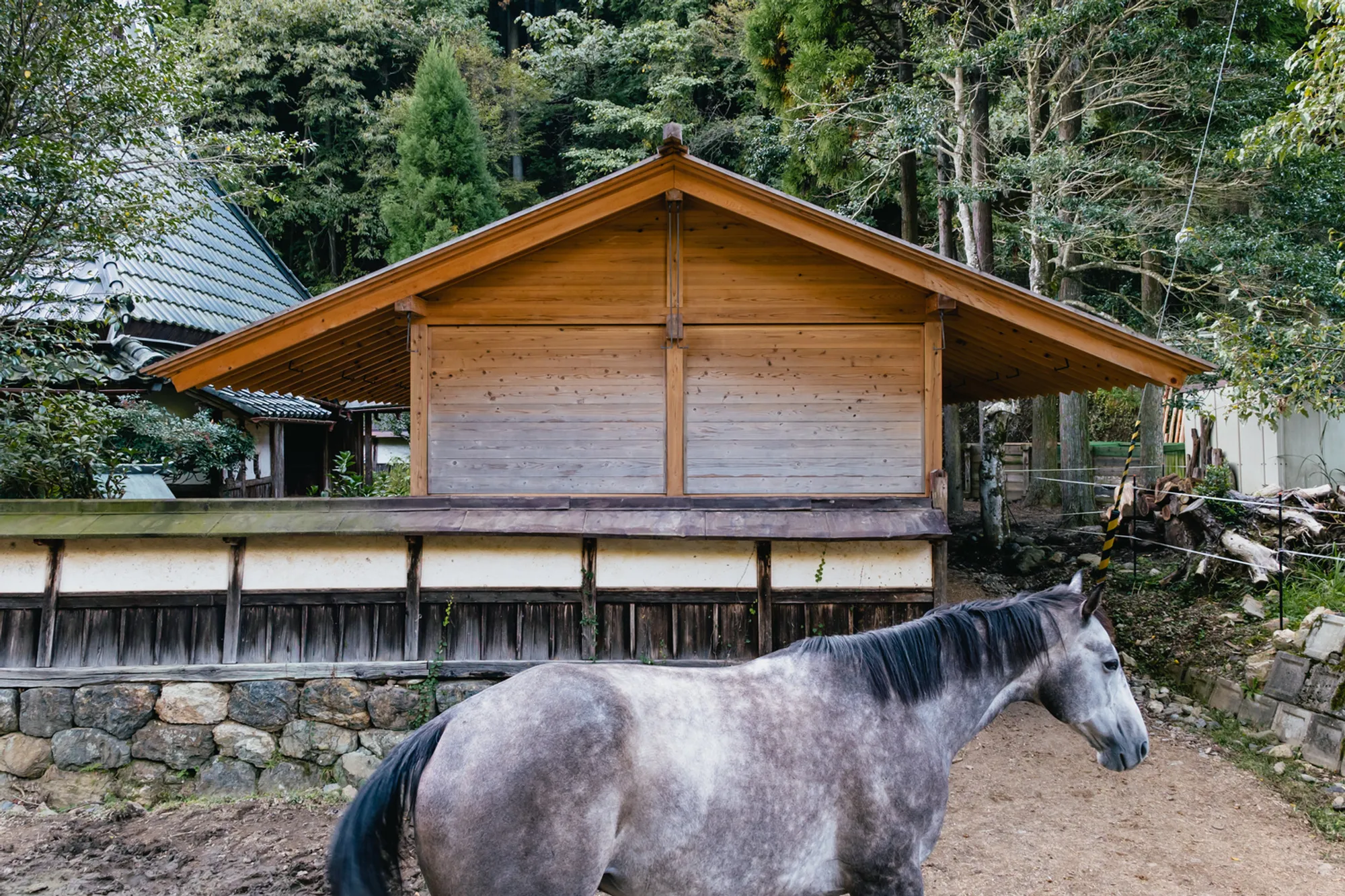
2M26 Builds a Nail-Free Horse Stable on a 200-Year-Old Farm in the Kyoto Mountains
Two cypress-and-cedar pavilions in Keihoku use traditional Japanese joinery and temple shutters to shelter horses and honor their surroundings.


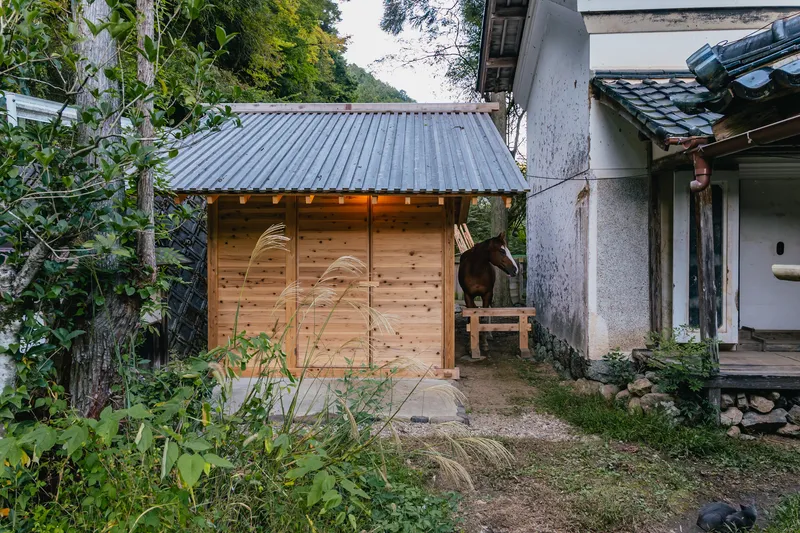
In Keihoku, the mountainous northern reaches of Kyoto, a thatched farmhouse compound has stood for roughly two centuries. Its main dwelling, outbuildings, garden, and thick soil walls form a miniature cultural landscape, the kind of place where adding anything new risks looking like an intrusion. 2M26, a Kyoto-based studio, was asked to insert a working horse stable into this compound. Their answer was two modest timber pavilions flanking the existing kura, the traditional storehouse with massive earthen walls. The buildings went up without a single nail.
What makes the Umagoya Stable worth studying is not its program (two horses, a saddle room, some storage) but the rigor of its material logic. Every structural connection is traditional Japanese joinery. Every plank of cypress and cedar was sourced locally. The floors are compressed soil and lime, a surface that lets the ground breathe while withstanding the daily impact of hooves. Even the ironwork, from hitching rings on the central columns to L-shaped shutter hinges, was custom forged by a Japanese blacksmith to 2M26's design. The result is a building that feels genuinely old, not nostalgic, not costumed, but built with the same intelligence and care as the structures it sits beside.
Settling into a Historic Compound
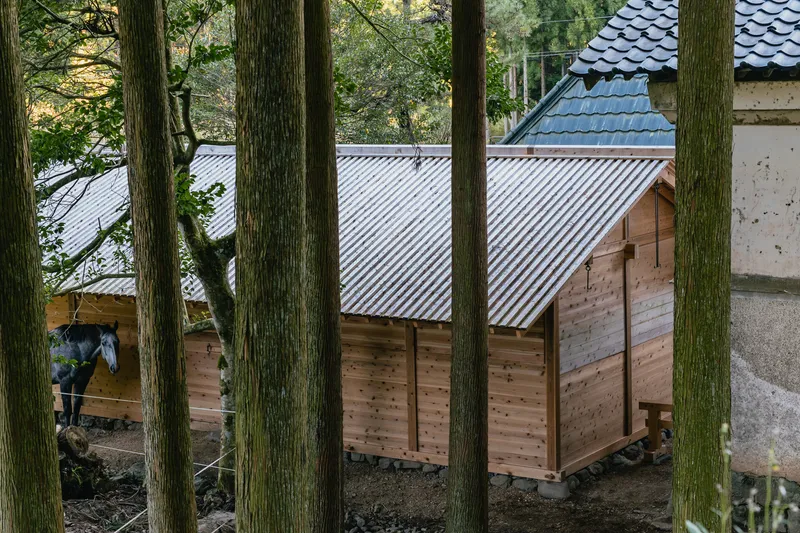


The siting is the first quiet decision that pays off. Rather than creating a single large stable, 2M26 split the program into two volumes, one on each side of the kura. This move prevents any new building from dominating the compound and instead reinforces the rhythm of small, distinct structures already present on the property. Seen through tree trunks and past stone retaining walls, the stable reads as one more layer in an evolving farmstead rather than a contemporary addition.
The corrugated metal roofing is a practical concession: it sheds the heavy snow common in this mountainous terrain and weathers gracefully against the dark bark of surrounding cedars. Where the metal meets timber, the eave details are clean but unfussy, letting the gable profile stay sharp.
Joinery as Structure and Statement

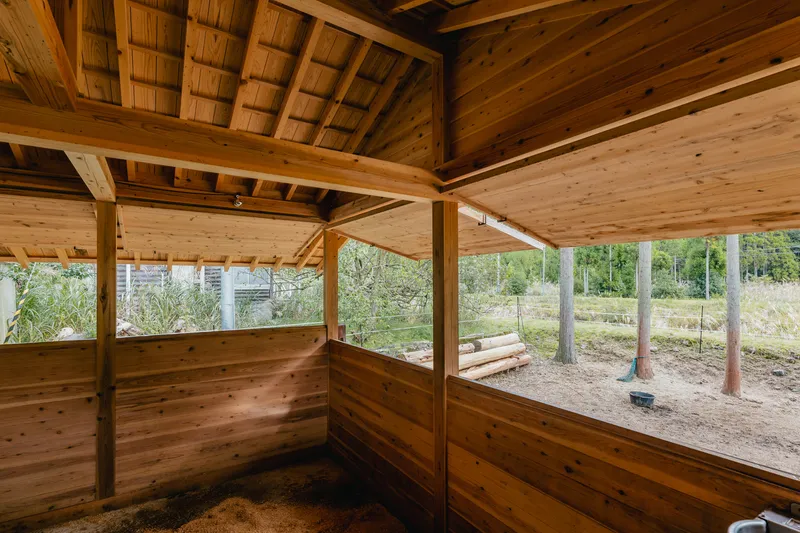
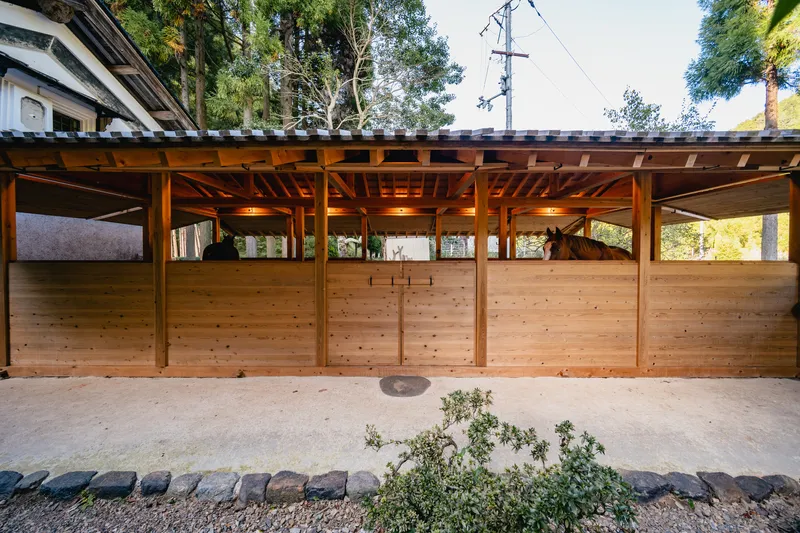
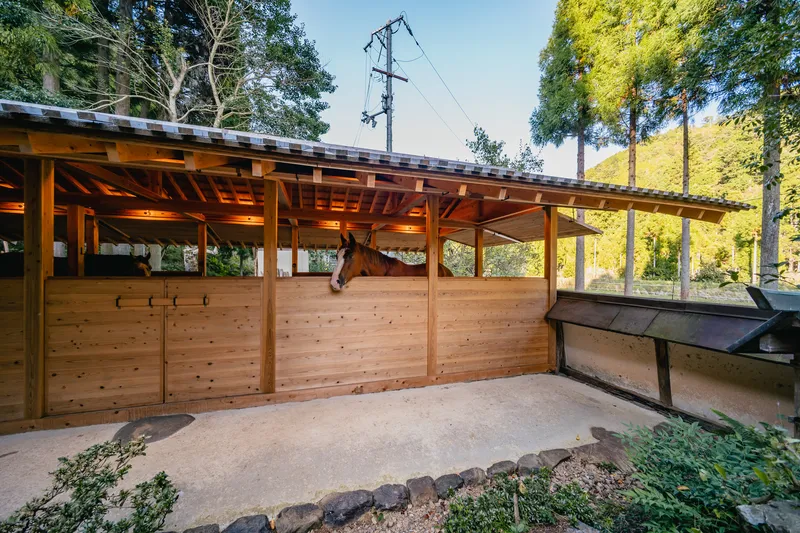
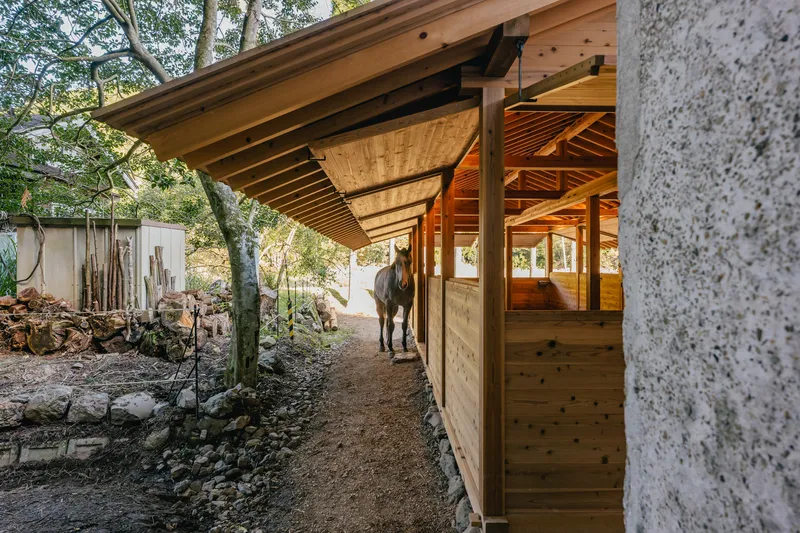
Walk inside and the structural logic is immediately legible. Slender cypress columns march down the center of the interior, supporting a gable roof whose every beam, rafter, and brace is exposed. No cladding conceals the joinery; no plasterboard hides a connection. The planking on both exterior and interior surfaces is left visible, turning the construction method itself into the building's primary aesthetic.
This transparency is not decorative. By keeping the structure exposed, 2M26 made it inspectable and maintainable, a pragmatic consideration for a working agricultural building that will take real abuse. The earth floor, a mix of compressed soil and lime, extends the same philosophy downward: breathable, repairable, and kind to the joints of the horses standing on it all day.
Shutters Borrowed from Temples


The horizontal wooden shutters on all four sides are the building's most versatile element. Lifted on L-shaped metal hinges, they open the stable completely to the paddock and the surrounding garden. Dropped and latched, they seal the interior against the typhoons and heavy snowfall that Keihoku endures. 2M26 cites Japanese temple architecture as the inspiration for these shutters, and the reference is apt: temples use the same principle of adjustable enclosure to let their interiors breathe in summer and close down tight in winter.
At dusk, with the shutters partially raised, the stable becomes a kind of lantern. A ring of simple bulbs inside bathes the timber frame in warm light, and the horizontal slats filter that glow outward. The transition from open-air pavilion to enclosed shelter happens through manual adjustment rather than mechanical systems, keeping the building's operation as low-tech as its construction.
Custom Ironwork and Material Honesty

Every piece of metal in the Umagoya Stable was drawn by 2M26 and forged by a local blacksmith: the hitching rings bolted to central columns, the hooks, the locks, the shutter handles. In a world where equestrian hardware is typically ordered from a catalog, this bespoke approach feels both extravagant and entirely consistent. If you are going to cut every timber joint by hand, buying off-the-shelf door hardware would undermine the whole premise.
The stone basements deserve attention, too. They lift the timber structure off the damp ground, a centuries-old technique for preventing rot in a climate with heavy rainfall. Combined with the corrugated metal roof and the soil-lime floor, the material palette is remarkably short: stone, timber, earth, metal. Nothing synthetic, nothing imported, nothing that could not have been built here three hundred years ago, except that it was built in 2022.
Between Indoors and Outdoors
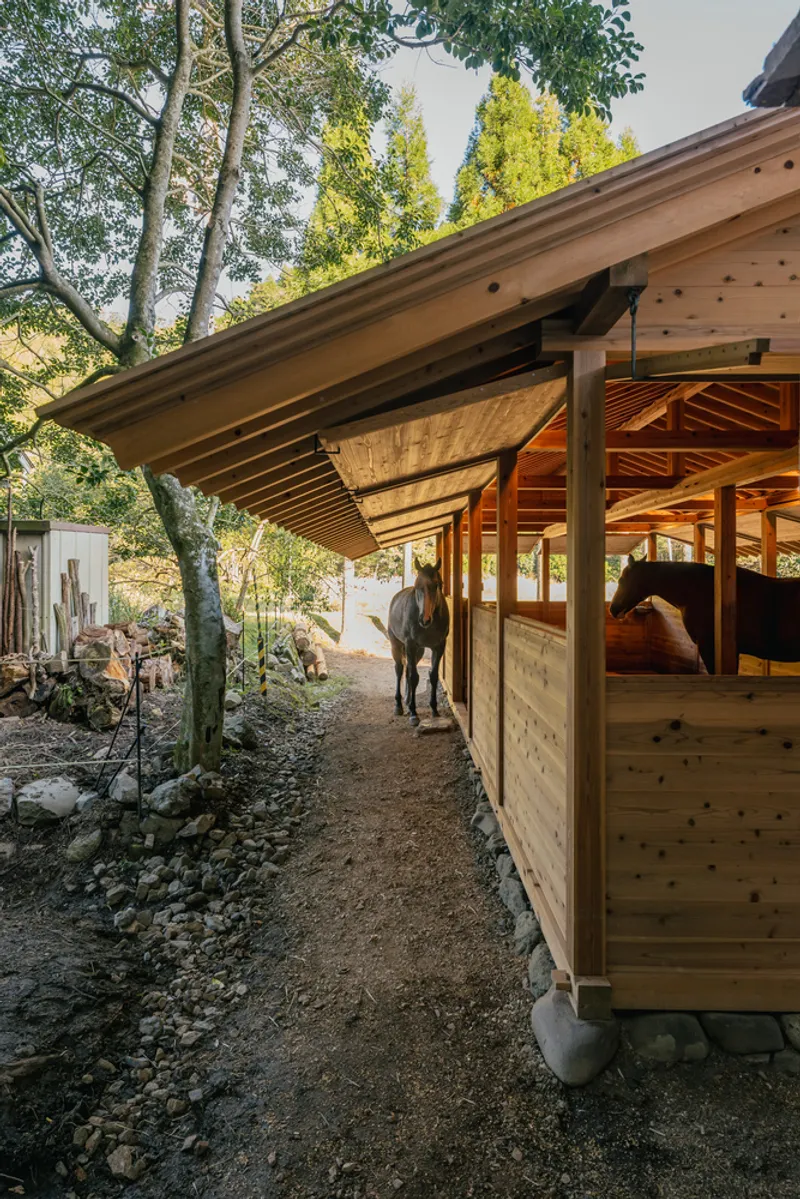

The relationship between stable and paddock is deliberately porous. With the shutters up, the interior is essentially an open-air pavilion; the horse can see trees, feel wind, stand in dappled light. The overhanging eaves extend that sheltered zone outward, creating a threshold space where horse and handler are covered but not enclosed. Under birch canopy and afternoon sun, the eave detail, rafters exposed, cladding tight, is one of the most photogenic moments in the project.
At night, the compound takes on a different character entirely. The illuminated metal roofs glow against the dark forested hillside, registering as two warm seams of light flanking the old kura. The scale remains modest; there is no grand gesture, just a pair of well-lit working buildings doing their job.
The Stall and the Garden
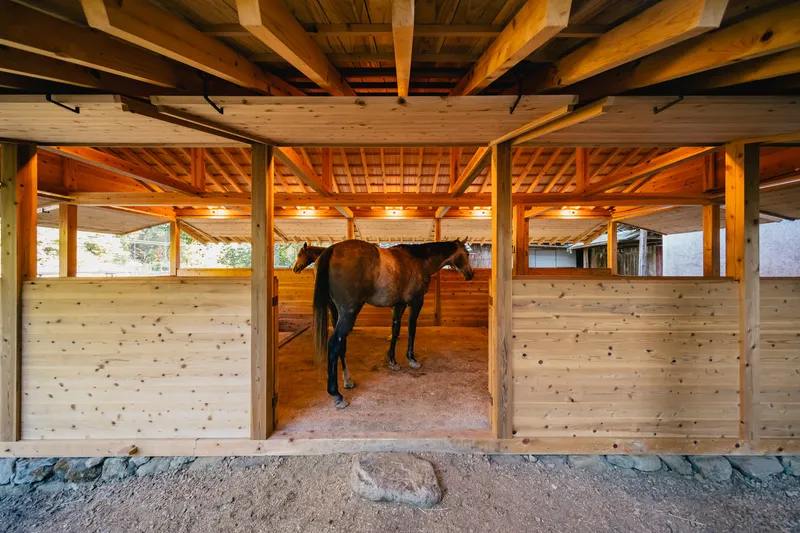


Inside the stall, sawdust over earth, a horse stands beneath a coffered ceiling of exposed joinery. It is a deliberately simple interior: no partitions beyond what is necessary, no finish beyond the natural grain of the cedar planking. The saddle room and storage occupy the smaller adjacent volume, keeping the main stable space as a single open bay that is easy to muck out and easy to ventilate.
The outbuildings and covered walkways on the property reinforce the sense that this is not a designed estate but a working place that has accreted structures over time. The weathered plaster of existing buildings, the mossy slopes, the stone lantern glimpsed through a stable opening: these are not curated vignettes but the ordinary texture of a rural Japanese compound that 2M26 was careful enough to leave intact.
Plans and Drawings


The floor plan reveals the essential simplicity of the layout: an elongated rectangular stable with multiple bays beside a smaller volume for storage and tack. The axonometric drawing is more revealing, exploding the timber frame to show how columns, beams, and rafters lock together without fasteners. The sloping gable profile and the even spacing of structural bays read like a diagram of traditional Japanese carpentry reduced to its minimum expression. The elevation drawing confirms how the horizontal cladding and overhanging corrugated roof work together to produce a low, ground-hugging profile that defers to the mature trees surrounding it.
Why This Project Matters
The Umagoya Stable matters because it demonstrates that traditional building methods are not museum pieces. They are viable construction systems for contemporary programs. 2M26 did not replicate a historical stable; they designed a new building that happens to use joinery, local timber, earth floors, and hand-forged hardware because those choices are better suited to the climate, the site, and the animals than any modern alternative would be. That is a functional argument, not a sentimental one.
It also matters as a lesson in restraint. The program is small, two horses, and the budget is clearly finite. But 2M26 treated every decision, from the split massing to the shutter hinges, as an opportunity to be precise. In a discipline that often equates ambition with scale, the Umagoya Stable makes a quiet case for ambition of craft. A building this modest, detailed this carefully, sitting this comfortably in a 200-year-old compound, is harder to pull off than most architects would admit.
The Umagoya Stable by 2M26, located in Keihoku, Kyoto, Japan. Completed in 2022. Photographs by 2M26.
About the Studio
Share Your Own Work on uni.xyz
If projects like this are the kind of work you want to make, uni.xyz is a place to publish your own, find collaborators, and enter design competitions.




Popular Articles
Popular articles from the community


Hill & Cross Opera: Sculptural Opera House Architecture Shaped by Tallinn’s Landscape and Identity
Hill & Cross Opera reimagines opera house architecture in Tallinn through its sculptural hill, civic plaza, glass wave and a luminous cross.

Co-Life: Senior Housing Design That Reconnects Older Adults With the City
Co-Life reimagines senior housing design through healing gardens, shared streets, workshops, and a sustainable community across generations.

The Earth Pod: 3D Printed Homes for Resilient Refugee Communities
The Earth Pod reimagines refugee housing through 3D printed homes made from clay, combining resilience, self-sufficiency, and rapid shelter.

The Ocean Hive: Sustainable Architecture for a Self-Sufficient Civilization at Sea
The Ocean Hive imagines sustainable architecture at sea, where modular habitats, algae, wave power and ocean waste sustain a growing colony.

Similar Reads
You might also enjoy these articles

Bamboo Housing Challenge 2026: Design Affordable, Sustainable Homes Using Bamboo
An international design competition by Bamboo U and IBUKU inviting architects and designers to reimagine affordable housing using bamboo — with the winning design built full-scale in Bali.

Computational Design & Education: Beegraphy Design Awards Introduces 7th Category (Featuring Jiyun's Innovative Approach)
Dive into Beegraphy’s 7th Design Awards category, where computational design meets education to create immersive, interactive learning tools, inspired by Jiyun’s work.

From Parametric Lighting to Urban Furniture: Join the 2nd Workshop in Beegraphy’s Computational Design Series
Dive into Cutting-Edge Design Techniques and Practical Applications with Industry Experts

Last Call: Unleash Your Architectural Genius in SHAK's Kindergarten Design Competition
Urgent call for architects to join SHAK's kindergarten design competition before the looming deadline


Explore Architecture Competitions
Discover active competitions in this discipline



Challenge to reimagine the Iron Throne


Photograph architecture without architects


Illustrate the lost glory of Angkor Wat - Render Challenge


Design challenge to reuse E-waste
Comments (0)
Please login or sign up to add comments
No comments yet. Be the first to comment!