Tidal Nexus
Blurring the boundary between land and sea, Tidal Nexus is a floating community network where climate resilience and civic vibrancy interlace.

As the climate crisis intensifies, coastal cities such as New York City must evolve to protect their waterfront communities. This project utilizes The Battery as a case study to explore ways to not only protect the city from rising sea levels, but also support communities socially, economically, and environmentally.
In 2012, Hurricane Sandy hit New York City resulting in record-breaking flooding with waters reaching as high as 13 feet. As a result of the storm, 17% of the city was flooded destroying hundreds of buildings, submerging over half of the subway tunnels, and leaving many neighborhoods without power (NYC Department of City Planning). Unfortunately, Hurricane Sandy was not an anomaly. Due to climate change, storms have continued to increase in severity, exposing coastal cities to unprecedented levels of damage.
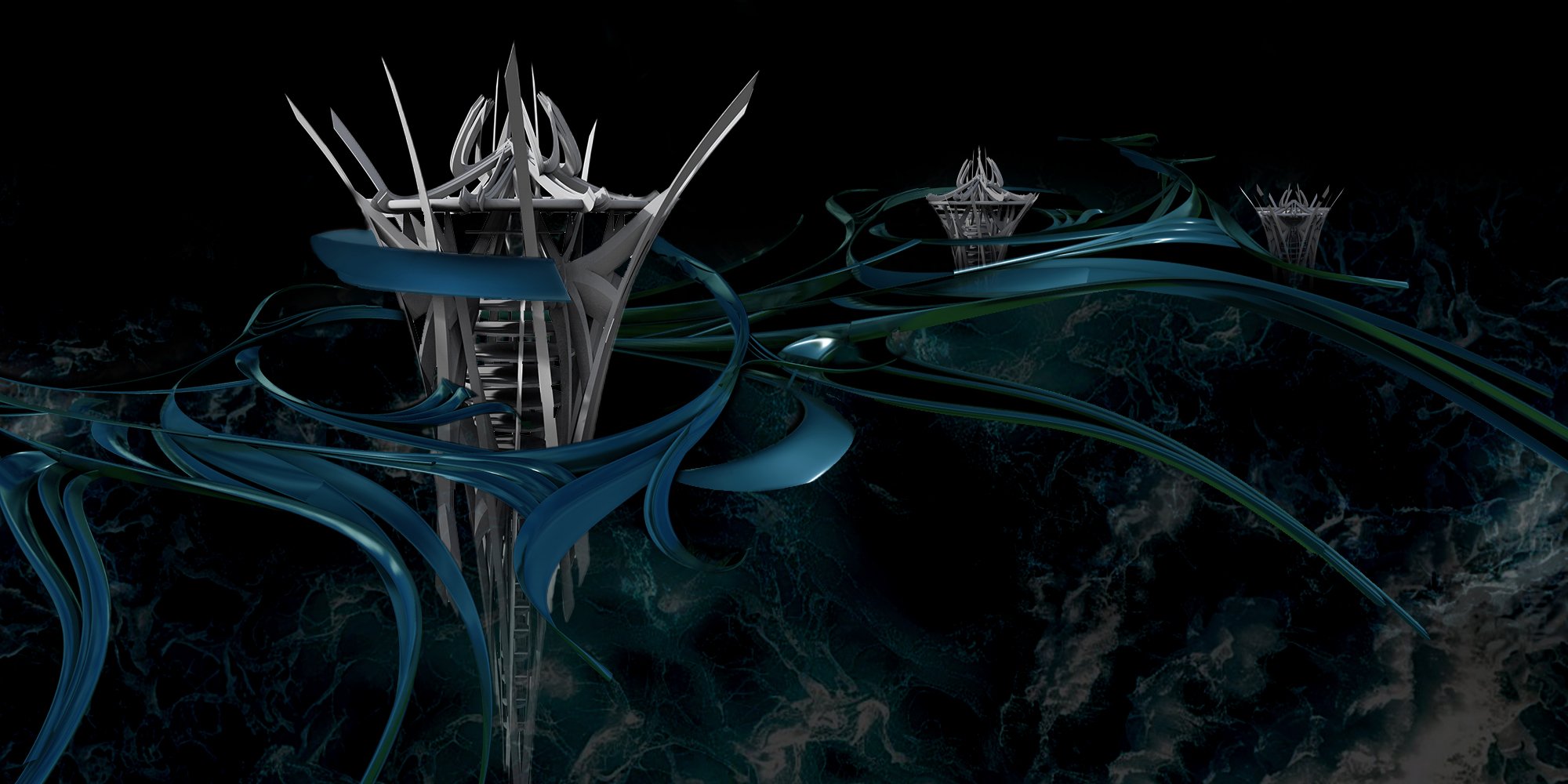
To address the devastating impacts of rising sea levels and storm surges, Tidal Nexus reconceptualizes The Battery’s urban grid as an active system capable of redirecting, absorbing, and harnessing water. Utilizing the flows of the Hudson and East Rivers, the addition follows the rivers’ currents and deflects tidal surges through its curved spines. In times of crisis, AI-driven water monitoring sensors embedded within the structure activate the outermost spines, transforming them into floodgates that provide a protective cap around Lower Manhattan. As water passes through the system, biofiltration panels seeded with marine vegetation naturally clean pollutants and trap debris. Each spine houses an internal network of micro-turbines generating renewable energy from the tidal flow. This energy is then redispersed throughout the complex powering the entire site. Overall, Tidal Nexus’ self-sustaining network of spines operates as a multifunctional infrastructural system, integrating flood mitigation, energy generation, and water purification into the urban grid.
In addition to harnessing the flow of water throughout the site, the spines also serve as public green spaces and trails. Artificial wetlands are interspersed across the network of spines in an effort to revitalize the waterfront’s ecosystem. Since the development of Lower Manhattan, the area has lost 85% of its salt marsh lands and 99% of its freshwater wetland habitats to urbanization and pollution (NYC Department of Parks & Recreation). These natural areas are vital to the survival of native plants and animals and serve as a means to absorb stormwater. By reintegrating wildlife into the urban grid, the project aims to provide an oasis for New York residents, restoring not only ecological balance but also a deeper connection between humans and nature.
Modules with artificial islands and underwater skyscrapers connect to the network of spines, serving as vibrant community hubs. These buoy-like modules provide the community with opportunities to learn, share, and gather. In the learning modules, research specialists operate state-of-the-art laboratories dedicated to monitoring water quality and rehabilitating native wildlife. Here, visitors can learn more about the state of the environment and what efforts they can make to preserve the planet through interactive exhibits and workshops. In the sharing modules, small business owners are provided with access to flexible, low-cost retail spaces to gain exposure and break into the competitive Manhattan market. Here, visitors can support local entrepreneurs and invest in their own communities. Gathering modules invite public interaction through adaptable gallery and performance spaces that host cultural events, art installations, and theatrical performances. These experiences cultivate a sense of belonging and offer compelling reasons for people to return, reinforcing the site’s role as a dynamic urban anchor. Submerged beneath the water, each module contains low-income residential units. Due to the high demand for housing and population growth, finding a place to live is not only difficult but expensive. Our site aims to address this issue by integrating affordable housing directly into the city’s waterfront infrastructure. Overall, Tidal Nexus’ multifunctional community hubs cultivate an inclusive urban network where environmental stewardship, economic opportunity, cultural expression, and equitable living intersect.
Despite its location on the water, Tidal Nexus remains deeply connected to the city’s existing urban fabric. Spines graft onto The Battery’s grid, anchoring to the site’s key landmarks. As visitors traverse through the site, the spines slowly arc towards the Statue of Liberty and Ellis Island, emphasizing the site’s significance as a center for immigration. Below the surface, Tidal Nexus has a series of underwater pedestrian tunnels and subway lines, increasing the connectivity between the floating modules and the surrounding city.
Overall, Tidal Nexus reimagines urban waterfronts as living systems of resilience, regeneration, and community. By integrating climate-responsive infrastructure with inclusive public spaces and ecological restoration, the project offers an optimistic blueprint for the future of coastal cities. As rising sea levels challenge our urban landscapes, Tidal Nexus invites us to not only adapt—but to thrive.