
To Bee
A project for humans and bees

With the progress of human civilization, the development of technology, the increase of the world's population, the damage to the environment and the animal world is increasing. We all know about the growing carbon footprint of man and the consequences of this on nature, on deforestation, on global warming. However, one problem remains in the shadows, one problem that concerns our survival, as well as many other species.
The bees.
Bees are at serious risk of extinction due to the loss of natural habitats, the use of pesticides, and the spread of parasites and viruses.
The main role of these cute insects in nature, as we well know, is to help pollinate thousands of plant species. 91 of the 100 most popular plant foods, which feed 90% of the world's population, rely on the "services" of bees to survive.
If the bees disappear, we can all imagine what will happen.
It is because of the listed problems that solutions to the problem are sought. How we can address this problem through architecture. With this project of the Beekeeping Center, which has hosted research and development activities, as well as many information and information activities, I strive to leave a deep mark on people, as well as to find solutions to at least some of the most pressing problems. .
The beekeeping center is located in North America, USA, North Carolina, Asheville. The property is located in Biltmore Estate - a private mansion / suburban park / in the south of Asheville. The terrain is predominantly hilly with an average slope of about 20%, eastern slope with rich surrounding natural landscaping. The access to the property is only from its eastern part, through the internal park transport network.
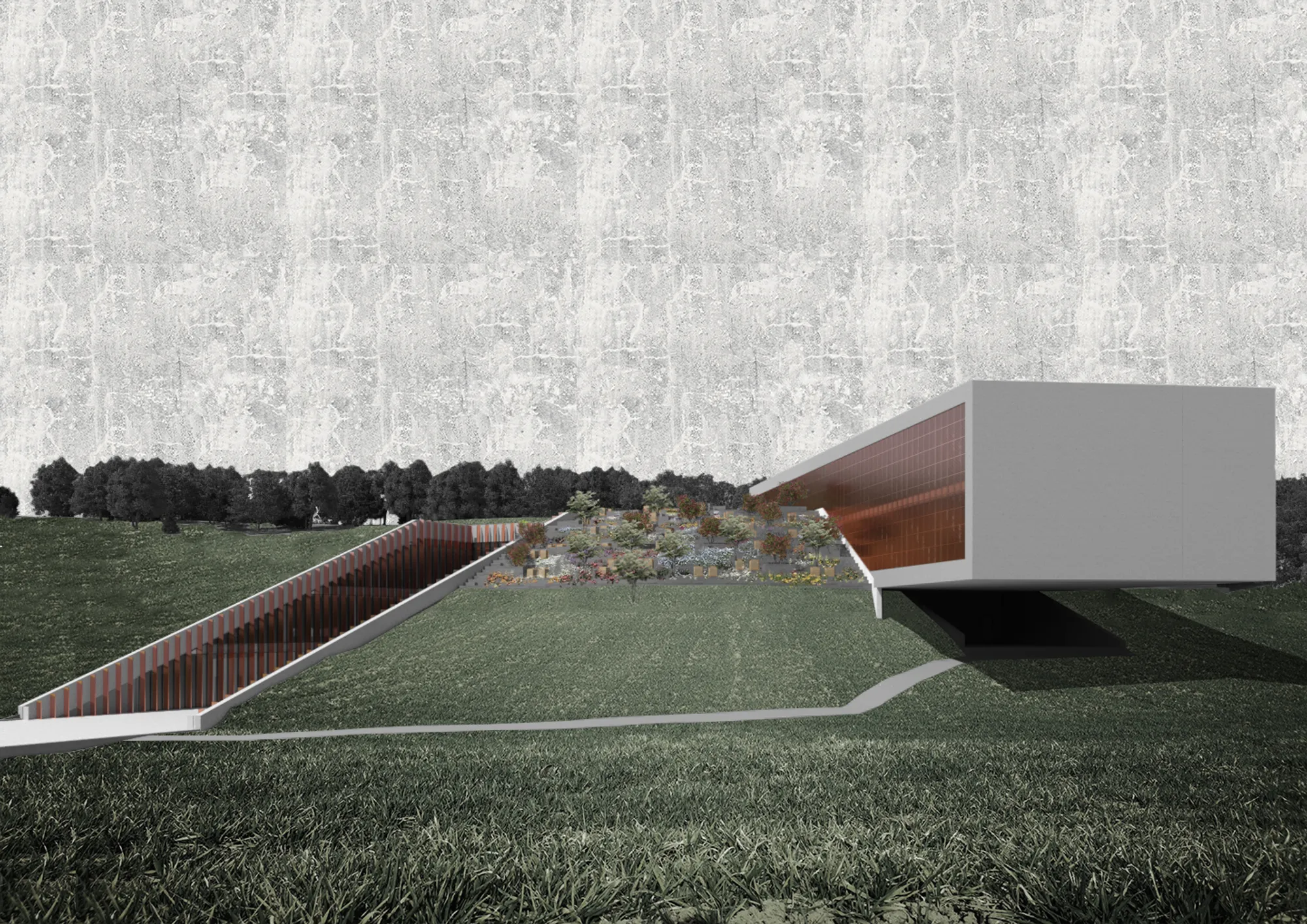
The beekeeping center is located on the eastern slope. The public access area is dug into the terrain and forms an orthogonal square space. Entering the slope is as rude and aggressive as the human footprint on nature. On the other hand, the place where people will look for solutions to problems, again comes from the negative imprint but is so located to work in harmony with nature. The location of the main volumes and the actual subtraction and addition of volumes differentiate different zones in situational terms. In the southern part of the property there is a classic apiary, where visitors can access, and in the northern part of the property there is a natural habitat for bees. It will be accessible only to researchers who will study the life and behavior of both honey bees and hundreds of other native bee species.
Parking, as well as refueling and exporting from the building, for employees and visitors are provided in the underground level. Visitors to the Center are also served by the 5 parking lots of Biltmore Estate with a capacity of about 2000 parking spaces. Free access to the park is limited and therefore the guests of the center will be brought by in-park transport.
The public access area is developed on 4 levels, 1 completely underground - parking and three semi-dug floors. The visitor center, the restaurant and the shopping area are accessible from the square. At the next level is the place where the main socially significant activity will take place, namely the information and information activities. On this level there are two flexible and multifunctional spaces - the exhibition hall and the workshop room. On the third level is the administration, as well as the connection with the research and production center.
The production process is organized in a vertical, downward direction, ie. the production of honey and bee products starts from the level of elevation + 9.00 m, which has a connection with the terrain, as each stage is on a different floor. The main production room -> filtering and separation -> packaging -> warehouse of finished products. To optimize the production process, as well as to introduce new products and technologies in beekeeping and honey production, a development cell with two manipulation cells is located at the same level. The last level of the building is reserved for research. Here are located a library, reading room, conference halls and a laboratory block.
When designing the building, I tried to provide the most short and comfortable connections both vertically and horizontally.
In terms of design, both volumes are solved with different design systems. The excavated volume will be built according to the "Top-down" system, a system in which the vertical bearing elements, the floor structures are built first and only then the excavation for the lower level. The floor construction is made of composite slab beams - steel beams and trapezoidal sheet metal and concrete. The strengthening of the excavations is through secant piles.
The two above-ground floors of the research and production center are partly cantilevered. The main structure there is a steel skeleton, a spatial truss type. Floor and roof structures are composite slab beams.
The materials and facade layout are selected to achieve and enhance the feeling of monumentality of the building, as well as to achieve the desired effect of opacity. The square space is surrounded by vertical copper slats, which do not allow a person to look away into the building, but only forward. The console bit the hill looks heavy and massive, dense. This feeling is achieved through the deceptive solid part, which is made of copper perforated panels, which allow light inside, but also prevent overheating. The other surfaces have a final coating of fiber cement boards, which visually resemble concrete blocks.
I sincerely believe that this building will leave a lasting impression on people and they will rethink their lives and how we should treat nature.



Popular Articles
Popular articles from the community


Co-life: Sustainable Architecture for Age-Friendly Community Living
Co-life reimagines sustainable architecture for seniors through courtyards, rammed earth, shared gardens, and spaces designed for belonging.

Co-Life: Senior Housing Design That Reconnects Older Adults With the City
Co-Life reimagines senior housing design through healing gardens, shared streets, workshops, and a sustainable community across generations.

The Earth Pod: 3D Printed Homes for Resilient Refugee Communities
The Earth Pod reimagines refugee housing through 3D printed homes made from clay, combining resilience, self-sufficiency, and rapid shelter.

Conexión: Biophilic Design Reimagines High-Rise Living in Hong Kong
Conexión reimagines high-rise living in Hong Kong through biophilic design, green facades, shared spaces, daylight, water and nature within.


Similar Reads
You might also enjoy these articles

The Rhythm of Seasons
A Farmers' Market Connecting Nature and the City


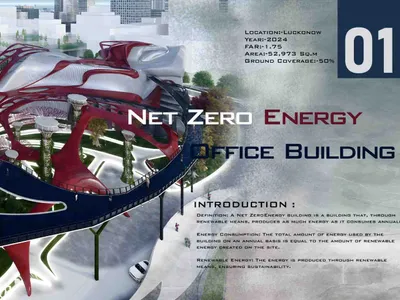
More Than a Building-Designing a Living System
More Than a Building-Designing a Living System
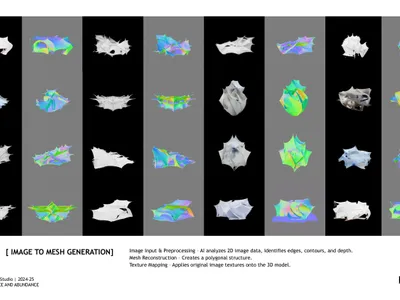
Base Beyond
DESERT COMPOUND ARID: TOURISM OF ABSENCE AND ABUNDANCE


Explore Architecture for all Competitions
Discover active competitions in this discipline




Challenge to reimagine the Iron Throne


Photograph architecture without architects


Illustrate the lost glory of Angkor Wat - Render Challenge


Design challenge to reuse E-waste
Comments (0)
Please login or sign up to add comments
No comments yet. Be the first to comment!