

Unintentional Prison: Rethinking Confinement as a Micro-City of Rehabilitation
A shortlisted entry reimagines penitentiary architecture as a digitally-inspired urban ecosystem for non-violent offenders.


What happens when you stop designing a prison to look like one? Mohammad Farooqui answers that question by replacing isolation blocks and fortified corridors with residential towers, co-working hubs, cafés, and tree-lined roads. "Unintentional Prison" treats its occupants not as threats to be contained but as people whose reintegration into society begins the moment they walk through the gate. The result is a facility that reads more like a compact urban neighborhood than a correctional institution, and that distinction is entirely deliberate.
Shortlisted in the Switching Prisons competition, the project earned praise from jurors including Michael Spight, Director of TAG Architects, who noted it was "architecturally well resolved, not like a prison at all," and Misak Terzibasiyan, Founder and CEO of UArchitects, who highlighted the "interesting working environment." Farooqui's design specifically targets individuals convicted of non-violent, cyber-based, or unintentional offenses: first-time offenders, youth, and people drawn into digital infractions who pose no physical danger. For this population, the project argues, architecture should function as a recovery tool rather than a cage.
An Entry Road That Signals Something Other Than Punishment
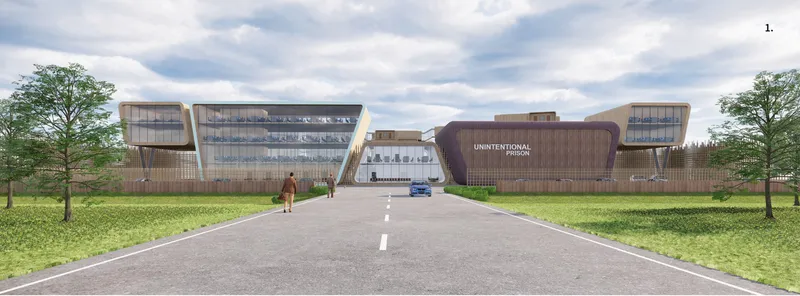
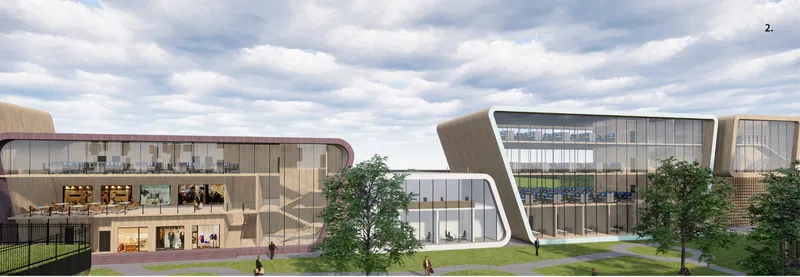
The campus approach immediately sets a different tone. Angled volumes with generous glazed facades line the entry road, creating a streetscape that could belong to a tech campus or a university precinct. There are no imposing perimeter walls in sight. Instead, the side elevation reveals cantilevered volumes clad in metal panels with full-height glazing, set among scattered trees. The architectural language is precise and contemporary, communicating openness and order rather than intimidation. This is the first act of the project's central argument: that security for non-violent offenders need not rely on brute fortification.
The outer boundary operates through what Farooqui calls a "web-secured zone," a layered security membrane that conceptually and technologically reinforces the building's digital metaphor. The entire design is framed through an operating system analogy: rather than treating inmates as malicious data to be erased, the architecture acts as a firewall and recovery tool, repairing and reconnecting both individual behavior and societal norms.
Curtain Walls and Structural Layers: Building the Digital Metaphor
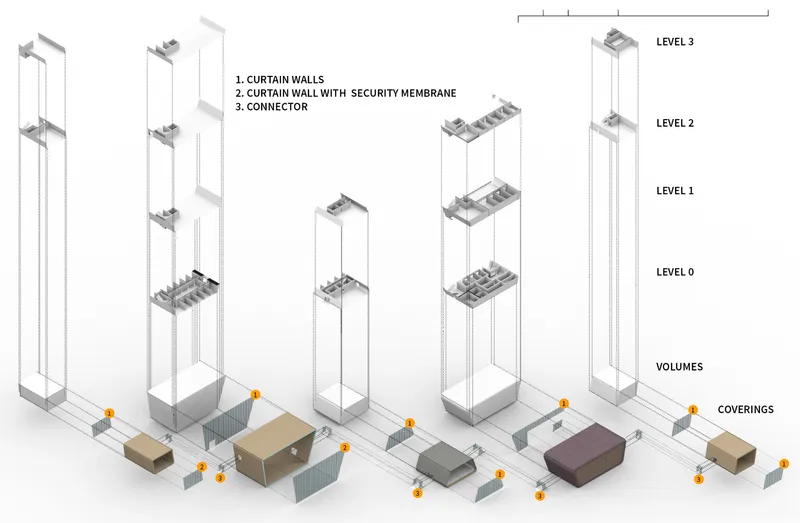
The axonometric assembly diagram breaks down the construction logic: curtain wall systems, structural volumes, and material coverings are organized across multiple levels with a clarity that mirrors the project's programmatic layering. Seven residential towers rise from a shared podium base, and each level of the podium serves a distinct function. Level 0 houses reception areas, visitor meeting zones, retail shops, interrogation rooms, and temporary holding spaces. Levels 1 and 2 contain administrative offices, co-working areas, training rooms, and system monitoring facilities. Level 3 is dedicated to libraries, control centers, dining areas, and multi-functional public spaces.
The material palette blends metal cladding with extensive glazing, keeping interiors visually connected to the campus landscape. This transparency is not decorative; it is a security strategy in itself, allowing passive surveillance while reducing the claustrophobic conditions that conventional prisons use as a default.
Shared Workspaces Where Officers and Inmates Sit Side by Side
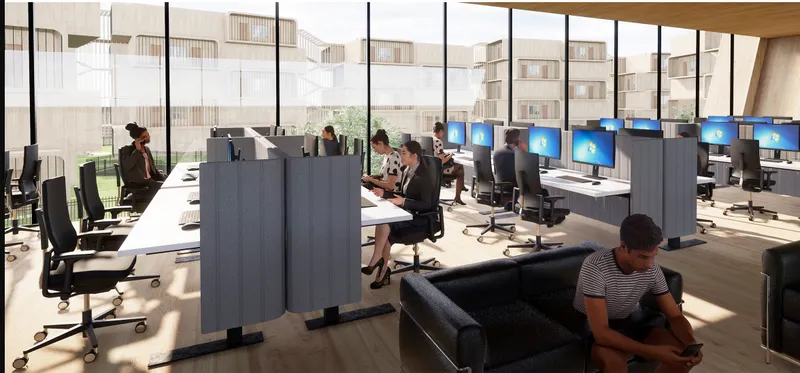
One of the project's most pointed design moves is the co-working space. The interior rendering shows an open-plan office fitted with workstations and computer screens, framed by floor-to-ceiling windows overlooking adjacent buildings. Prisoners and officers share these spaces, a gesture that is both symbolic and practical. Inmates participate in training programs aligned with digital literacy, cybersecurity, and the tech industry, bridging their sentence with future employability. The architecture deliberately removes the spatial hierarchies that reinforce an us-versus-them dynamic, replacing them with a working environment that rewards trust and productivity.
Social Spaces That Build Community, Not Isolation
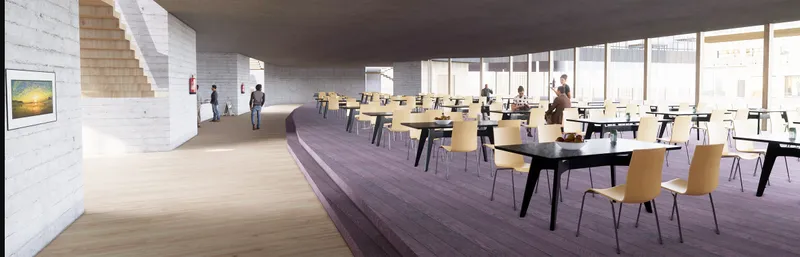
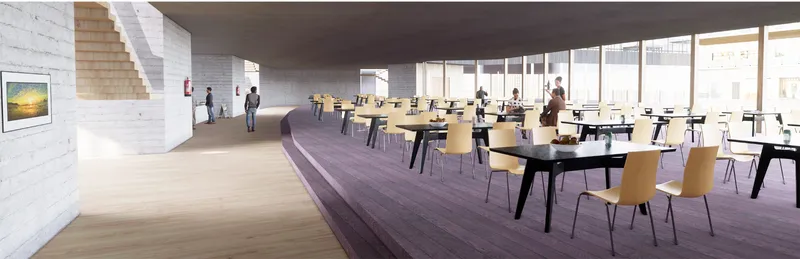
The cafeteria and dining hall interiors reveal a design sensibility focused on warmth and collective experience. Timber tables and purple flooring define the cafeteria space, where a curved ramp sits beside a textured concrete wall, offering accessibility alongside visual interest. The dining hall continues this palette with light wood tables, purple carpet, and walls of floor-to-ceiling glazing that flood the room with natural light. These are not sterile institutional canteens. They are social spaces calibrated to encourage interaction, reduce psychological fatigue, and normalize daily routines.
Farooqui's micro-city approach means that retail shops, cafés, banks, auditoriums, and wellness zones all exist within the secure boundary. The intent is to recreate the rhythms and responsibilities of urban life so that release does not come as a shock but as a seamless continuation of habits already practiced inside.
Cells Designed as Minimal Apartments, Not Cages
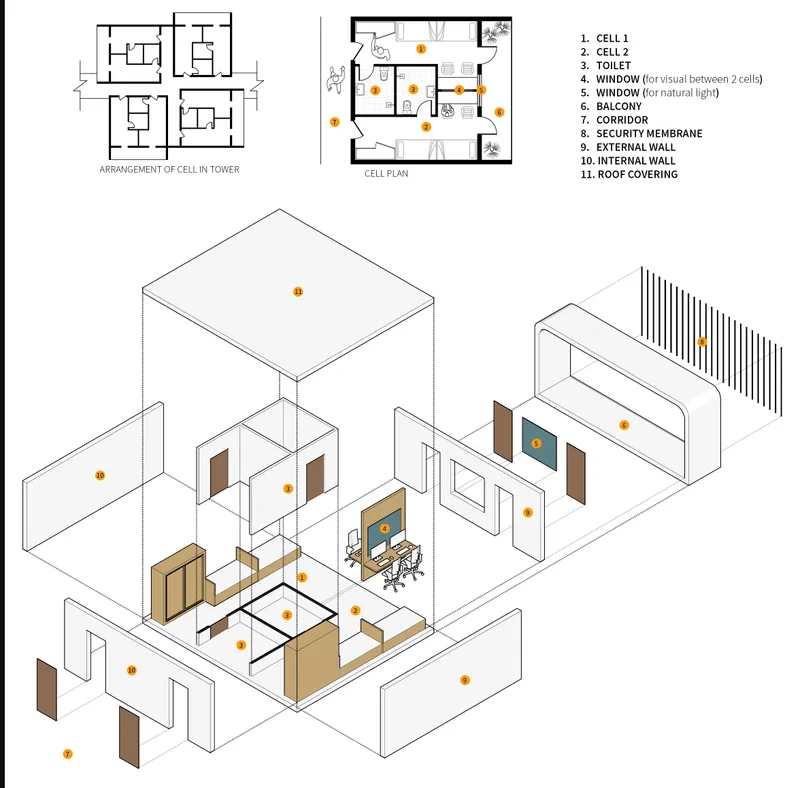
The exploded axonometric and plan drawings detail the modular arrangement of cells, walls, doors, and roof components. Each unit contains two separate rooms, a shared bathroom, balconies, and windows designed for both daylight access and transparency. Visual communication between adjacent cells is intentionally encouraged, a strategy aimed at reducing the psychological toll of prolonged confinement. The modular construction logic allows the system to scale across the seven residential towers while maintaining consistent living standards throughout.
There is nothing soft about this approach. The units are minimal and clearly structured. But they respect a basic premise: that people who committed a non-violent offense and will eventually return to society should not be broken by the architecture they inhabit while serving their sentence.
Why This Project Matters
"Unintentional Prison" confronts the reflexive assumption that all incarceration requires the same spatial logic. For individuals convicted of cyber crimes, digital infractions, and other non-violent offenses, Farooqui makes a compelling case that the architecture of confinement should match the nature of the offense. The proposal does not advocate leniency; it advocates precision. Structured freedom, layered security membranes, and shared work environments replace the blunt instruments of isolation and physical fortification with a system tuned to actual risk and actual outcomes.
In an era where crime and identity are increasingly virtual, the design of correctional facilities cannot remain anchored to 19th-century spatial models. Farooqui's project demonstrates that rehabilitation architecture can be rigorous, legible, and humane simultaneously. The real confinement here is not the wall; it is the structured environment that demands accountability, builds skills, and prepares people for a life beyond their sentence. That is a harder problem than building a fortress, and a far more useful one to solve.
View the Full Project
About the Designers
Designer: Mohammad Farooqui
Enter a Design Competition on uni.xyz
uni.xyz runs architecture and design competitions year-round that reward proposals with spatial conviction and real site intelligence.
Project credits: Unintentional Prison by Mohammad Farooqui Switching Prisons (uni.xyz).


Popular Articles
Popular articles from the community


The Amber Palace Opera: A Geological Fiction Surfaces on Tallinn's Baltic Waterfront
Pierre Brillard reimagines a Baltic legend as a public landscape, opera house, and waterfront promenade rooted in Tallinn's coastal identity.

Manzana Morphosis: Stretching Barcelona's Grid into a Living Landscape for 2050
A radical reworking of the Eixample manzana turns density into a tool for generous public space, vertical ecology, and environmental performance.

Singing Woman: An Opera House That Performs Before the Curtain Rises
Ovidiu Cristian Pavel's conceptual opera house translates Estonia's choral identity into a sculpted waterfront landmark facing the Baltic Sea.

Cloaked Colonization: A Mobile Underwater Habitat That Moves Like a Fish
Micah Abaya's shortlisted EHC Pacific entry reimagines ocean settlement as a dispersed network of self-sustaining architectural organisms.

Similar Reads
You might also enjoy these articles

Shakur's House: Exposed Brick as an Interior Organiser in a 168 m² Mashhad Residence
Brick moves indoors in this Mashhad residence, where masonry walls, glass partitions and teal planes sequence a compact home without closing it off.

Day and Night Park: A Time-Based Urban Newsstand in Beijing
A temporary urban newsstand in Beijing blending travel, light, and reading through poetic colors, compact form, and community-focused design.

Modernist Patio Renovation in El Masnou, Barcelona by Oliver Segura Arquitectura + Cebrià Arquitectura
Modernist patio renovation blending tradition and innovation with a movable pool, leveled floors, and Catalan materials in El Masnou.

Alto Residencial Coop: Cooperative Housing Development in Santiago de Compostela by Carbajo Barrios Arquitectos
A linear cooperative housing complex blending white volumes and perforated metal façades, enhancing community living, natural light, privacy, and urban integration.


Comments (0)
Please login or sign up to add comments
No comments yet. Be the first to comment!