
Urban Oasis: Sustainable Urban Architecture in Berlin
Reimagining former barracks in Berlin as a green, productive urban district where sustainable architecture and urban gardening grow together.


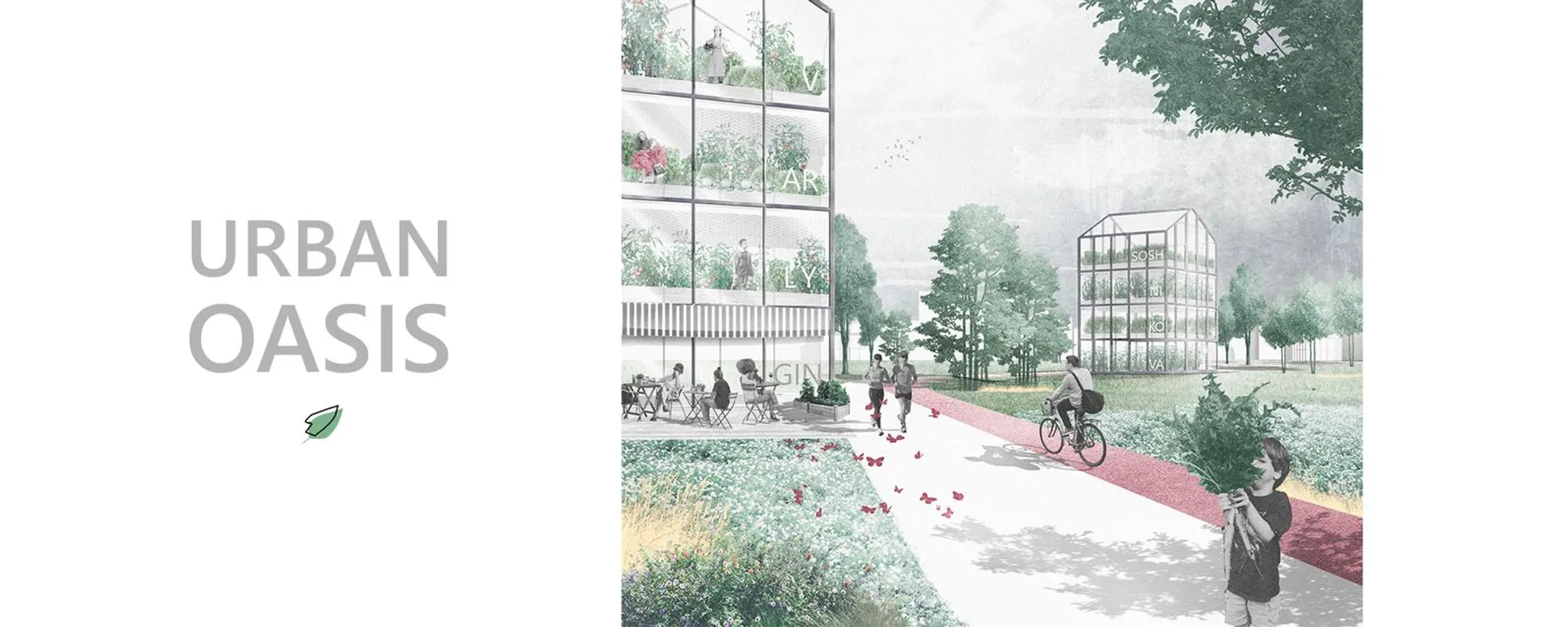
Urban gardening plays a significant role in Germany’s urban culture, and Berlin stands as one of the most prominent examples of how green initiatives can coexist with dense metropolitan life. Located in the Spandau district, the Urban Oasis project "URBAN OASIS - Renovation of territory of former barracks, Spandau district, Berlin" proposes the renovation of a former barracks territory by redefining it as a model of sustainable urban architecture. The project responds to the growing challenges faced by megacities: land scarcity, ecological imbalance, social fragmentation, and the loss of productive green spaces.
Rather than treating urban gardening as a peripheral activity, the proposal positions it as a core architectural and urban strategy. Garden communities, greenhouses, and productive landscapes are woven directly into the built fabric, allowing nature and architecture to operate as a single, integrated system.

Rethinking Garden Communities in a Dense Urban Context
The Spandau site has historically been shaped by layers of development, from military infrastructure to informal garden communities. As urban pressure increases, much of this land is expected to undergo densification. Urban Oasis does not resist this transformation; instead, it reframes it. The project rethinks Berlin’s garden culture as an adaptable urban typology capable of evolving within high-density environments.
Through the analysis of historical maps, from the early 20th century to contemporary conditions, the project traces how built mass and green areas have shifted over time. This research becomes the foundation for a future-oriented strategy where density and cultivation coexist. Green areas are no longer residual spaces but active components embedded within housing, public buildings, and circulation networks.
Typologies of Integration: Architecture Meets Urban Gardening
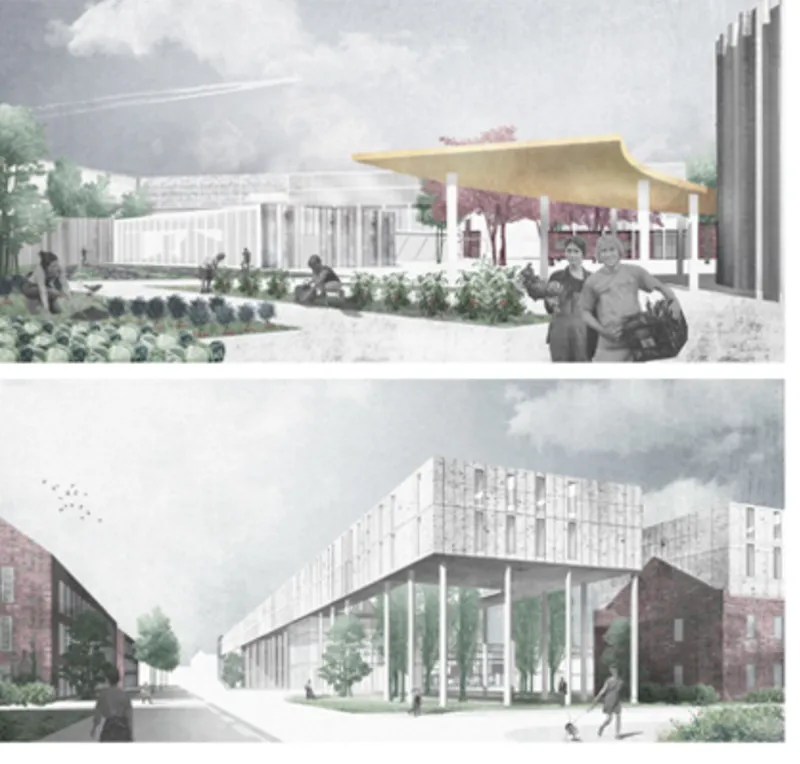
A series of architectural typologies is developed to explore different ways gardening can be integrated into dense urban development. These range from compact housing blocks with rooftop greenhouses to linear structures that combine residential, communal, and productive functions. Each typology reacts to specific site conditions, regulations, and spatial limitations, ensuring flexibility and adaptability across the district.
The territory is divided into groups of quarters, each interpreting the urban gardening concept in its own way. Some prioritize community gardens and shared courtyards, while others integrate greenhouses into elevated structures or inner blocks. Together, these variations create a lively and diverse urban fabric unified by a continuous system of recreational and green spaces.


Public Space, Movement, and Social Interaction
At the urban scale, the project introduces a network of public spaces that connect the quarters into a coherent whole. Pedestrian paths, green corridors, and open plazas are designed to encourage movement, interaction, and collective use. Elevated walkways and bridges link buildings while preserving permeability at ground level, allowing landscapes to flow uninterrupted through the site.
These public realms act as social condensers, where residents, visitors, and gardeners intersect. Markets, workshops, and shared cultivation areas transform everyday activities into opportunities for community engagement, reinforcing the social dimension of sustainable urban architecture.
A Model for Future Megacities
Urban Oasis proposes more than a site-specific regeneration; it offers a transferable model for future urban development. By embedding productive landscapes into dense architectural systems, the project challenges conventional separations between city and nature. It demonstrates how sustainable urban architecture can address ecological responsibility, social resilience, and spatial efficiency simultaneously.
Designed by Evgenii Varlygin and Anastasiya Soshnikova, the project envisions a future where cities grow not by erasing green spaces, but by cultivating them within the very structure of urban life.




Popular Articles
Popular articles from the community


The Earth Pod: 3D Printed Homes for Resilient Refugee Communities
The Earth Pod reimagines refugee housing through 3D printed homes made from clay, combining resilience, self-sufficiency, and rapid shelter.

Co-life: Sustainable Architecture for Age-Friendly Community Living
Co-life reimagines sustainable architecture for seniors through courtyards, rammed earth, shared gardens, and spaces designed for belonging.

Co-Life: Senior Housing Design That Reconnects Older Adults With the City
Co-Life reimagines senior housing design through healing gardens, shared streets, workshops, and a sustainable community across generations.

The Musturak Paradise: Senior Living Architecture for a Connected Future in Temara, Morocco
The Musturak Paradise reimagines senior living architecture in Temara via private homes, social spaces, culture, community, and shared care.


Similar Reads
You might also enjoy these articles

Eco Chapel: A Green Architecture Pavilion Designed in Symbiosis with the Forest
Eco Chapel uses green architecture to weave prayer, learning and reuse into a forest pavilion shaped by modular hexagonal canopies for life.
Kaffeebühnen: Coffee Shop Architecture Designed as a Civic Stage Between Vienna’s City and Park
Kaffeebühnen turns coffee shop architecture into a civic stage, linking Vienna’s park edge, urban life, warm timber yards, and coffee craft.
Healing Façade: Sustainable Architecture for Reforestation, Community, and Sacred Ecology in Ethiopia
Healing Façade reimagines sustainable architecture as a living wall that restores soil, catches water and renews Ethiopia's forest churches.


Urban Forest: A Vertical Ecosystem for 5,000 Workers in Singapore's Changi Business Park
Radially stacked pods and layered green decks turn a 7-acre plot into 47 acres of ecological workspace projected for 2040.


Comments (0)
Please login or sign up to add comments
No comments yet. Be the first to comment!