

Vertical Cemetery | Sustainable Funerary Architecture
Reimagining deathcare through vertical form, where memory, ritual, and sustainable funerary architecture converge in the heart of the city.


As global population growth accelerates, cities are forced to confront a question that is rarely addressed in urban discourse: what happens to the dead? While architecture continuously evolves to house the living, spaces for death and remembrance remain bound to horizontal, land-intensive typologies that are increasingly unsustainable. The Vertical Cemetery Future of the past project by Aishwarya Rajasekar responds to this crisis through a bold exploration of sustainable funerary architecture, proposing a new archetype that reconciles density, ritual, and memory within an urban framework.
Recent demographic studies reveal an alarming trajectory. In 2014, the global birth-to-death ratio stood at 3:1; by 2016, it declined to 2:1. Projections indicate that by 2045, available land for burials worldwide may be exhausted. This spatial crisis is particularly acute in rapidly urbanizing regions such as India, where burial grounds are constrained by expanding cities, rising land values, and cultural sensitivities surrounding death. The Vertical Cemetery positions architecture as a mediator: between life and death, past and future, scarcity and dignity.
Death, Density, and the Urban Condition
Cemeteries are often treated as passive, peripheral spaces, removed from daily urban life and rarely integrated into the city’s spatial logic. In reality, they are critical cultural infrastructures that embody collective memory, belief systems, and rituals of grief. In India, burial and cremation practices vary across religions, yet all share a common challenge: diminishing land availability.
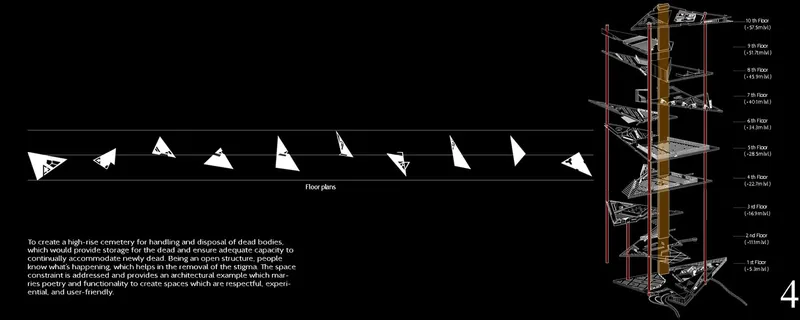
This project challenges the conventional notion of cemeteries as horizontal landscapes. Instead, it introduces a vertical funerary typology that responds to urban density while preserving the sanctity and emotional depth associated with death rituals. By stacking burial and memorial spaces vertically, the design drastically reduces land consumption while expanding the spatial narrative of mourning.
Conceptual Framework: Life, Death, and Grief
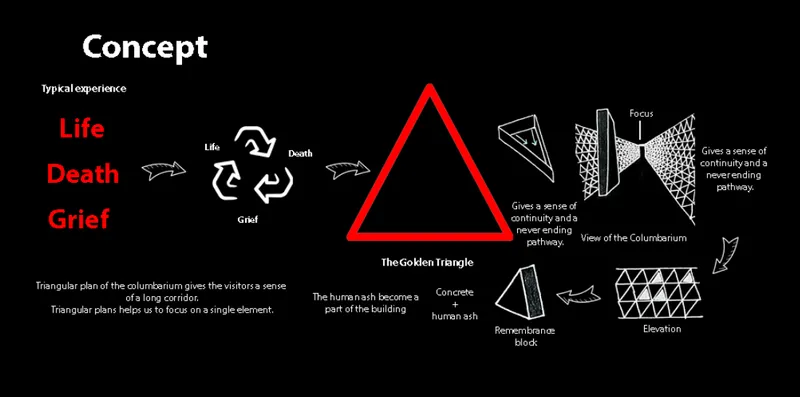
At the heart of the project lies a cyclical understanding of human existence, Life → Death → Grief → Remembrance. This cycle informs both spatial organization and architectural expression. The building is conceived not merely as a repository for the dead, but as an experiential journey for the living.
The primary geometric generator is the triangle, referred to as the Golden Triangle. This form symbolizes balance, continuity, and spiritual ascent. The triangular plan creates elongated visual corridors, reinforcing a sense of procession and introspection. Movement through the building becomes a metaphorical transition, from the chaos of the city to a contemplative realm of memory and acceptance.
Human remains, transformed into ashes or interred bodies, become part of the architectural narrative: embedded within remembrance blocks, columbarium walls, and memorial spaces. In this way, the deceased are not hidden away but integrated into a living architectural system that acknowledges their continued presence in collective memory.
Site Response: Kilpauk Cemetery, Chennai
The proposal is situated within Kilpauk Cemetery, Chennai, one of the city’s largest and oldest burial grounds. Spanning approximately 15.8 acres, the cemetery was closed for new burials in 2005 due to lack of space, making it a poignant and highly relevant site for intervention.
Surrounded by dense residential neighborhoods, churches, and urban infrastructure, the site reflects the tension between living communities and spaces of death. The Vertical Cemetery addresses this condition by consolidating burial functions vertically, freeing ground space for public pathways, water bodies, landscaped zones, and transitional spaces that soften the boundary between the cemetery and the city.
A multi-tier vault system is introduced, capable of accommodating thousands of burials within a compact footprint. Vaults are designed for reuse after a fixed period, ensuring long-term sustainability and responsible land management, key principles of sustainable funerary architecture.

Programmatic Organization and Ritual Spaces
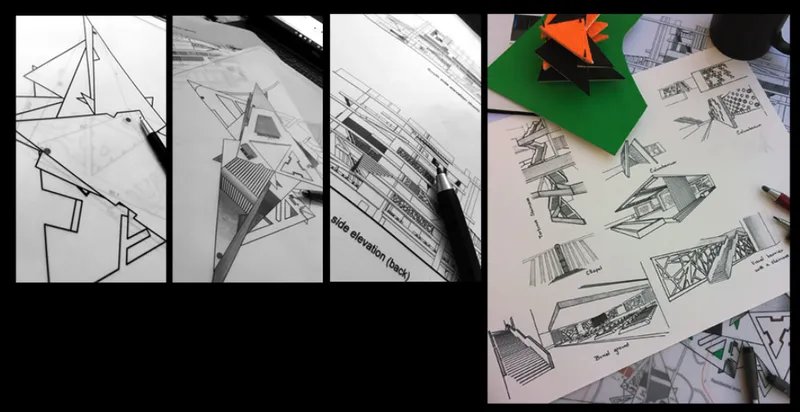
The building integrates multiple layers of ritual, reflection, and public engagement. Key spaces include:
- Chapel and Prayer Halls: Spaces for religious ceremonies and collective mourning.
- Columbarium: Vertical niches for ashes, forming textured memorial walls.
- Burial Zones: Multi-tier vault systems designed according to religious customs.
- Memorial Spaces: Quiet zones for remembrance and contemplation.
- Processional Pathways: Linear and spiral routes symbolizing emotional transition.
- Public Amenities: Cafés and resting areas that normalize the presence of death within everyday urban life.
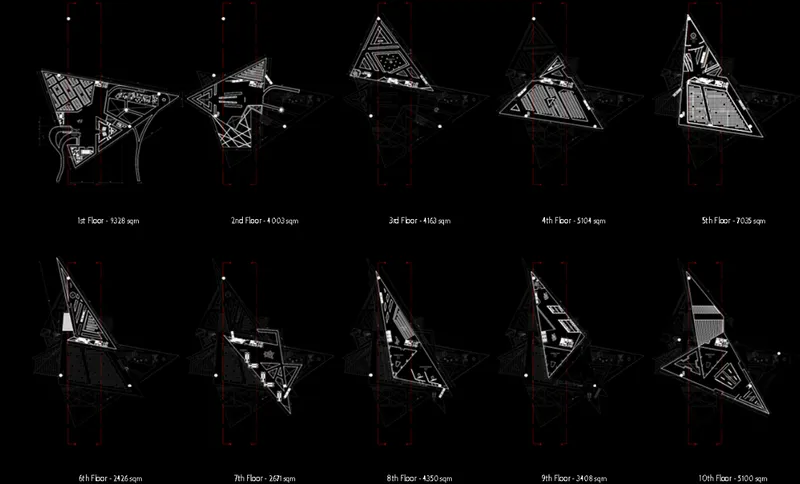
Movement through these spaces follows a carefully choreographed sequence: entry, ceremony, farewell, and remembrance, allowing visitors to process grief gradually rather than abruptly.
Structure, Materiality, and Symbolism
Four primary structural columns anchor the building, representing the elemental forces of air, fire, water, and land, a symbolic framework rooted in spiritual and natural balance. These columns guide both structural logic and spatial hierarchy.
Material choices reinforce the emotional atmosphere:
- Grey and Black tones evoke solemnity, protection, and mystery.
- White surfaces introduce moments of purity, light, and transcendence.
- Concrete and stone provide permanence and weight, grounding the architecture in timelessness.
Light is treated as a critical architectural element. Controlled apertures, framed views, and vertical shafts allow daylight to penetrate deep into the structure, transforming spaces of grief into environments of calm reflection.
Rethinking Cemeteries as Civic Architecture
Rather than isolating death from public life, the Vertical Cemetery proposes a new role for funerary spaces, as civic and cultural architecture. By incorporating accessible pathways, gathering spaces, and visual transparency, the project challenges the stigma associated with cemeteries and reframes them as places of collective memory and urban pause.
This approach aligns with contemporary discourses in sustainable funerary architecture, which advocate for compact, adaptable, and socially integrated deathcare infrastructures. The cemetery becomes not an end-point, but a meaningful layer within the city’s spatial and emotional fabric.
The Vertical Cemetery by Aishwarya Rajasekar is a powerful response to the spatial, cultural, and environmental challenges of modern deathcare. Through its vertical organization, symbolic geometry, and sensitive integration of ritual and public space, the project establishes a new archetype for sustainable funerary architecture.
In confronting the inevitability of death, the project does not seek to erase grief: but to give it form, dignity, and continuity. It stands as an architectural reminder that even in the densest cities, there is space for remembrance, reflection, and respect for those who came before us.


Popular Articles
Popular articles from the community


The Amber Palace Opera: A Geological Fiction Surfaces on Tallinn's Baltic Waterfront
Pierre Brillard reimagines a Baltic legend as a public landscape, opera house, and waterfront promenade rooted in Tallinn's coastal identity.

Tsunami Convergenics: Turning Catastrophic Ocean Forces into Underwater Housing Infrastructure
A speculative underwater settlement off the coast of Onagawa, Japan, treats tsunamis and typhoons as energy sources rather than threats.
Extended Shell: Retrofitting Kolkata's Balconies as Living Urban Thresholds
A modular retrofit system recovers the social and environmental intelligence of Kolkata's historic verandas for contemporary Park Street residents.

Faces of the Soviet Avant-Garde: Turning Moscow's Street Names into an Open-Air Museum
A network of sculptural installations across a Moscow residential district transforms forgotten architect names into spatial encounters with cultural memor

Similar Reads
You might also enjoy these articles

Eco Chapel: A Green Architecture Pavilion Designed in Symbiosis with the Forest
Eco Chapel uses green architecture to weave prayer, learning and reuse into a forest pavilion shaped by modular hexagonal canopies for life.
Kaffeebühnen: Coffee Shop Architecture Designed as a Civic Stage Between Vienna’s City and Park
Kaffeebühnen turns coffee shop architecture into a civic stage, linking Vienna’s park edge, urban life, warm timber yards, and coffee craft.
Healing Façade: Sustainable Architecture for Reforestation, Community, and Sacred Ecology in Ethiopia
Healing Façade reimagines sustainable architecture as a living wall that restores soil, catches water and renews Ethiopia's forest churches.


Urban Forest: A Vertical Ecosystem for 5,000 Workers in Singapore's Changi Business Park
Radially stacked pods and layered green decks turn a 7-acre plot into 47 acres of ecological workspace projected for 2040.

Explore Vertical Cemetery Competitions
Discover active competitions in this discipline

Challenge to reimagine the Iron Throne

Photograph architecture without architects

Illustrate the lost glory of Angkor Wat - Render Challenge

Design challenge to reuse E-waste
Comments (0)
Please login or sign up to add comments
No comments yet. Be the first to comment!