

WARTA CAMP - container student housing
The student housing, designed near the Warta riverfront, redefines what a student housing can be and responds to the global problem of waste.

The competition Container City gives a chance to redefine what a student housing can be. The designed building must serve young people studying a diversity of classes, from all around the world. The concept behind the project was to create a comfortable, spacious and functional space of the student housing building.
Apart from limitations, there are many strengths to using containers – such as fast and easy construction process. Most of the containers can be used as prefabricated elements, delivered to the construction site and ready for installation.
When I first started working on this project, I thought that I have to find the right location of the designed student housing. It had to be located somewhere near university, in large city, near entertainment spaces – somewhere where young people can live, relax, study but also have some fun. The site for this project has also been chosen by following the rule “recycling” in another meaning - not just recycling of the building material, but also as the recycling of space. The ideal location was the site near the Warta river in Poznan – one of the largest cities in Poland. In previous years, old broken-down garages were standing on this plot. Now the site is vacant and very attractive. Student housing located on this site would give the space a new value and would create a great spot for students from all around the world.
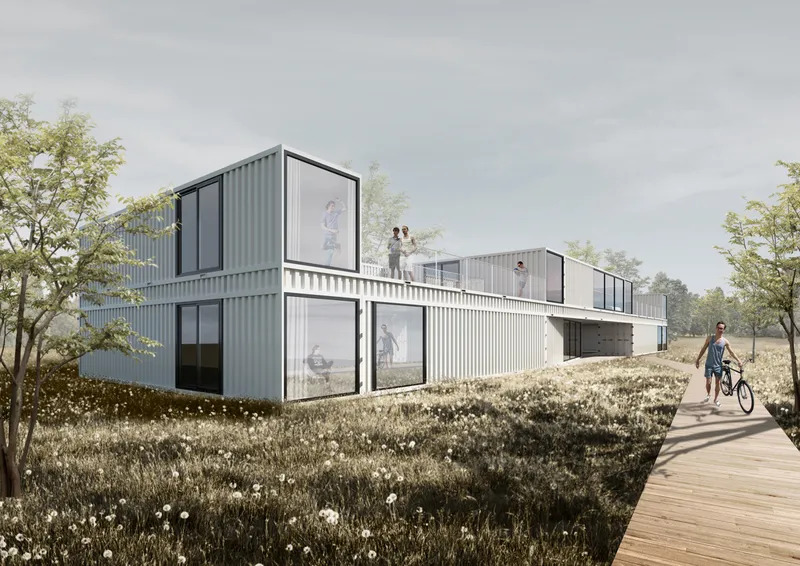
The front facade of the building is parallel to the Warta river - providing the majority of the apartments a beautiful view of the river and the panorama of the city. Locating the building this way gives the best view of the building to the people approaching it.

The design process was quite complicated – I wanted the project to be easily adapted in a variety of spaces – that’s why the building has such a simple and logical structure. The building can be expanded as well, so it can be adjusted to the form of a site. It is well insulated which makes it possible to be adapted even in harsh weather conditions.

The designed structure was based on using fifteen shipping containers (size 40' x 8' x 8'6") and creating a two-storey building. There is a layer of slab and thermal insulation added between the storeys. The form of the building is almost symmetric. It has been designed to provide every apartment enough sunlight. All apartments have 2 big windows directed to different sides of the world. They both are the same size but one is a fixed window and the second one is a sliding window. There is a wooden path leading to the building. In the student housing there is a patio area, available to every student, providing a meeting space but also a quiet and intimate relaxation space.
I wanted the student housing to be adapted to the needs of people with disabilities. They can easily access every apartment on the ground floor and the common space. On the ground floor there is a large patio with benches made of containers’ trapezoidal sheets and two green areas. The surfaces of the patio are: wooden boards and concrete slabs, which makes the building’s ground floor fully accessible to wheelchair users. Apartments’ doors were designed using containers’ double doors. They are modified to be comfortable for users.

Students can access the first floor by stairs. The communication is based on wooden decks, which can also serve as common areas. There is a common space on the first floor, connected to a balcony. In summer it is possible to open the sliding doors and connect internal common space with the balcony, creating a large, open common area.
I knew that I wanted to create a very comfortable apartments, in spite of designing with very restrained conditions. The apartments had to be fully equipped enable the maximum level of personalization of the space. It was possible by designing a wall bed/sofa and a folding desk. The first arrangement gives the user free space, which he or she can use in many creative ways which require larger amount of space. The second arrangement is everyday/party space - the user can simply rest on the sofa or host a party. The third arrangement is private - working or sleeping space. The wall bed/sofa creates a comfortable, large bed and the folding desk makes an excellent working spot. In order to create cosy space I designed a wooden floor and a plywood wall, designed as a peg board – providing users with many ways of personalizing the space. The furniture was designed using black metal frames and perforated sheets.

The problem of waste is a global issue, which every country in the world is facing. Nowadays people finally start to notice it and find multiple ways of reusing everyday objects. However, we are still producing more waste than we are creatively reusing – it is still an underestimated design area and it is our duty, as designers of many disciplines, to raise awareness and show innovative design solutions based on recycled materials.

Popular Articles
Popular articles from the community


Opera on the Sea: Driftwood Logic Shapes a Timber Opera House on Estonia's Coast
Trevor Orgill's opera house translates the entangled drift of floating timber into a civic building where wood, water, and music converge.

Manzana Morphosis: Stretching Barcelona's Grid into a Living Landscape for 2050
A radical reworking of the Eixample manzana turns density into a tool for generous public space, vertical ecology, and environmental performance.
Faces of the Soviet Avant-Garde: Turning Moscow's Street Names into an Open-Air Museum
A network of sculptural installations across a Moscow residential district transforms forgotten architect names into spatial encounters with cultural memor
Opera by the Sea Estonia: Three Shells Dissolving Architecture into Tallinn's Coastline
A winning opera house proposal replaces monumental form with interconnected shells that blur the boundary between building, park and Baltic Sea.

Similar Reads
You might also enjoy these articles
The Rhythm of Seasons
A Farmers' Market Connecting Nature and the City

More Than a Building-Designing a Living System
More Than a Building-Designing a Living System
Base Beyond
DESERT COMPOUND ARID: TOURISM OF ABSENCE AND ABUNDANCE

Comments (0)
Please login or sign up to add comments
No comments yet. Be the first to comment!