
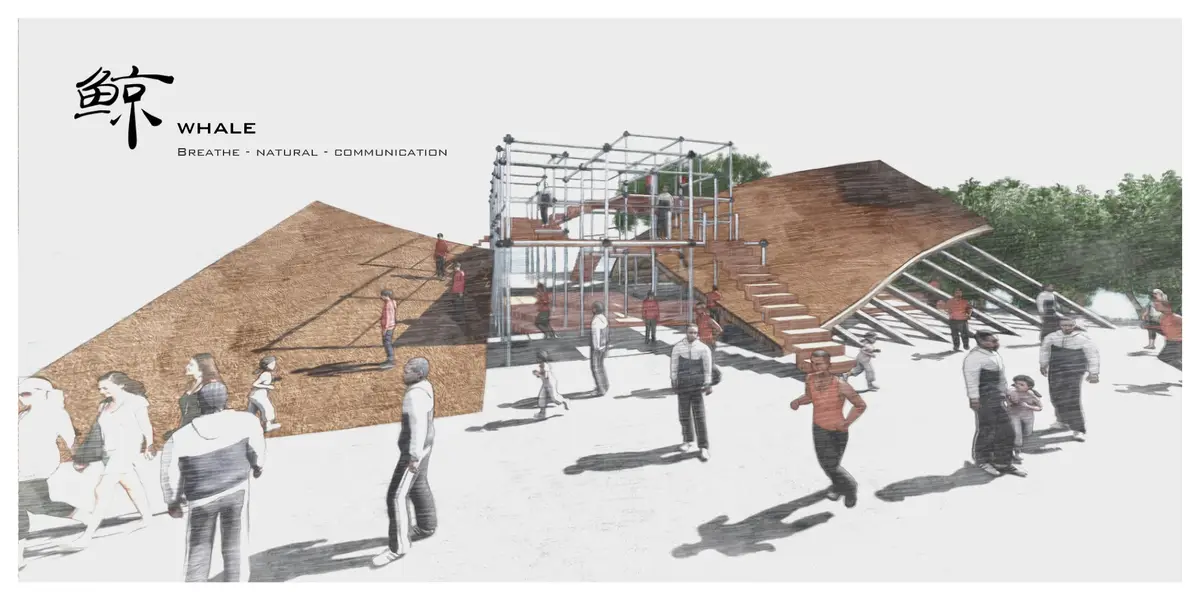
Whale
Breathe, Nature, Communication

When we first saw the topic, we hoped to break with the traditional café model and create a new operating model that would go beyond ordinary cafes.
First we thought about the function of the coffee shop. The function of a regular coffee shop is to provide a place for coffee and light meals, where people can either chat or focus on their own affairs. At the beginning of our design, we wanted our coffee shop not only to take these features into account, but also to solve real social problems and maximize the value of its existence. After our research and reading the data, we found a few of the most want to solve the problem:
1. Economic problems of the local population. Bali is known as a famous holiday destination, with countless annual holidaymakers, numerous resorts and luxury restaurants built on the island that look thriving. But in practice, the operators of these premises are generally not locals, and the economic situation of the local Indigenous people is still not very good. After investigation, the local production of coffee beans in Bali, so we want to improve the economic problems of the First Nations through a new way of selling.
2. Communication between people. The communication here is not limited to the exchange between tourists and tourists, but also extends to the exchange between tourists and indigenous peoples, and even between different faiths and peoples.
Local environmental issues. As we all know, because Bali has been a tourist destination for a long time, countless tourists have been here for decades, the annual garbage is innumerable, and even now there are some coastal areas because of too much garbage has become uninhabitable and visitable. If the government organizes special people to clean up, it will be a huge financial expense, so we want to help clean up the garbage on the shore through some public welfare activities.
To this end, we change our mind and define the café as a place where events take place, and all space designs are designed to facilitate events that take place in this building. So we abandoned the traditional coffee buying and selling model, and instead of offering good coffee directly, visitors bought beans in an Aboriginal-led market around the building and then went into the café to make coffee for the waiters, so that Aboriginal people could increase their income by selling coffee beans and visitors could drink quality coffee. It also increases communication between First Nations and visitors. In addition to the grinding of coffee beans and coffee production can also choose to pay others to make, or choose to make their own. We have a wide production desk on the first floor of the café where people can make coffee, and by making coffee, people can teach each other the experience of making and exchange coffee-related topics, thereby increasing the exchange between tourists. In addition to a fixed large operator's station, the space in the café is very flexible, people can choose according to their own needs to use the space, or even create their own space.
In addition to coffee-related activities, we have added a wide space in the café where we can host group events, where the café's management organizes events to attract nearby tourists and residents, who meet through the events to communicate and become friends. Due to the flexibility of the space, it can be changed to an open-air cinema, nightclub, ballroom, surf training center, etc. as interactive as needed. In addition, people can be organized to participate in public welfare activities, go to the seaside to pick up abandoned bottles to bring back, to make the café needed to block, in exchange for free coffee production opportunities. People also through such blocking production activities and public welfare activities, enhance communication.
Our emphasis on activities stems from our design experience. Prior to this we have also been involved in the design of other communication space, nothing but how to increase communication between people through reasonable space design, but through many experiments we found that reasonable space design does not necessarily increase people's willingness to communicate, but by organizing a variety of interesting activities can increase people's willingness to communicate, so how to based on cafes, and according to people's day activity itinerary, design an easier-to-use activity space, become the core concept of our design.
After defining these basic concepts, we moved on to the specific design implementation phase. Because of the pursuit of space flexibility, we chose the space construction way of shelf bonding. Traditional local architectural forms are also referenced in the design of the whole body. The choice of materials also takes into account the environmentally friendly integration of traditional local architecture, selecting thatch, soil and wood.
In the original idea, in order to increase people's participation in the event, we wanted to get visitors involved from the start in the building process and trade their work for free coffee. But for some reason, the idea had to be abandoned in several design changes, but we thought it was a very meaningful and potential idea, as was the public good of picking up bottles and making enclosures by the sea, and we hope that both ideas can be developed in the future, either in the expansion of the project or in other projects. I think it's both our regret and the future potential of the project.
Since our designs are flexible according to activities and people's usage needs, I guess over time our buildings will become more comfortable and easy to use, as our homes are, and the café functions of this management model will become more and more abundant, evolving into a cultural exchange center based on cafes.

Popular Articles
Popular articles from the community


Little Red Riding Hood: Architectural Design as a Journey Through Fear, Light, and Storytelling
Little Red Riding Hood reimagines the fairy tale through architectural design shaped by fear, light, scale, memory, uncertainty, and choice.
ALGAL REALM: A Bio-Integrated Lunar Habitat Design for Life Beyond Earth
ALGAL REALM reimagines lunar habitat design with algae-powered life support, 3D-printed regolith, and vertical living for a lunar future.

The Musturak Paradise: Senior Living Architecture for a Connected Future in Temara, Morocco
The Musturak Paradise reimagines senior living architecture in Temara via private homes, social spaces, culture, community, and shared care.

Co-life: Sustainable Architecture for Age-Friendly Community Living
Co-life reimagines sustainable architecture for seniors through courtyards, rammed earth, shared gardens, and spaces designed for belonging.

Similar Reads
You might also enjoy these articles

Day and Night Park: A Time-Based Urban Newsstand in Beijing
A temporary urban newsstand in Beijing blending travel, light, and reading through poetic colors, compact form, and community-focused design.

Modernist Patio Renovation in El Masnou, Barcelona by Oliver Segura Arquitectura + Cebrià Arquitectura
Modernist patio renovation blending tradition and innovation with a movable pool, leveled floors, and Catalan materials in El Masnou.

Alto Residencial Coop: Cooperative Housing Development in Santiago de Compostela by Carbajo Barrios Arquitectos
A linear cooperative housing complex blending white volumes and perforated metal façades, enhancing community living, natural light, privacy, and urban integration.

Vil Genis School by BPA ARCHITECTURE – Massy, France
Vil Genis School in Massy, France, features sustainable design, south-facing classrooms, community integration, accessible spaces, and modern educational architecture.

Comments (0)
Please login or sign up to add comments
No comments yet. Be the first to comment!