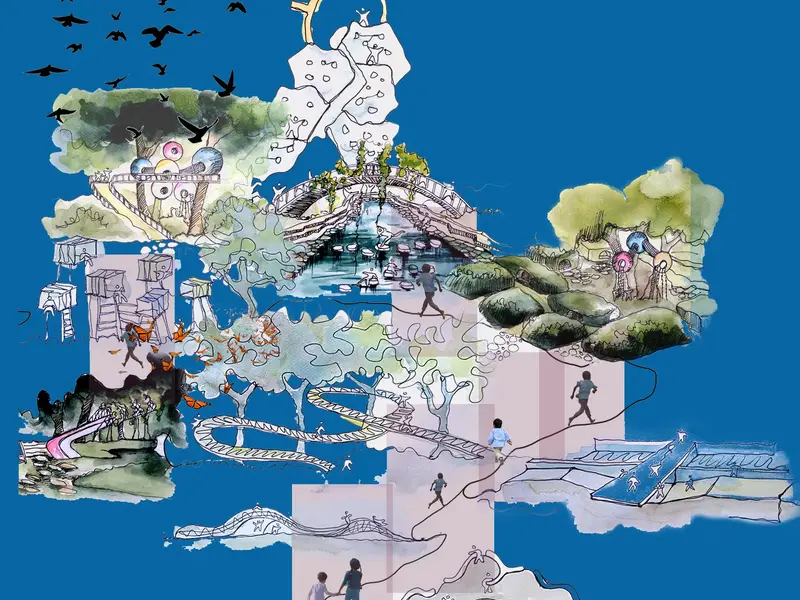
ARCHITECTUE FOR CHILDREN: ARTICULATING ARCHITECTURE WITH RESPECT TO THE NEEDS OF THE CHIL
“Children are a kind of indicator species. If we can build a successful city for children, we will have a successful city for all people.” Enrique Peñalosa, Mayor of Bogotá” Children’s environment has a great impact on their physical and mental development. Child oriented urban planning celebrates inclusivity as it is more than just designing parks and playgrounds for children. Despite the fact that by 2030, around 60% of the world population will be minors, little or no efforts are put in by the designers, architects, urban planners, city developers to design child friendly cities. Even in Pakistan spaces lack creativity and a child-oriented approach, resulting in insensitive and boring places. Due to lack of creative spaces, children spend more time indoors, affecting their emotional and physical well-being. COVID scenarios further aggravated the situation, making children habitual of staying indoors and spending hours glued to their mobile phones or tv screens. Besides hampering their physical strength, the continuous use of screens affects the mental development as well. When cities are designed keeping in mind mostly adults, as the stakeholders, the spaces become only functional.


Similar Publications
Discover more publications you might be interested in

The illusion of minimalism

Earth Side: Between the Ground and the Returning Body

Fostering Human-Bird Connection:Exploring Architecture as a Catalyst for Bird Conservation

MELANGE -RECREATION CENTER

architecture portfolio 2025

THE OASIS BIOME: A REGENERATIVE AGROECOSYSTEM
Explore Play Area Competitions
Discover active competitions in this discipline


Challenge to reimagine the Iron Throne

Photograph architecture without architects

Illustrate the lost glory of Angkor Wat - Render Challenge

Design challenge to reuse E-waste
Comments (0)
Please login or sign up to add comments
No comments yet. Be the first to comment!