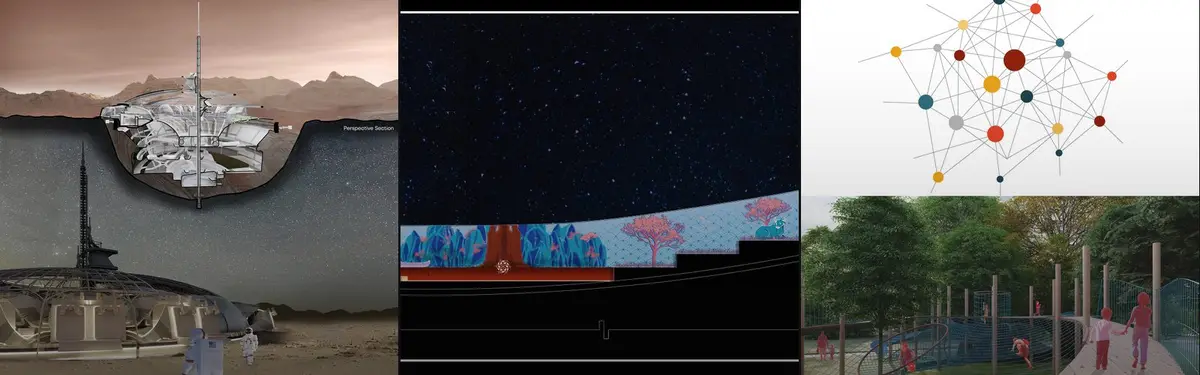

Computational Design
SKLUsing algorithms, parametric tools, and data-driven processes to generate and optimize architectural and design solutions.




Historically, designers were primarily guided by their experience and knowledge to resolve design problems. However, in a digitally powered world, we have more information at our disposal - information that can be built upon and used to enrich intelligent design processes. It has substantially modified the way that human beings have been able to technology into various areas of life including in architecture. The earliest example of parametric design is the Sagrada Familia, where Antonio Gaudi applied advanced mathematics and physics to the Sagrada Familia (1882-present) and created an extraordinary specimen of design. Img 1: Computational analysis of Sagrada Familia columns Computational design or parametric architecture/design is the application of algorithmic languages to the design process. It can be used for designing and calculating complex tasks. In the 21st century, the use of computers has proliferated physical forms, but also for behaviors, interactions and all other types of artificial products. Classical design — activities that pertain to the design of objects we use in the physical world; Design thinking — activities that enable companies to put the user at the center of every design decision and to create innovative products focused on human wants and needs; Computation design — activities involving processors, sensors, memories, actuators, data and networks. The main goal is not necessarily to document final results, but rather to help designers during creation by enabling them to define, test or search for solutions using a programming language. Computational design is thus an upcoming creative field that draws upon algorithms to develop and/or design building typologies like housing, commercial buildings, urban design, public architecture etc using specific computer software programs. How does computational design work? Computational design is a paradigm shift in our thinking and working. It will eventually touch every aspect of the AEC business, and some have dubbed it the "defining moment" of this decade. While the definition of computational design is still being developed, experts describe it as an algorithmic problem-solving process that employs digital capabilities to set values and generate solutions. Fundamentally, designers are used to working with drawing tools like Sketch, Rhino and 3D Studio to materialize their ideas. Starting from a concept, the software helps them visualize it on screen. With the computational design, the generative process is powered by machines. Rather than drawing lines and shapes, designers have to specify all computational instructions to create the output. During the creation process, computational design involves four major steps. • Algorithms - methods to solve problems step-by-step • Decomposition - breaking a design into smaller components • Pattern recognition - finding similarities, trends, and patterns • Abstraction - focusing on what's needed to solve a problem, ignoring what's not Computational techniques have radically changed how people construct interfaces, services, objects, or buildings. The generative process is fueled by algorithms, whereas the output is not generated by humans using a drawing tool but by following instructions, variables, and parameters. Over the next few years, computational design is set to transform business, culture, and community. What are some tools and trends that offer efficiency in computational architecture/design? Computational design is experiencing numerous trends, and the pace of change and innovation in this sector of the building industry is remarkably fast. With increasingly sophisticated computing methods, more powerful tools can be incorporated into the design processes. Generative design and parametric design are two emerging trends that fall under the scope of computational design. Architecturally, generative design isn't new - there have been many tools for 3D modelling and rendering available for quite a while. Digital software, used to design buildings, requires the architect to specify variables, parameters, and constraints so that the computer can create the output as described in the input. 3D rendering tools help architects visualize the result of the parametric process. As a result of this integration, software such as Grasshopper is able to be integrated into Rhino Modeling, and the results are stunning structures. It helps the architect generate forms by using decision nodes and conditions. On the other hand, Parametric Design utilizes Programs or Parameters in the form of constraints to solve a design problem. For example, instead of designing walls using exact lengths, heights, and thicknesses, symbolic parameters are used that have specific domains. In other words, a set of walls is represented symbolically. It is typically used in BIM tools and refers to the concept of a family/object that describes sets of building elements. Architecture Competitions Computation-based approaches in design have emerged in the last decades and rapidly became popular among architects and other designers. In today’s world the need to solve issues has been constant - while architects apply relevant design thinking to offer solutions - emerging tools and technology are helping to resolve issues faster and more efficiently. While these tools and knowledge about it are accessible in a few parts of the world, they are still inaccessible in many. Architectural/design competitions thus offer an opportunity to explore these tools by collaborating with various software companies. They are a great way to find creative design enthusiasts who not only have the relevant skills for designing and developing computational projects but who provides a platform to share visions regarding the problems affecting our society today. UNI Design Competitions UNI is a global network of architects and designers who are solving some of the most challenging problems around the globe. UNI brings together the world's largest pool of design challenges that are curated by the finest architecture academicians and professionals globally. Since 2017, UNI has hosted more than 200+ architecture competitions for various idea level to realization level briefs. In the past, UNI has helped 50+ organizations, universities, and government bodies to use our platform to generate architecture and design solutions through competitions. Explore current challenges that explore Computational design: Discover other competitions: https://uni.xyz/competitions n