
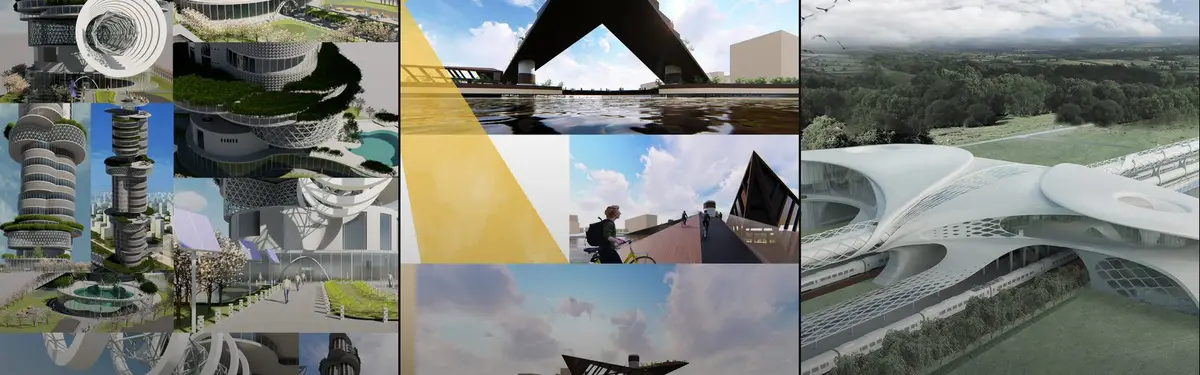

Transportation
Design and architecture projects addressing mobility, infrastructure, and transit systems within urban environments.
2Transportation refers to the movement of people and goods from one place to another. We have been transporting ourselves and our needs for centuries due to the evolutionary gift of mobility. Through advances in technology, people are able to travel farther, explore more territory, and exert influence over a wider geographical area. Transport has always influenced occupations, living conditions, conflicts, and eventually cultural exchange. By applying new inventions and discoveries to transportation problems over time, travel times decreased and the ability to move more and larger loads and resources increased. The development of transportation has revolutionized urban environments - work, travel, and daily life. Transport networks remain one of the most critical tools a country can rely on even today. People are attracted to cities/areas by the promise of jobs, prosperity, faster travel, and a higher quality of life - the world is more connected than ever. However, this attraction has also created problems of overpopulation, traffic congestion, air pollution, and other issues that have put increasing pressure on our urban environments. Transit design and architecture thus focuses on upgrading transport networks or on creating sustainable/innovative and faster means of travel. Img 1: Vehicles for various modes of transport over the years (Authors: Larousse, Pierre, 1817-1875)Importance and impact of transport infrastructureThe major modes of transport developed by humans over time were: Land, Water and Air. Land includes the most extensive transport means of roads and rails, while water and air help us with political, social and economic relations and have given us the opportunity to explore the world much faster. Public transport has been a very crucial part of enabling cities and urban design. The ability to scale cities while maintaining the quality of spanning them makes them a vital element in any urban environment. Road terminals, stations, docks, and air terminals are major transportation facilities that may be found throughout every city to aid in the better utilisation of these systems. These infrastructures have a huge network of transit means where the human population meets, arrives or departs. Img 2: All transport systems must be efficiently connected for better urban environments (Credits-Shutterstock)In the case of passenger transportation, terminals integrate many modes to allow riders who are switching between modes to benefit from each mode's advantages. For example, connect airports to city centres and suburbs. Automobiles utilise parking lots as terminals. Although some cargo is delivered directly from the place of production to the point of usage, terminals serve as transhipment points for freight. Due to the heavy reliance on such systems for mobility bad/good transport infrastructure changes the identity of a region. It either gives them resources and economic gains or contributes to ill-managed urban systems with congested roads and leads to poor development of other architectural typologies like housing, commercial buildings, industrial sector etc.Due to the associated adverse effects, transportation is often controversial in terms of modal choice and capacity increase. Travelling by car can be seen as a tragedy for communities where personal flexibility and comfort deteriorate the natural and urban environment of all. The density of buildings depends on the means of transportation, and public transportation allows for better space utilization. Good land use keeps general activities close to people's homes and places higher-density developments near transport routes and hubs to minimize the need for transport. But in case of bad land use/illegal construction transport systems can be disastrous. Transportation facilities consume the land, and in cities, pavement (for roads and parking lots) can easily exceed 20% of total land use - hence developing an efficient transportation system can reduce land waste and reduce pressure on the city infrastructure. It is only in recent years that rapidly growing urbanization is being questioned, as a result of urban analysis which brings a much broader range of skills than those traditionally relied on—spanning such areas as environmental impact analysis, public health, sociology, and economics. Img 3: ‘The Green Link’ winner for Hyperlocal - Re-imagining infrastructure for Mumbai locals Therefore, the future of transport systems not only relies on new cutting edge advancements but rather on strategies for improving the existing ones. Future of transportation in cities/globally The result of this mass adoption of personal vehicles, and the increased use of general transportation, has resulted in pollution and urban congestion. Both of these are unsustainable for the benefit of the planet and the health and well-being of people. Transportation is one of the largest sources of greenhouse gas emissions, accounting for 70% of total domestic oil consumption. Therefore, in the next decade, transportation will revolutionize with radical new inventions powered by renewable energy to address pollution and congestion concerns. Fuels and engines are as important to transportation design as efficient infrastructure. To change the future, the micro factors of net-zero transport systems also need to evolve.• FuelsPetroleum has been used as the primary fuel for automobiles since the 1860s, but its climate impact makes the need to find alternative renewable energy sources urgent today. Battery-powered electric vehicles, on the other hand, are in fashion now, but there are still loopholes in terms of excessive energy consumption and accessibility.Biogas and hydrogen are solid alternatives and offer revolutionary possibilities. Biogas provides an off-the-shelf solution for heavy-duty and long-haul vehicles, which will also be a "stepping stone" in the transition to hydrogen, as its infrastructure is adaptable in future. Hydrogen has the potential and is ecologically an ideal fuel. The current challenge for large-scale hydrogen is producing hydrogen in a form that can be used for transport.• Automated VehiclesAudiovisual vehicles combined with artificial intelligence (AI) will bring a future of convenience and comfort in future transportation. Public vehicles powered by advanced algorithms will pick up people travelling in the same direction. In the future, robotic vehicles will likely be completely different from the hands-free/big-screen versions we've come to expect. Img 4: AI and automated vehicles are a part of future transportation (Credits: https://towardsai.net/p/ethics/the-ethics-of-ai-and-autonomous-vehicle)• Super-sonic speedsThe introduction of life-enhancing innovations while being accountable for their impact has worked wonders. In July 2012, several companies announced their vision for a new transportation system, "Hyperloop" by 2030. Said to be safer than cars, faster than trains and less harmful to the environment than aeroplanes, hyperloop technology is rapidly evolving.Considered the biggest and fastest breakthrough of the 21st century, it challenges all modes of transport in a race against time. It is considered the most sustainable means of transport that can reduce the carbon emissions of flights by 58%. Besides low impact and reduced travel time, the hyperloop is expected to solve the housing crisis. It can allow people to live in the suburbs due to rapid travel and thus reduce pressure on cities and residents.Img 5: Virgin Hyperloop - a concept (Credits: https://virginhyperloop.com/)Architecture competitions Due to the problems of urban overcrowding and the need for faster transport services, the world's transport systems are trying to stay ahead of the crowd. Companies are introducing faster ways and innovations to travel every year. Transport modes such as smart roads, self-driving helicopters, elevated bike paths and bullet trains are upcoming technologies that will change the way transportation systems work in urban areas.Although making room for future innovation is on the move, existing transport infrastructure in major cities is overloaded. Cities are facing an overhaul due to congestion and haphazard urban development. The urgency to change these systems demands an equal amount of attention. How can we as urban designers and architects help balance and solve current issues as well as plan for the future? Img 6: “VERTI-PARK” Jury commendation for Yo Parking Architecture competitions are a great opportunity for architects to experience the possibility of pushing their limits of theirs. For students as well as professionals architectural competitions provide a platform to solve issues around the world that they wouldn't experience in general practice/academics. Curated challenges offer a collection of ideas from designers with relevant skillsets regarding the present and future problems affecting our society. For a discipline of a large magnitude like Transportation, can we take an opportunity and share our visions of a better urban future through open competitions? Explore more projects in Transportation: UNI Design CompetitionsUNI is a global network of architects and designers who are solving some of the most challenging problems around the globe. UNI brings together the world's largest pool of design challenges that are curated by the finest architecture academicians and professionals globally. Since 2017, UNI has hosted more than 200+ architecture competitions for various idea level to realization level briefs. In the past, UNI has helped 50+ organizations, universities, and government bodies to use our platform to generate architecture and design solutions through competitions.Discover other competitions: https://uni.xyz/competitions


