
Co-design Milan 2020
Design for creative minds
Overview
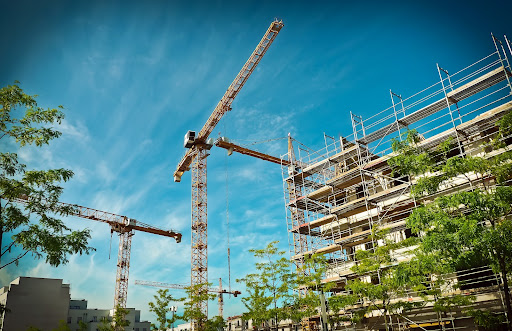
Img 1: Modern day construction site.
Premise
Buildings are often designed aspiring for their long lives. With our modern-day construction materials, the average lifespan of a building can be considered as 40-50 years. However, what happens when a building dies and what if it becomes defunct before that?
Buildings when clubbed together form a locality which in turn add up to build a city. Proper functioning of any such building becomes an asset to a city. Contrarily, a defunct building is eventually a liability to a city.
Technological boost embarks our lifestyle enhancement. With this change, if a building cannot cater to the changing need of the society, it gets abandoned even before its physical death.
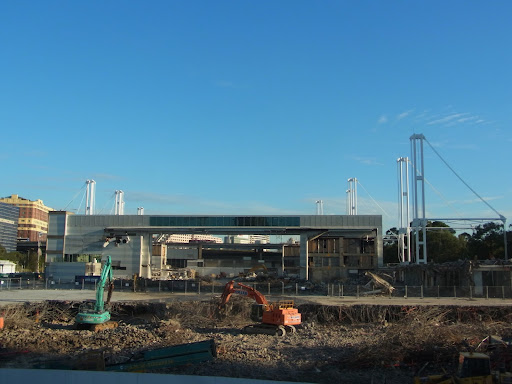
Img 2: Demolition of Sydney Convention and Exhibition Center designed by Phillip Cox in March 2014.
Co-design
Historically and even contemporarily, buildings have become obsolete as society advanced due to technology. Mills, churches, airports, stadiums, convention centers etc. became inoperative due to the same. This issue was faced globally and there are multiple ways to tackle it.
To address this issue, adaptive reuse was the most commonly adopted method. It ranged from converting deserted chapels to houses, refurbishing run-down factories for a different purpose, renovating dilapidated old theatres or opera houses for modern day uses etc. A few such examples can be found here.
In another scenario, buildings ended up being demolished when they become outdated. Such an example of a demolished building designed by Phillip Cox can be found here.
It paints a very gloomy picture suggesting that sometimes it is not the durability or ‘iconic’ design, but societal change that can lead to the demolition of a building.
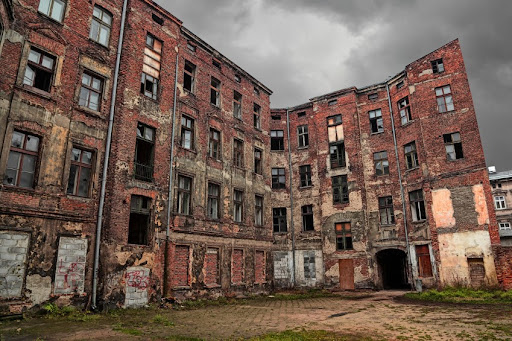
Img 3: State of abandoned buildings.
Issue
A building is constructed on the estimation of it to serve people for at least its physical cycle (approximately 50 years). But if it gets demolished before the physical death (assuming 30 years), there is a loss in this anticipated use of the building. Additionally, there is a loss of money that was put into the construction materials used. Moreover, what happens to the building material when it is torn down to debris? Should this question be answered before we start building?
With technology advancing exponentially, our building strategies are becoming inefficient to cater to the pace of changing needs. Thus, buildings are becoming incompetent in a shorter duration of time than ever before.
Is there a need to reflect on the way we’re thinking and designing buildings?
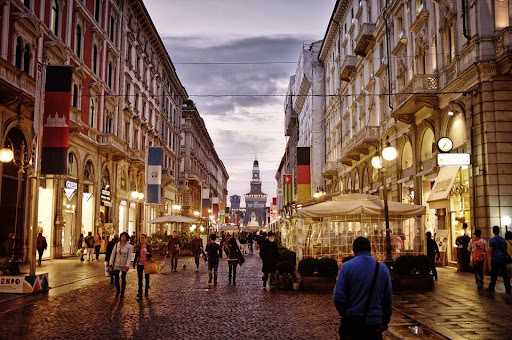
Img 4: Shopping Street in Milan.
Tale of Milan
Milan is considered as a leading alpha global city with strengths in the field of fashion, finance, art, design etc.
Post the damage caused due to allied bombing in the Second World War, Milan prospered economically and a lot of buildings especially industries came up. However after the period of high industrialization, the city was left with a large number of abandoned buildings, especially factories, compounding upto an area of 6.7 million square meters (as per Giorgio Bigatti in his book on Milan’s industrial landscape).
Milan is a hub for designers and an important economic center of Italy. It captured the heart of designers and professionals when ‘assembly line’ boomed. Later, it became one of the world’s fashion capitals in the 1980s with the international success of Milanese houses like Armani, Versace and Dolce and Gabbana. It has now become an open territory for exchange among experts, enthusiasts and amateurs alike.
Due to the high land prices found in the market areas of Milan, it becomes difficult for the young firms and freelancers to afford their own working space.
Objectives
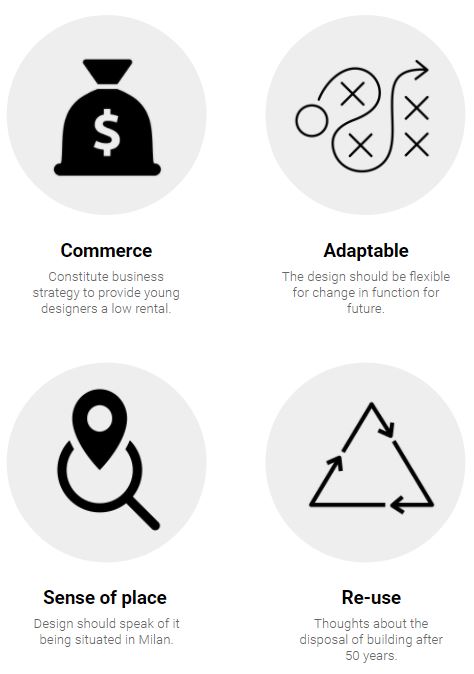
Design Brief: Propose a Designer’s Hub in CityLife, Milan that can inhabit shared studio spaces for young design firms and freelancers. (2500-3000 number of designers).
The land prices in this district are very high. Hence, if the building designed gets demolished/defunct before its physical death, it would cost a heavier financial loss to the city than any other piece of land in the city today. This challenge is an opportunity to solve the problem of outdating buildings by constructing something evolutionary for the designers by the designers.
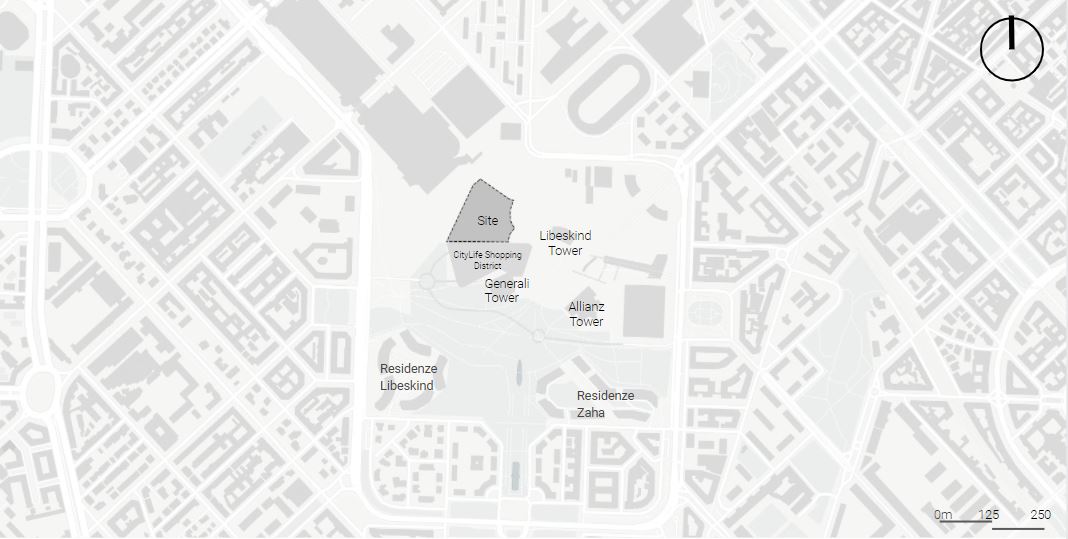
Img 5: Site Plan
CityLife - Site
CityLife is a residential, commercial and business district in Milan is situated a short distance away from the old city center of Milan. This district constitutes some fine examples of architecture displayed by celebrated architects including Zaha Hadid, Arata Isozaki and Daniel Libeskind. It is also one of the most popular shopping districts in Italy accompanied with luxurious residential towers.
- Area: 11,405 m2
- Site coordinates: 45°28'46.2"N 9°09'17.1"E
- Maximum ground coverage: 30%
- F.A.R.: 3
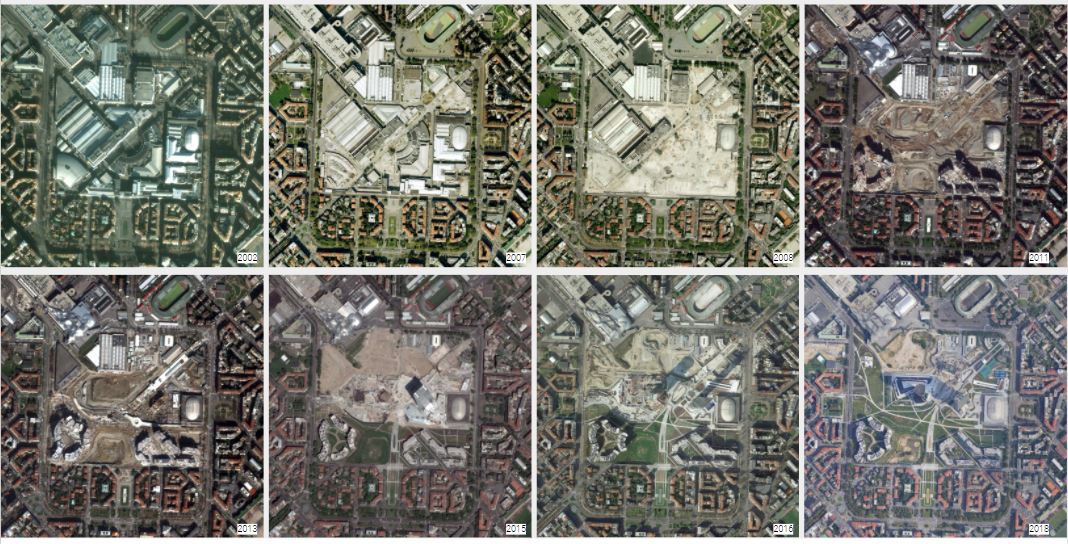
Img 6: Historical Imagery of CItyLif
CityLife - Development
Until 1923, this land was used to carry out military exercises. It was later bought be the Ente Autonomo Fiera Internazionale di Milano to carry our urban fairs and it became its headquarter until 2006. It was then shifted to the outskirts of the city and the land was up for an international tender won by CityLife with an urban regeneration project by Zaha Hadid, Daniel Libeskind and Arata Isozaki. In order to construct the same, the existing 20 exhibition halls were completely demolished as can be seen in the Historical timeline shown above.
Similar Competitions
Discover competitions you might be interested in


A Global Graduation Competition for Architecture, Urban Design & Interior Design


Aesthetic Design Ideas for a Better World · Student Category
