
Convene
Design Challenge - Contemporary interpretation of a religious complex
Overview
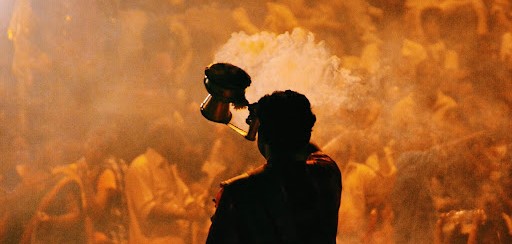 Fig: 1 - Faith is interpreted by different people in distinct ways.
PREMISE
Religion is everywhere. Whether they acknowledge it or not, there is no human society without it. The diversity in the make-up among religions is stark, but their representation is in similar forms.
There are more than 10,000 religions in the world of which Christianity, Islam, Hinduism and Buddhism are widely practised. Each of these has its own norms and tradition, but their manifestation is often produced, in the form of praying and sacred rituals.
Sacral architecture is important as it provides a space for like-minded people to come together and perform rituals, and acts of worship. From temples to mosques to churches, every structure has a unique architecture, form and layout which guides the movement and services in spaces.
Are we more alike than different?
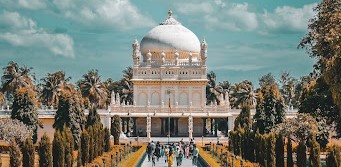 Fig: 2 - Innovation in religious architecture is rare since the designs are rooted in history and traditions.
ISSUE
The evolution of religion has occurred over the past century, where technology and scientific advancements have played a major role. This socio-cultural system is old, and outdated traditions are abandoned. But their values still hold a place of the high regard in relevance to peoples’ lives.
Every religion stresses on basic values of compassion, solidarity and respect for all human beings. This ideal is practised widely in religious buildings, as they operate as places of worship as well as a cornerstone for the social well-being of the community.
Traditional religious architecture encompasses huge, monolithic structures that create private and intimate public space inside. While modifications are seen in the external form of these structures, their layout always reflects the journey to a spiritual place. The entrance symbolising procession, proclamation in the prayer hall and communal gatherings are to be incorporated in a meticulous manner.
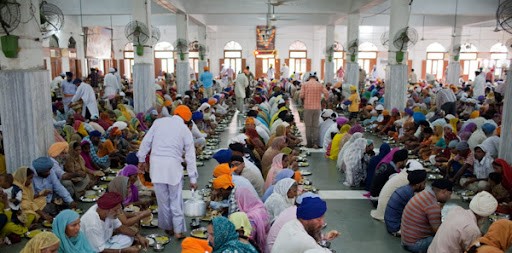 Fig: 3 - Sacral spaces gather people of similar faith under a single roof but their purpose extends beyond that. (Credits: AmritsarWorld)
BRIEF OF THE COMPETITION
The challenge is to design a contemporary temple complex that performs as a sacral space as well as a public center for social good.
A temple is a space where the Hindu religion people worship. The rituals are carried out around a statue, around which several layers are wrapped around to create a journey, physical and spiritual. The design must be a contemporary rendition of the form of a traditional Indian temple.
The complex will also function as a centre for social work such as shelter for the homeless, food distribution etc. The complex must be able to connect with people with its form and layout. The aesthetic will be an important part of the design.
The aim of the design is to challenge the notion of what a traditional temple must look like, but instead try to embed the essence of the religion in the design itself. The capacity of a religious building to work towards the social good of a community is huge, and this must be promoted in the design proposal.
OBJECTIVES
- Aesthetic: The design of the structure must be an altered version of pre-existing temples.
- Multi-functional: Spaces for communal activities must be planned for different social events.
- Harmony: The relationship of the building with context (physical and mental) must be explored.
- Context: The design must respond to the (existing) site conditions. The wider socio-cultural, economic and environmental settings are to be considered in the design approach.
GEORGE TOWN, MALAYSIA
The land of Malaysia has a diverse terrain not just geographically but also demographically as well. A large group of people in the country are Indian Malaysians with varying cultural backgrounds within. They follow Hinduism and many sacred sites are distributed all over the nation’s cities.
George Town is the capital city of the state of Penang. It has a colonial history and a multi-ethnic and diverse religious society. There is a significant population of Hindu people in the city, where they have settled around Indian landmarks.
SITE
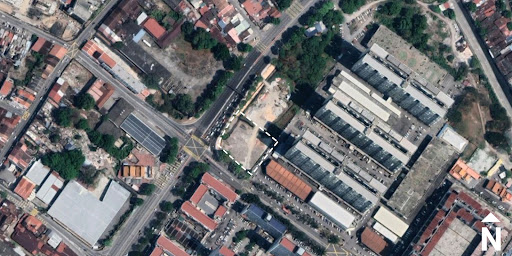
The site is located by Tun Dr. Lim Chong Eu Highway, in the mixed-use neighbourhood of Pengkalan Weld. The site is surrounded by eateries and residential settlements attracting a lot of visitors and pedestrians in the area.
- Coordinates = 5°24'28.3"N 100°19'58.5"E
- Site Area = 2911.48 sq.m
- Height Restriction = 9 metres
- Maximum FAR = 1
- Ground coverage = 30%
Setbacks (as per CAD plan)
Ground Coverage refers to the ratio of the maximum allowed solid/permanent footprint on the site to balance the built and unbuilt spaces. You can utilize the other 70% of the site for any temporary intervention/recreation.
AREA PROGRAMME
- Main praying hall ~ It must be built for a capacity of 100 visitors of 300 sq.m The spaces for darshan, mandapa and shikhara and so on must be provided.
- Exhibition hall, Outdoor Gallery ~ 200 sq.m
- Items shop ~ 100 sq.m
- Administration offices ~ 100 sq.m
- Courtyard, Garden spaces and other open areas
- Parking and Services
