
On the way
Design challenge for rest opportunities for heavy vehicle drivers
Overview
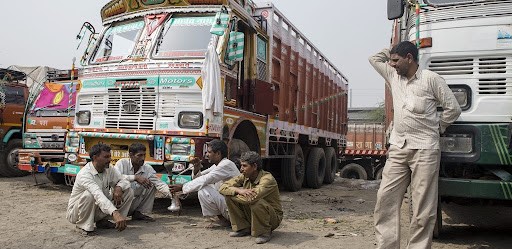 Fig: 1 - Truck drivers gathered around their trucks during their leisure time. (Credits: Sightsavers)
TRADE AND TRUCK TRANSPORTATION
Even today, nearly 67% of India’s trade and transportation relies heavily on land transportation via trucks.
The drivers of these large vehicles transverse the nation on its highways delivering goods between different locations. Spending days away from their homes and families, they tend to drive long hours on even longer roads with little to no rest. These lengthy journeys are further made difficult with the lack of rest infrastructure for these drivers.
They spend hours of the day and night travelling, stopping only occasionally for meals or to stretch their legs at small roadside establishments. Moreover, the lack of space for rest means that most drivers sleep in their vehicles.
In a country that depends on these drivers for trade and transportation, can we design opportunities that allow these essential workers to rest and recuperate, thereby easing their journeys?
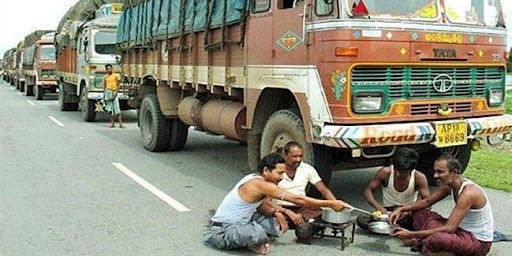 Fig: 2 - Most of the time, truck drivers end up eating at dhabas or on road sides due to lack of hygienic eating places on truck routes. (Credits: Quora, Inc. 2021)
JOURNEY ON THE ROAD
While being essential to trade and transportation nearly 84% of truckers are dissatisfied with their profession primarily owing to the lack of security and safety amenities on the roads. The most abundantly available recourse to these drivers is ‘Dhabas’ (roadside eateries) that are usually small spaces run on modest economical means. With time some of these dhabas expand and grow but they also begin to cater to higher economic strata. Since most drivers come from humble backgrounds it is thus important to create cost-effective solutions that welcome them.
Another challenge is the various ways in which rest manifests for these drivers who tend to travel for a variety of distances in a range of different time constraints. Rest for these drivers comes in three primary modalities - Pit stops, for quick breaks and relief; Stops for Meals, and finally stops to sleep. All 3 cases are essential to ease the journey yet few spaces allow for all three activities, in the specific economic niche.
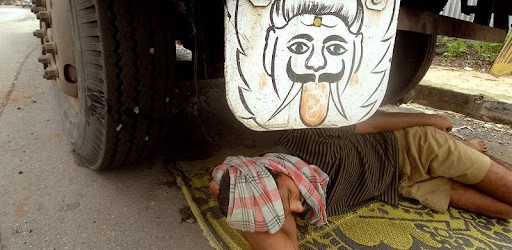 Fig: 3 - There are very minimal rest stop options for truck drivers on the go, and they end up sleeping at roadside eateries or in their own trucks. (Credits: Team-BHP)
REST STOP FOR TRUCKERS
Today this cumbersome lifestyle means that fewer individuals are drawn to the profession. Yet as a nation India continues to rely on them for a majority of its trade and transportation needs.
It thus becomes important to consider opportunities that we can design to help make these journeys easier.
Brief: The architecture competition brief calls for a design of a rest stop for about 100 truck drivers on Indian Highways.
The rest stop must be able to provide 3 different degrees of rest to its stakeholders:
- It must allow quick pitstops for relief and refreshing oneself.
- It must allow for spaces to share and consume meals.
- It must allow spaces for sleep and longer rests.
Most importantly the design outcome must allow for these opportunities in a cost-effective way.
OBJECTIVES
Design: The outcome must display your novel design approach in a clear and legible way.
Cost-effective: The design outcome in its materiality and design must be cost-effective.
Modular: The design should be able to adapt to changing needs of its users.
Robust: The design should be able to sustain through adversity and require little or cost-effective maintenance.
SITE

The site for this project is located on National Highway 544, a 340-kilometre-long National Highway in South India connecting Salem in Tamil Nadu to the city of Kochi in Kerala. The chosen area is located in Kannadi-Kerala. Surrounding land is sporadically used for agriculture and there is a Renault service store and a few other smaller establishments in the area.
The designed outcome should employ elements that can be easily replicated around the country if and when needed.
- Site Area: 2,202 sq.m
- Height Restriction: 8 meters
- Maximum Built Up Area: 2,202 sq.m
- Ground Coverage: 50%
- Coordinates: 10°44'17.2"N 76°37'30.3"E
Similar Competitions
Discover competitions you might be interested in




Healing places through music.


The Global Benchmark for Architecture Dissertation Awards
