Prima Facie
Digital facade design for our cities’ urban fronts
OVERVIEW
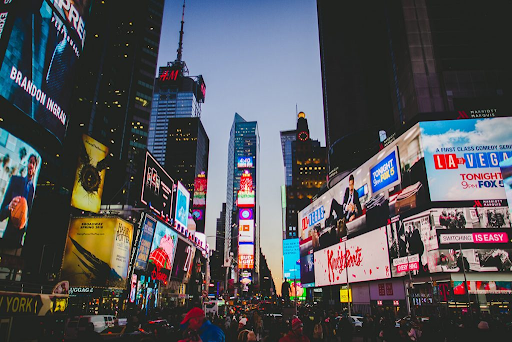
Img 1: Times Square, one of the world’s major hubs of trade centres with media facades. Source
Premise
The current age is one that operates connected to the spheres of media, communication and advertising and is vastly impacted by it. A fast paced life: both professional and personal, and the dynamic, ever mobile nature of our day has lead to us being exposed to these media outlets like never before. Quite simply, people don’t have the same kind of time to pay heed to telecasted digital media if it’s not on the go even as the world undergoes a digital revolution.
Digital facades on buildings then become an attractive way to grab eyeballs on a magnificent scale: the building becomes the canvas and sophisticated technologies allow for impactful narratives to be effortlessly relayed on to a huge audience, multiplying the intended user group and the media’s message manifold.
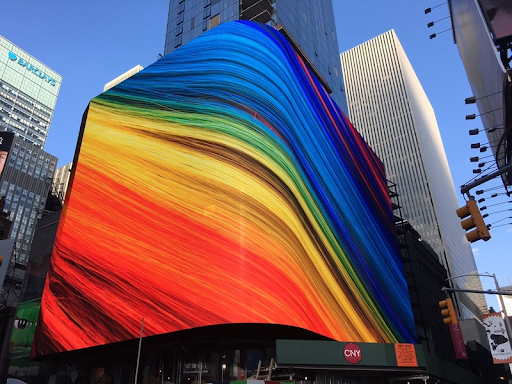
Img 2: Wrap-around LED on a building at the Times Square, currently the highest-resolution display in the history of the Square Source
The Many Faces of Digital Facades
In many famous cases across the world, digital façades become the very identity of the building, where they are used for public announcements, to show solidarity with a world event, for celebration of festivals, or simply to issue a message in public interest. Given the right location, they can act as wonderful activators of an urban space, instilling it with ever bustling movement. Further, used rightly, a robustly told narrative through visual aid can be among the best tools there are for mass awareness.
However, as with any sophisticated piece of technology on that scale, there are certain drawbacks associated with their usage, including the high demands for maintenance and its operation. Their usage therefore remains limited to metro cities and corporate high rise towers.
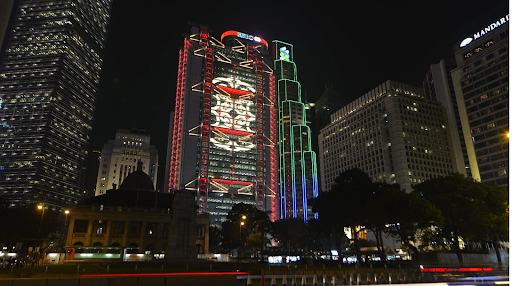
Img 3: The HSBC Building in Hong Kong by Norman Foster. The building received a lighting facelift when its media facade was installed inkeeping with the dynamism of Hong Kong’s skyline in 2015. Source
Issue
Digital facades can simultaneously act as a façade lighting, a piece of art, a surface for advertising and even a jumbotron. They present an unprecedented opportunity for cosmetic refurbishment of a number of buildings and most of the glass skyscrapers dotting major metropolitan cities. Buildings that affront expanses of public space on the ground, but don’t necessarily speak to them. While the multi-coloured light language of many such installations may give off a playful impression, the transformative effect it can have on its immediate local context is invariably important and noteworthy.
Furthermore, a number of buildings with even remarkable facades lose their sense of attraction post sundown, and fall into the diurnal cycle of activation only during work hours.
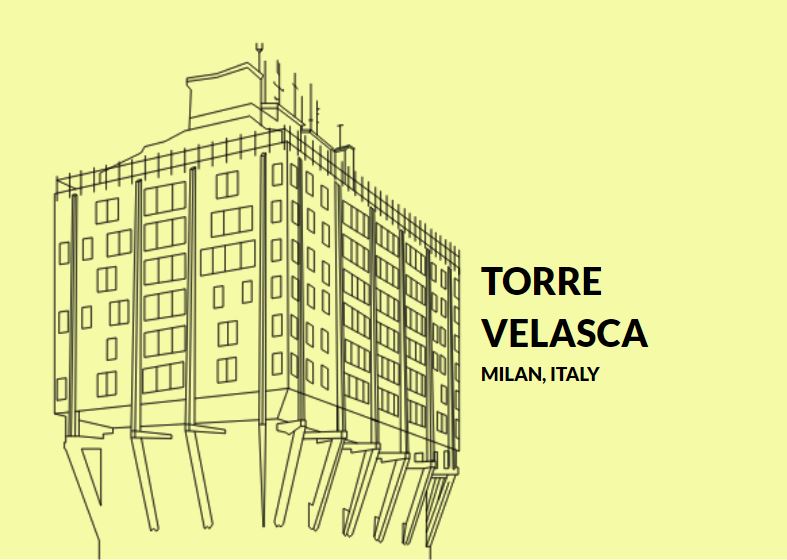
Img 4: A representative image of the area of intervention on the facade of the Torra Velasco in Milan, Italy.
Brief of the competition
The challenge is to design a digital façade on the given building (The Torra Velasca, Milan, Italy) to act as an activator, for itself and the immediate surrounding, and to add an additional layer of dynamism and post operation-hours utility to the building.
The façade must look to utilise innovative details for it to be applied on an existing building while also taking into account the building’s usage during day time. A narrative must guide the design, preferably to be telecasted on the facade itself, which can be derived either from the local context of the building or a relevant social message. Details of the building and the fraction of area to be occupied on its existing facade by the intervention are stated in further slides.
An important distinction that needs to be borne in mind is between a media façade and devices designed specifically and only for advertising, like LCD screens mounted on buildings. The former is always a permanent part of the architecture and its primary function is architectural.
Objectives
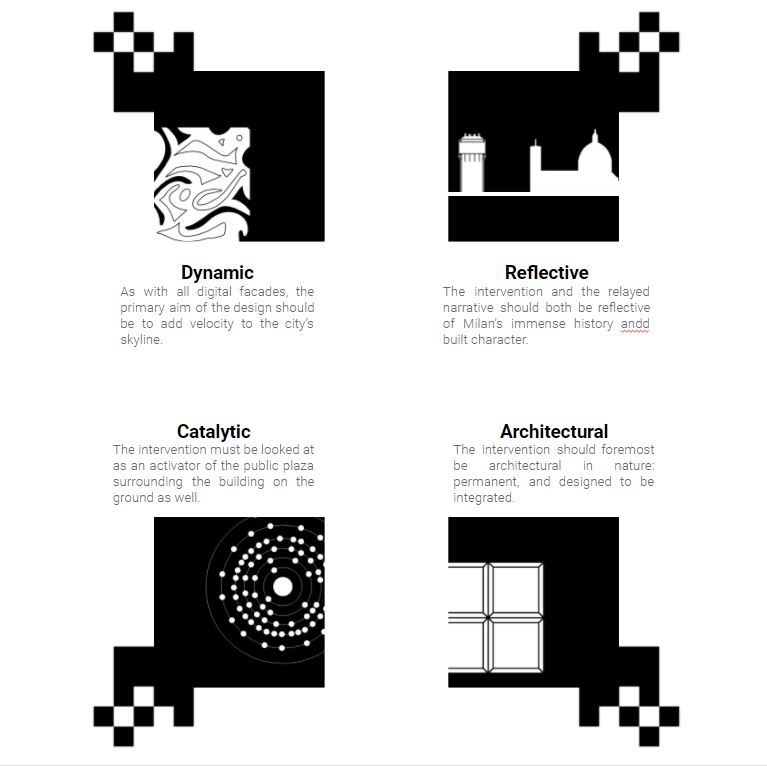
The above are the more qualitative aspects that the design of the digital facade must satisfy, and can be a beginning point for participants to conceive their design.
Design Outcome
Apart from the “soft” objectives denoted previously, the design of the digital facade must be carried out in two layers. While the first is expected to be delivered through drawings, while the second may be represented through renderings, visualisations and such.
Design of the Digital Facade
- The type, size and location of panels to be fitted to constitute all (or part) of the facade of the building
- Conceptual understanding of the physical structure of the media facade in relation to the existing facade of the building.
- The impact the digital facade has on the existing facia of the building, and how the former responds to the latter, especially considering that the digital facade would be used only after sundown. Eg: Dichroic Panels that can be used during both times.
- The usage of alternative energy sources involving minimum interference with the existing infrastructure of the building. Example: solar absorbent digital display panels. (No details expected in the scope of the competition)
Narrative of the Digital Facade
- The visual narrative, moving or static to be telecasted on the digital facade. This could be reflective of culture, context, a prevailing issue, or anything that adds value to the overall visual morphology of the city. This can be designed in any form as indicated earlier: patterns, still images, motion art, a slideshow: anything that is visually engaging and meaningful.
- It must be borne in mind that the primary function of the digital facade to be designed isn’t advertising, but they may occasionally be used so.
- The conformity and relationship between the narrative and the design of the existing facade of the building, i.e. if the facade is designed to cover only parts of the building’s facade, the narrative must be designed based on that.
- Suitability of the narrative and digital facade for public announcements.
Milan
Milan is a city in Northern Italy, the capital of Lombardy and the second most populous city in Italy after Rome. Milan is the conduit of several cultural pursuits not only in Italy, but in all of Europe and the world. It is often regarded as an alpha hub for art, commerce, design, education, entertainment, fashion, finance, healthcare, media, services, research and tourism. Milan has a continuous built albeit mostly low rise morphology, and as a city, it stands at the precipice of several renaissance era buildings, as well as modern buildings carving their own identity in its newly formed business and commercial hubs.
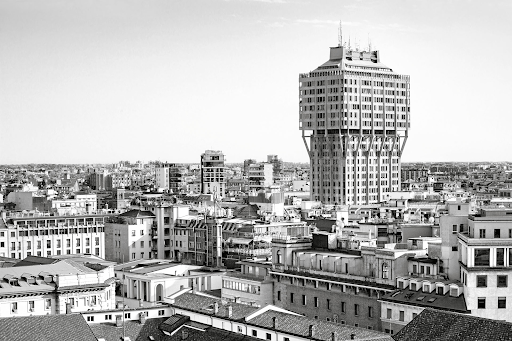
Img 5: The Torre Velasca standing out from Milan’s skyline. Source
Torre Velasca
The site for the intervention is an iconic building standing out among Milan’s skyline, Torre Velasca, a skyscraper commissioned in the 1950s, designed by the BBPR Architectural partnership. The tower was born at the precipice of the first generation of Italian modern architecture, while also attempting to stay true to the traditions of Lombard fortresses and tower. They were characterised by massive profiles, narrower at the bottom, and enlarged at the top, supported by wooden or stone beams, and that is what the Torre Velasca tries to emulate. The result was a building that polarises onlookers and critics to this day, with some claiming it as striking a fine balance between traditional and modern architecture, while others claiming it to be an eyesore standing out in Milan’s skyline that is otherwise dotted with domes and pitched roofs. Regardless, Torre Velasca was placed under protection as a historic building in 2011.
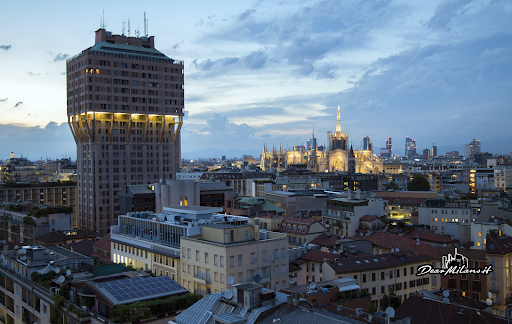
Img 6: The Torre Velasca and the Duomo di Milano highlighting the skyline of Milan. Source
Torre Velasca: Today
Torre Velasca was initially designed as a mixed use building, housing both offices and mid range to luxury apartments, and retail on the lower floors. In all, Torre Velasca comprises over 20,000 square meters of office, multifamily and retail space. As of today, the protected building was acquired by an international real estate investment firm, who will undertake a “modernisation” program to transform the tower into a high-quality office-led, mixed-use scheme. This presents an interesting opportunity for a cosmetic refurbishment of the iconic building, one that can also contribute to the urban edifice of Milan.
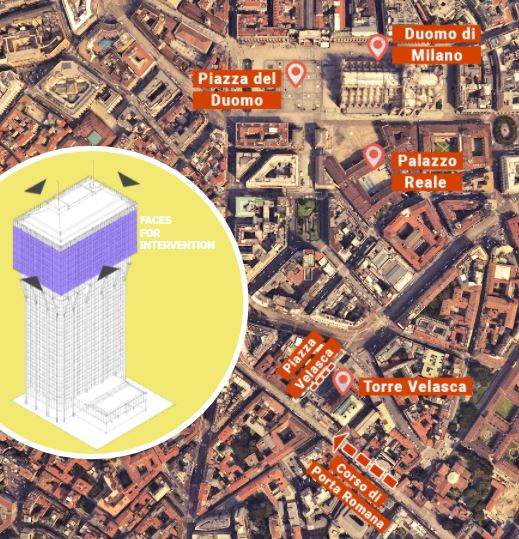
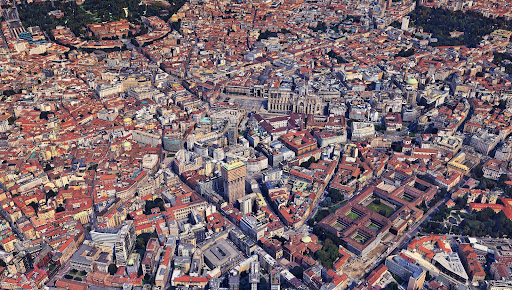
Img 7: Aerial View of the Site.
Site Plan
The Torre Velasca is located on the historic Piazza Velasca in the heart of the city’s historic central business district, close to the world famous Duomo di Milano cathedral. For the purpose of this competition, please note that only the enlarged portion of the Torre Velasca (highlighted in the diagram above) is to be considered.
Surface Area of the faces for designing the Digital Facade: 3430.2 sq.m.
Only restriction to be followed: The vertical edge of the digital facade must not be more than 600mm from the facade of the existing building. The detailed model of this building is available in additional resources folder (details on page12).
About Swift
Swift serves as a unit block for UNI in the field of transient architecture realm. It intends to break the fusion of traditional design barriers and methodologies by making it a platform for experimentation and conceptual exchange of ideas in modular, transient and mobile architecture. It is a research initiative dedicated to provide opportunities for designers from all domains to explore ideas that go beyond the boundaries of the discipline and enrich our built environment holistically; thereby opening up possibilities for promotion of temporal architecture thought at a global level.
Queries: support@uni.xyz
Discover other competitions: https://uni.xyz/competitions
Facebook: https://www.facebook.com/unixyzglobal/
Instagram: https://www.instagram.com/uni.xyz/
Discover FAQ’s about this competition on our help forum here: https://help.uni.xyz/