

School Of Thought
School that redefines learning
OVERVIEW
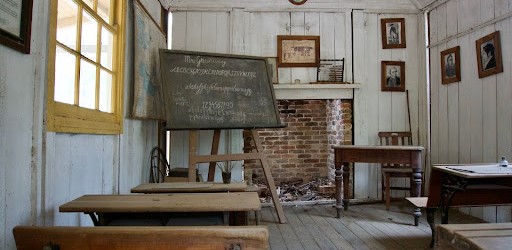
Fig: 1 - Education from a blackboard and books inside a room
EDUCATION BEFORE DECADES
Education is a form of absorbing and inculcating knowledge, of which learning is an integral part. Over the years, education has evolved into a system and has been organized and re-written innumerable times to a point where it has now it is majorly constrained to classroom teaching focused on academic learning.
The idea of hands-on experience and vocational training is still not a vital part of the curriculum for the majority of schools and educational systems around the world. The ability of self-learning and creative thinking is automatically curbed due to this method of teaching, making education not at par with the current requirements set.
Reports from McKinsey, show that by 2030 the need for cognitive, technological, social and emotional skills is growing, while physical, manual and basic cognitive skills will decline.
Is the curriculum and physical environment of school preparing the children for this?
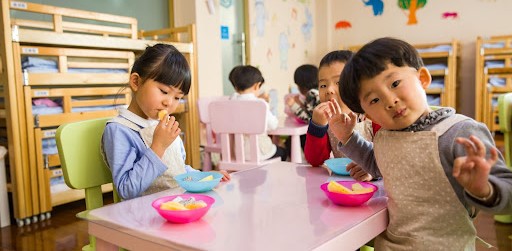 Fig: 2 - Learning from classroom surroundings
REGGIO EMILIA APPROACH
In order to impart knowledge, education has inevitably inclined towards academic gain rather than applicative skills and knowledge. One of the few different pedagogy techniques that developed after World War Two, along with great economic and social development in Italy was the Reggio Emilia approach.
The Reggio Emilia approach is an educational philosophy that is focused on preschool and primary education. It is a pedagogy described as student-centred and constructivist that uses self-directed, experiential learning in relationship-driven environments. The program is based on the principles of respect, responsibility, and community through exploration and discovery through a self-guided curriculum.
At its core is the assumption that children form their own personalities during the early years of development and are endowed with "a hundred languages", through which they can express their ideas. The aim of the Reggio approach is to teach how to use these symbolic languages (e.g., painting, sculpting, drama) in everyday life.
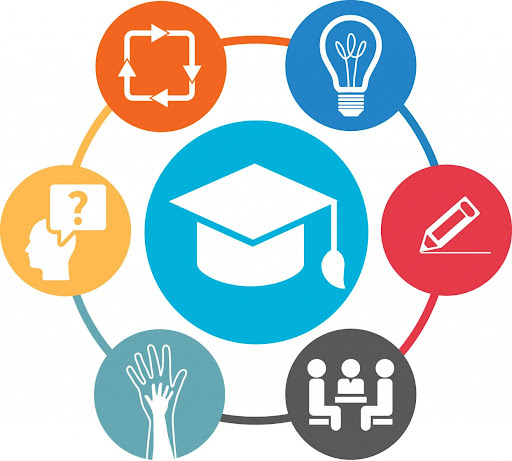
Fig: 3 - Six Things to improve learning
ENVIRONMENT MAKES BETTER LEARNING
Taking insights from the Reggio Emilia technique of education, curated along with a curriculum that inculcates vocational training and skill development as a part of the educational system, a new form of pedagogy can be devised.
To address the transition in the curriculum from only academic oriented learning to one that infuses an innovative model, the physical built environment needs an upgrade too.
The challenge here is to design a high school where the space itself instigates this ideology.
It must integrate the basic academic learning facility areas along with spaces for other forms of learning and activity.
- Grade: 9-12
- Capacity of students: 600
- Coaches/Mentors: 50
- Other Staff : 10
- Limit of each class: 40
OBJECTIVES
- Implementation: Integrate a unique form of pedagogy in the built environment based on the ideas mentioned previously.
- Universal: Curriculum as well as design must be universal in nature.
- Collaborative: Create fluid spaces that collaborate with each other.
- Interactive: The physical environment must have elements that interact directly with students.
The objectives can be a point of beginning to conceive this design. Participants can assume their own contexts before initiating their design process.
CANADA
Canada is the world's second largest country by area located in the southern part of North America. Their population is highly urbanized although sparsely populated with over 80 percent of inhabitants residing in cities. It ranks highest among international measurements of government transparency, civil liberties, quality of life, economic freedom, and education. It spends about 6% of its GDP on educational development. They follow the K-12 education system where the school officially starts at the age of 4-5 for kindergarten and goes up till the 12 th grade.
SCARBOROUGH, TORONTO
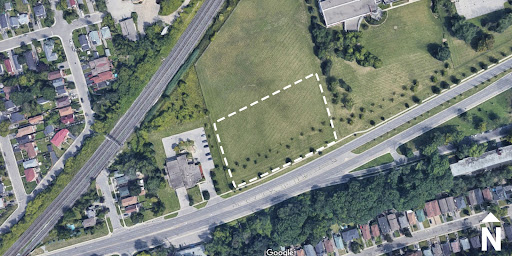
The site chosen for this project is located in the Birchcliff neighbourhood in the old district of Scarborough. It is an old quarry site that is now used for city redevelopment and urban planning. The site consists of a college, petrol station, and a few stores in its immediate vicinity and is a part of a predominantly residential area. The “Futuristic School” is aimed at serving the children in the neighbourhood of Birchcliff and its others in close proximity.
- Site coordinates: 43°41'21.4"N 79°17'09.0"W
- Site area: 9007 sqm
- Height limit: 15 m
- Maximum FAR: 1
- Ground Coverage: 60%
Setbacks (as per CAD plan)
Ground Coverage refers to the ratio of maximum allowed solid/permanent footprint on the site to balance the built and unbuilt spaces. You can utilize the other 40% of the site for any temporary intervention/recreation.
Similar Competitions
Discover competitions you might be interested in




Challenge to design public laboratory


The Global Benchmark for Architecture Dissertation Awards
