Strata 2020
Printing Homes for those displaced by borders
OVERVIEW
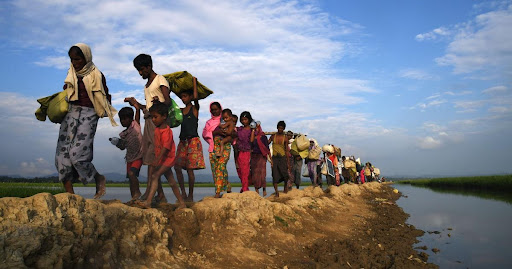
Img 1: An image showing a group of Rohingya refugees migrating from one place to the next. Source
Premise
The biggest democracy in the world, India, is also quickly becoming the epicentre of one of the biggest refugee crises in the world. Assam, a border state in the nation, owing to its geographical location and shared international frontiers has been facing the brunt of this influx since as far back as 1951.
A National Population Register was put into effect after the 1951 Census of India, and a lengthy battle that the natives fought with authorities and migrants over the eroding identity of the state and limited resources due to large scale migration into the state. In the first draft of the updated NPR released in September 2019, roughly 1.9 Million people have been excluded owing to wrong names, spellings, unavailability of papers, etc. Even as the region remains in political and social turmoil, the government has sanctioned the construction of atleast 11 more detention camps across the state to house people excluded from the register.
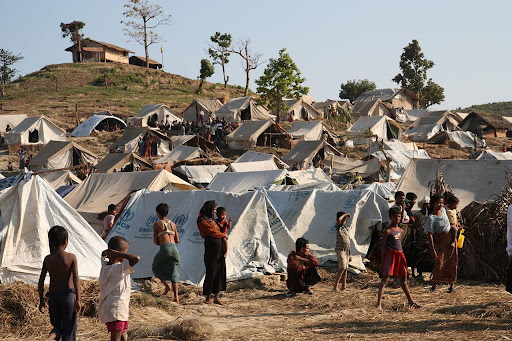
Img 2: An image of the UNHCR camp for refugee rehabilitation, representative of the habitation issues with these settlements. Source
Issue
At present, a majority of the people whose name didn’t make it into the draft are housed in camps in existing prisons across the state. Furthermore, the total capacity of the detention camps proposed stands at roughly 14000 people, clearly not enough for the number of people detained. Total projected budget for their construction alone (excluding logistic blocks) estimated at 1000 Crore INR ($140 Million).
Various news sources have reported about in-human living conditions inside camps and prisons, apart from overcrowding and a lack of resources. Fear and depression among detainees is extremely common owing to an uncertain future. Even with the detention camps in place, dignified living for the detainees remains an unattained target. Home ownership remains the primary concern of a number of detainees whose lives were thrown into the whirlwind following the NPR. If they aren’t deported, their lives shall still remain at a standstill with virtually no work opportunities to rebuild their lives.
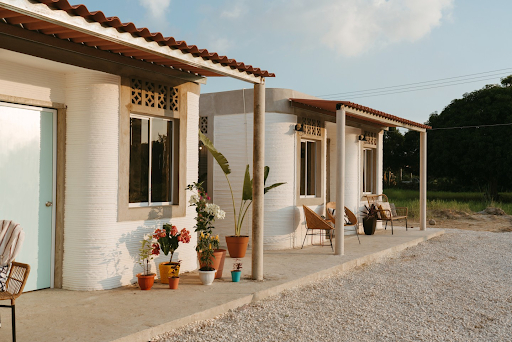
Img 3: The community of 3D printed homes by ICON and NewStory ready for occupation in Tabasco, Mexico. Source
Is a Solution in Sight?
Several nations have gauged into low cost, alternate construction methods to house their growing refugee and desolate population. 3D printing has emerged in that sphere as a dominant technology, a potential solution, that can achieve economy of construction in record time, along with the structures being seismically and thermally resilient.
An inspiring practical application of this was seen in Tabasco, Mexico where an entire 50 house neighbourhood was recently 3D printed, with each house costing as less as $4000, and delivered in less than 24 hours. The community houses the poorest families in Tabasco who earned less than $4-5 per day.
India’s Assam and Rohingya situation is being termed only the second biggest humanitarian refugee crisis after Syria in the world. Can the nation too employ this progressive technology to house its detainees?
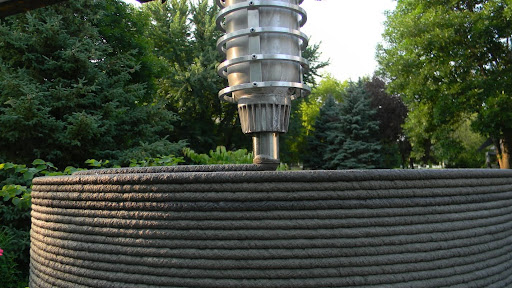
Img 4: A representative image of a wide nozzle concrete 3D printer that was used to print and build an entire fantasy village by Andrey Rudenko. Source
Can construction technology help in the quick and dignified rehabilitation of some of these displaced people?
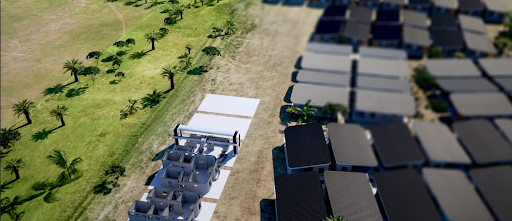
Img 5: A conceptual visualisation of a planned 3D printed colony. Courtesy, ICON Build. Source
Brief of the competition
The challenge is to design an assembled accommodation, and thereafter a neighbourhood, to absorb the rising and foreboding crisis in Assam using the principles of 3D printing construction.
The challenge is to employ the technology to achieve dignifiable residences for the displaced families. Participants must design a singular modular unit for 3D printing keeping in mind the design objectives. The same unit must then be used to design an entire neighborhood comprising of 150 households on the given site.
When employed in construction, 3D printing allows not only a continuous thermal envelope, high thermal mass, and near zero-waste, but also speedy construction, a much broader design palette, next-level resilience, and the possibility of a quantum leap in affordability.
However, as with any other technology, 3D printing also has its set of limitations that would pose the design guidelines for this challenge.
Objectives
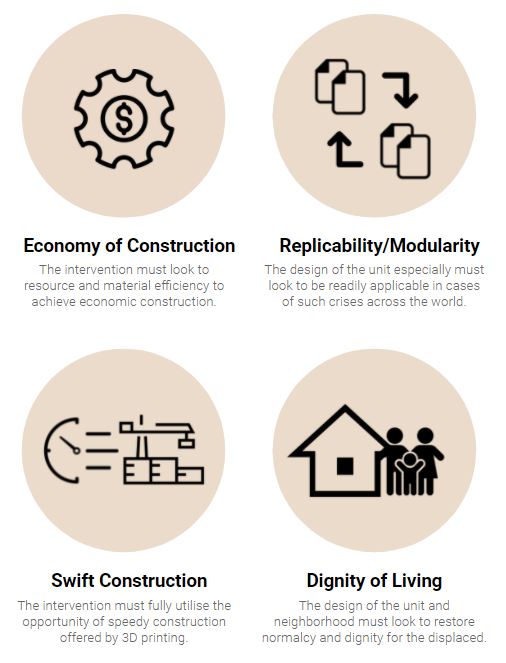
The following objectives can be a point of beginning to conceive this design. Participants can assume a rough context from the region’s images provided and a 4 person family demographic before initiating their design process.
Unit Plan
DESIGN GUIDELINES
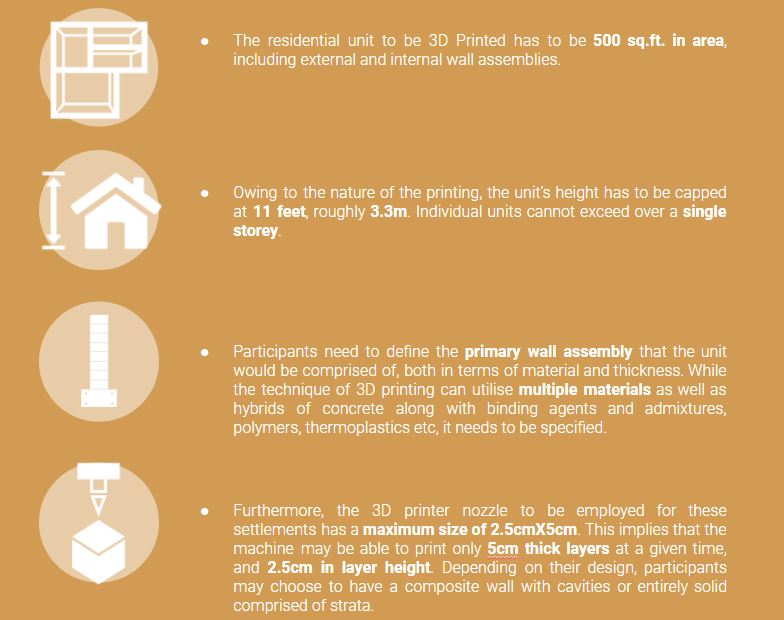
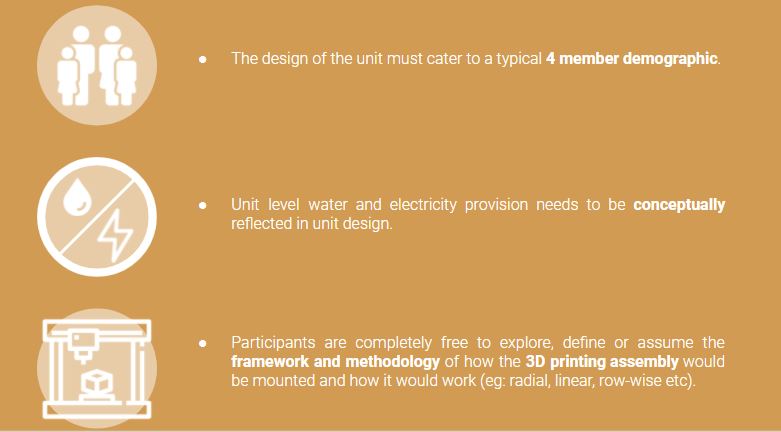
Structural Outline
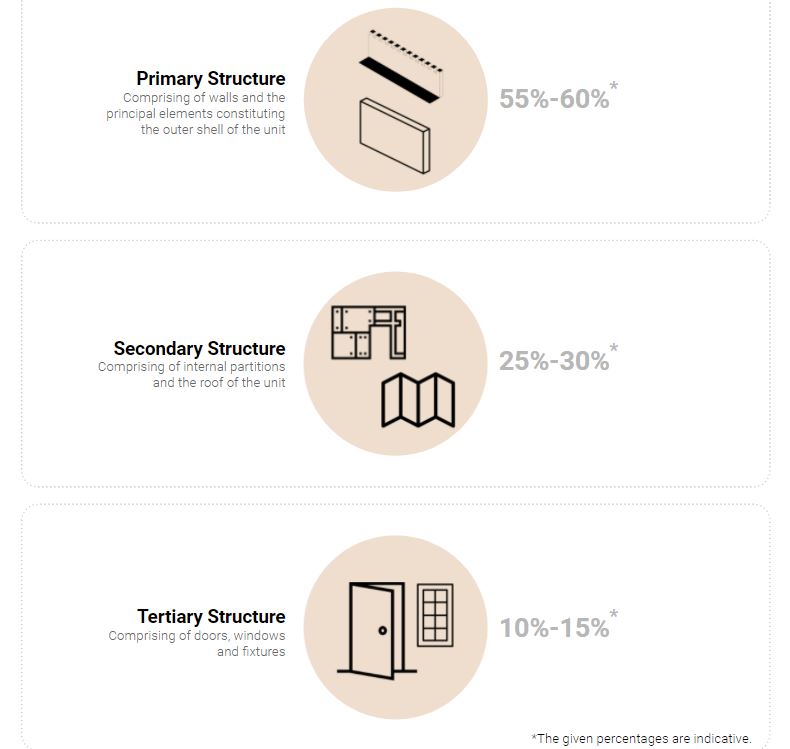
The above divisions are to be seen as rough guidelines for the structural constitution of the house.
Apart from the primary structural constituents, participants have complete control over whether 3D printing is to be employed in the secondary and tertiary components or not. Alternative materials including but not limited to steel, wood, wrought iron, plastic etc may be explored as long as they satisfy design objectives.
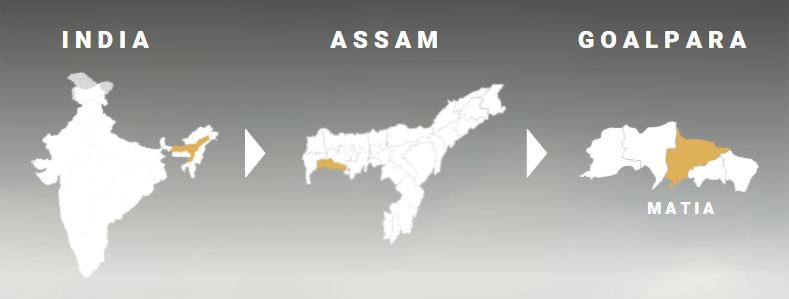
Goalpara, Assam, India
Goalpara is an administrative district in Assam, India, located in the state’s southwestern region. Situated roughly 150 km west of Guwahati, and to the North of Meghalaya state, it has close proximity to Assam’s shared international border with Bangladesh, from where most of the influx of immigrants happens. The region encompasses an extremely fertile belt of land in the floodplains of the Brahmaputra river, and has a semi-hilly terrain. In 2006 the Indian government had named Goalpara one of the country's 250 most backward districts.
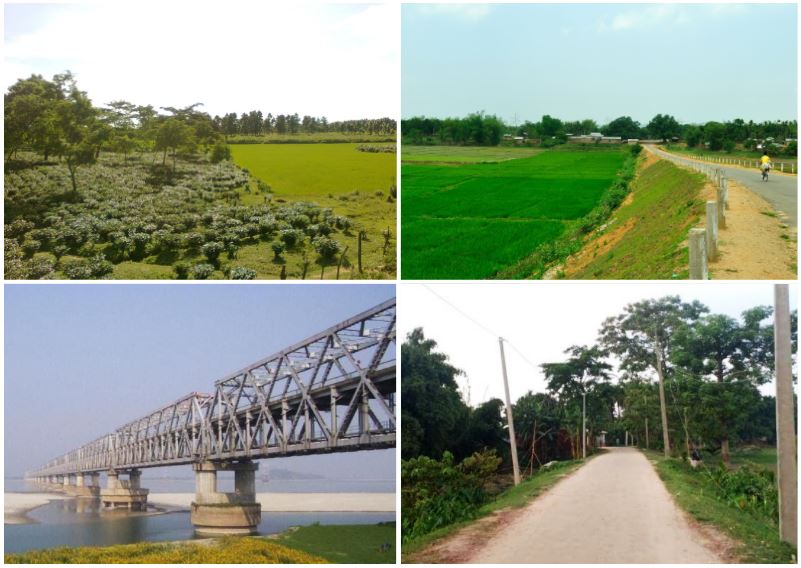
Img 6: Set of images to familiarise participants with the context of Matia, Goalpara, Assam, India.
Context
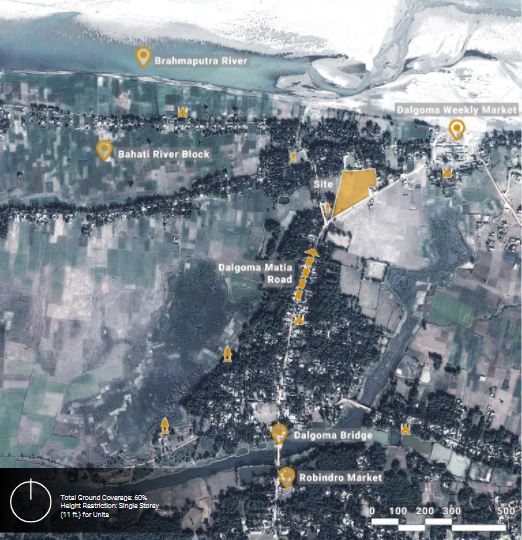
The site for the intervention is located in the town of Matia located within Goalpara. The town lies on the banks of the Brahmaputra river, and has a primary agricultural economy. As with Goalpara, the town too is rich in biodiversity and abundant scenic beauty. The ecological sensitivity of the region and soil type proves to be rich ground for experimentation with 3D Printing technology.
The first and the largest of atleast eleven more detention camps being built right now is in Matia, nearing completion.
Note: It must be borne in mind that even though the intervention is contextualised, participants must look to propose their design with a farsightedness to employ 3D printed homes universally.
Img 1: World in conflict - 18th and 19th Century
Site Plan
Within the 1.6 Ha site, 150 such 3D printed homes/units must be placed to form a fully functional neighbourhood. Provision of greens, circulation and open spaces need to be worked out on the Masterplan Level. Areas for Community Spaces/Facilities, Services, and Admin need to be only earmarked and designated on the master plan simply by way of a boundary. Participants can assume municipal provision of site level services. All units are to be printed/fabricated on site, and part by part prefabrication off site may not be assumed.
Judging Criteria
Presentation: The fundamental to a good entry is a good presentation.
Concept/Idea: Quality of thought and intent in pre-design phase.
Spaces/Programme: How the spaces are calculated and ordered.
Design Outcome: The final architectural outcome of the solution.
The judging panel can also add other criterions based on their internal discussions - which will be in line with the problem statement. Participants are advised to fulfil above given criterions first in their design.
About Unfuse
Unfuse serves as a unit for Uni in the field of Architecture. It intends to break the fusion of traditional design barriers and methodologies by making it a platform for experimentation and conceptual exchange of ideas in architecture, urbanism, society, culture and ecology. It is a research initiative dedicated to providing opportunities for designers from all domains to explore ideas that go beyond the boundaries of architectural discipline and enrich our built environment; thereby opening up possibilities for promotion of architectural thought at a global level.
Queries: support@uni.xyz
Discover other competitions: https://uni.xyz/competitions
Facebook: https://www.facebook.com/unixyzglobal/
Instagram: https://www.instagram.com/uni.xyz/
Discover FAQ’s about this competition on our help forum here: https://help.uni.xyz/