
Bio-Modular
Tiny Housing NY

Problem Statement
Planning plays an important role in controlling the density and efficiency of the cities. However, the pressure of unrestrained urbanization overcomes the future projections of these plans, causing exponentially increasing problems in the cities. Housing is one of the biggest problems in the big cities and New York City is one of them as the most populous city in the US and symbol of the metropolis in the world. Having this huge housing problem with limited amount of space trying to shelter a huge and fluctuating population with temporary residents, the problem is exponentially growing, becoming more complex and severe every day, especially after the COVID-19 pandemic. When housing expenses consist the majority of the budgets, the living standards of the houses do not offer much in the city, unless you can pay huge amounts. When real estate is incredibly valuable in New York City, there are still many vacant parcels in the city, not preferred for development so far, most probably due to their small or odd sizes and shapes. These empty lots are a huge loss of potential, causing poor environmental qualities in terms of lack of safety, hygiene, and aesthetics, affecting the neighborhood negatively. On the other hand, it is clear that the resources are limited not only in NYC, but in the whole world, so it is necessary to transform these types of forgotten or unfavorable urban lands, contributing to the city and their citizens, with limited (or even no) housing budget in the best sustainable way.
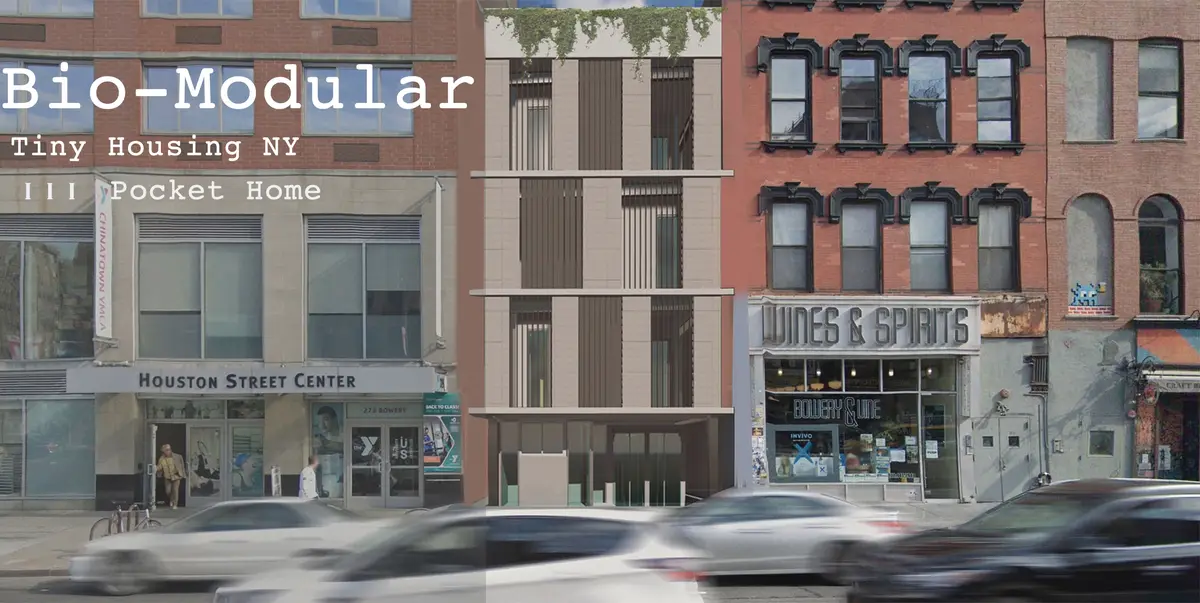
As a response to this problem statement, a modular, sustainable, flexible, and temporary housing design is aimed, using optimum space for maximum comfort conditions, having natural light and ventilation, contextually compatible, and contributing physically and socially to its location in the vacant plot located at Bowery 271 in New York City. Within this context, the project is modular and sustainable in its very essence, using an innovative lightweight masonry unit made of bioplastic produced from recycled waste[1].
Bio-plastic Modular Masonry Unit as the Main Construction Material
Both for the AACs and the pumice blocks, their raw materials are sand-originated materials that are not suitable for recycling. After demolishing buildings constructed with these types of concrete masonry units, debris is carried away to a location far from the city and left to the environment hazardously. This debris has no chance to dissolve in the environment, as cement is used as an additive and materials become inappropriate for recycling. Whereas bioplastics are plastics obtained from renewable biomass sources such as vegetable oils and animal fats, corn starch, straw bale, wood chips, food scraps, which are degradable in nature. This bioplastic building block is lighter than other widely used masonry units. This bioplastic masonry unit has an interlocking system, making the unit modular itself, which will bring remarkable logistic advantages together with financial advantages[2].
The mechanical property of the bioplastics under the addition of graphene oxide which is the main additive results in a rigid and strong material that can be easily compared with the cement-based standard blocks. There occurs aluminum, silicate, and radon in the manufacturing process of the AACs, which are highly harmful to the human respiratory system and damage the lungs severely, causing cancer. Unlike these concrete or pumice-originated masonry units, the manufacturing process of bioplastic masonry units will decrease pollution in the environment, which also will decrease the emission rates, hazardous oscillation of gases, or the pollution of materials in the environment by using them in the process itself, which will result in cleaner and healthier environments due to the ‘eco-friendly’ or ‘eco-supporting’ manufacturing process. Furthermore, they provide a significant decrease of waste produced by humans and decrease pollution in the environment, as they recycle and transform waste into construction materials. Other than the masonry units, bioplastic is used at the wall partitions, flooring materials, sound-proof façade cladding, wind, and solar shading panels, consequently all through the building, except the load-bearing elements of the building and a bored pile foundation (preferred for minor intervention in a multi-story building site) which is proposed to be steel structure and the glass surfaces. Bioplastic masonry units are produced by molding manually, so they can be produced easily and in a short time.
A Workshop for Producing Spare Bio-plastic Building Materials
As a part of the design scenario, it is assumed that all bioplastic building materials will be manufactıred in a production facility, carried to the site for the construction of the Bio-Modular Tiny Housing completely. Then, as the building is designed for medium-term temporary use (between 6 to 12 months), it is foreseen that there will be outage, aging, and decline, due to disassembly and assembly cycles, as well as routine use. For the production of comparatively small amounts of bioplastic building materials for renewal, there is a workshop with a waste collection room at the rear side of the ground floor. The appropriate wastes of the building’s garbage will be separated, kept, and recycled in this workshop, making it self-sufficient.
We want to change the world, by changing our world_through this design. Designed as a housing opportunity aiming equality for all people with ‘limited’ or ‘no’ budgets, who can not afford the rent can work here at the workshop part-time or full-time, if they wish. In the tough conditions of New York City, Bio-modular Tiny Housing NY is thought to be a shelter for all.
About the Design of the Living Units
The interior designs of the twelve living units for one, two people and couples (four units at three upper floors with surface areas between 14.5 sqm and 22.5 sqm) are aimed to be compact, all using two levels, comfort-oriented, all having natural light and fresh air. The living units share a common and inner circulation space with a lift, a staircase, bike racks, and a peripheral balcony-type of outer space on each floor, which became a necessity after the COVID-19 pandemic. Depending on the future different-sized urban residual plots to be moved to, these interior living modules can be changed as they are modular, and put into larger or different-sized rooms flexibly, expand or shrink, consequently can be changed in both ways.
The plumbing shafts are shared by two adjacent living units, gathered, and continue vertically at two points. The storage areas are provided inside the living units with large closets. There is a common outdoor trash chute system on the north side of the common balconies on each floor, enabling the garbage disposal to reach directly to the waste collection room practically.
The Terrace
As widely used in New York City, the terrace is designed as a shared recreational space giving the residents a place to hang out, view the street and the environment. As in the rest of the building, the terrace consists of sitting modules, table modules, stepped seating module, stage module, and even screen module, converted to each other when necessary made of bioplastic masonry units.
In addition, a chiller unit will be placed on top of the lift tower hidden behind its parapets.
The Entrance Floor and the Façades
Although the located plot is considerably small, the entrance floor is set back, leaving space for a small sitting area in front of the small deli, serving both to the entrance building and the outside, as a contribution to the street.
There is a small lobby with a front office area including a reception desk linked with an office, a mailroom and a staff toilet. There is a circulation area at the center of the building, composed of a lift and a staircase. At the rear side of the ground floor, there is a laundry room for the common use of the residents, next to the workshop for bioplastic masonry unit (BMU) production, and a waste collection room next to it.
The plot at Bowery 271 is surrounded by buildings on three sides. The two sides are completely blocked with higher buildings and the backside is blocked one and a half floors from the ground level. In that sense, there is a full entrance façade facing north-west and a partial rear side façade facing south-east. Bowery Street is a dense street on the routes of police and ambulance, next to an even denser avenue E Houston Street on the routes of police, ambulance, and fire trucks with a lot of noise pollution due to sirens. Both front and rear façades use a combination of sound-proof façade cladding against noise pollution, and vertical shades for wind and sunlight regulation, constituting a barrier on both sides of the peripheral outer space at each floor around the living units. There are 30 cm gaps left on both sides of the building, as required.
Conclusion
Bio-Modular Tiny Housing in NY aims to create a new way of living, proposing a sustainable, modular, and flexible solution, having equality and environmental sensibilities in multiple ways through its integrated design, based on the use of innovative bioplastic material in its very essence to make a difference in the life of modern metropolises through the case of New York City.
[1] The bioplastic, modular, lightweight masonry unit with interlocking qualities is designed by the two of the team members; Erdem Baz (BSc in Mech. Eng.) and Dr. Elif Mıhçıoğlu (B Arch, MSc, PhD) and is applied for a patent in July 2021.
[2] For 1 sqm of wall, the number of masonry units to be used is the same as the others. So, with a truckload of standard masonry units can build about 36 sqm of wall. We can imply that 4 times more can be built with the same volume of specially designed modular bioplastic masonry units, composed of 6 modular surfaces that can be flat packed and can be packed on top of each other requiring less space. On the other hand, as mentioned above, when a pumice concrete block unit weighs about 8 kg and an AAC unit about 5 kg, the proposed bioplastic unit weighs about 3 kg.

Popular Articles
Popular articles from the community


Co-life: Sustainable Architecture for Age-Friendly Community Living
Co-life reimagines sustainable architecture for seniors through courtyards, rammed earth, shared gardens, and spaces designed for belonging.

The Ocean Hive: Sustainable Architecture for a Self-Sufficient Civilization at Sea
The Ocean Hive imagines sustainable architecture at sea, where modular habitats, algae, wave power and ocean waste sustain a growing colony.

Conexión: Biophilic Design Reimagines High-Rise Living in Hong Kong
Conexión reimagines high-rise living in Hong Kong through biophilic design, green facades, shared spaces, daylight, water and nature within.

Play: Fragments of Their World
Familiar architecture becomes modular playground design, creating safe spaces where displaced children can learn, connect, imagine and play.

Similar Reads
You might also enjoy these articles
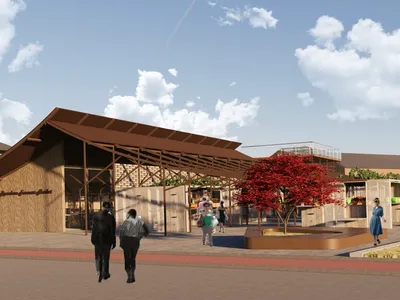
The Rhythm of Seasons
A Farmers' Market Connecting Nature and the City
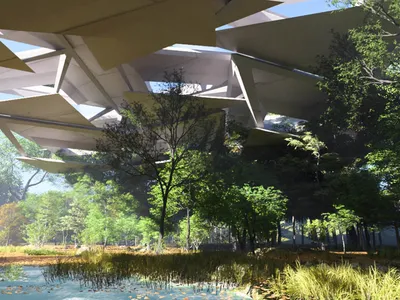


More Than a Building-Designing a Living System
More Than a Building-Designing a Living System
Base Beyond
DESERT COMPOUND ARID: TOURISM OF ABSENCE AND ABUNDANCE

Explore Modular Housing Competitions
Discover active competitions in this discipline


Challenge to design mud housing for contemporary communities

Design challenge to reuse E-waste
Comments (0)
Please login or sign up to add comments
No comments yet. Be the first to comment!