
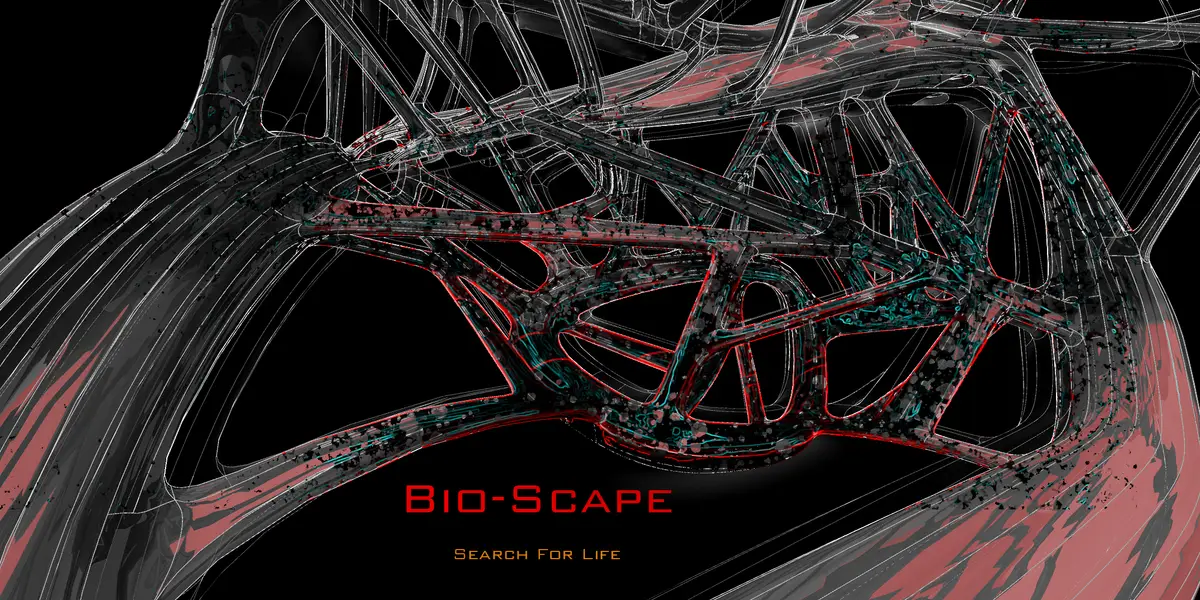
BIO-SCAPE, Search for life
Connection of Bio web language to a Martian hub

The known fact about planet exploration brings us to the design for a Martian hub, The “Paleo-habitable planet” (reflecting its ancient habitability), the intention was to bring in research to conduct the search for life and water on Mars. The name of the Project is BIOSCAPE to relate the biological research and the elements to be found, to the Martian landscape. The design is created by the Bio Spatial Web system that helps to create a relation between the terrain of Mars and the design for the hub. The Martian surface is believed to host a habitable environment in early history, as well the event of the researchers is to find the evidence of the building blocks of life in the form of organic molecules. The hub is spread out in 4000sq meters in the creation of a colony. So the concept behind the design was to create a bio web structure created by 3D printers that can be extended in the future to create a colony. The structure represents veins, arteries, and the nervous system similar to the living body to emphasize the potential of life on the planet Mars.
The hub is situated at the start of the fall on a cliff in Gediz Vallis Ridge, This is considered to have an abundant amount of minerals spring, Volcanic ash, and dry ice, which could be very helpful for the researchers. There was also new evidence that shows the site has a similar climate and erosion to earth and maybe ascent onto the Greeheugh pediment. The design tackles the harsh climate conditions that have no gravity, no breathable air, a very thin atmosphere with high radiation levels. Its surface is rocky with frequent dust storms. The temperature swings on the planet could be from 70 degrees Fahrenheit to minus 100 degrees Fahrenheit on the same day. That is the reason for the Housing and the community living and gathering spaces are kept underground to not get exposed to such extreme temperatures in the same day cycle. The top portion of the community living space is still exposed to the sunlight to enter the space. The construction in the harsh climatic conditions is done using the spider 3D printer using the Martian solid and dry ice which can be a strong compound to create a bio web structure. The application of red Color on top helps it kill fungi and Moses and works as a sealant and prominent detective color. Organe in the housing space gives energetic positive energy. The exterior will be made with metal that can be reused from the rockets itself and glass as the components and material required to make it are abundant on Mars. There is much spatial waste in our solar system that can also be used as material to build in the interior spaces and clear out the waste. The waste can be pulled by magnets that can be attached to the rocket.
The initial idea of the design was to use the site to its advantage being on the cliff of the start of the speculative dry ice falls. The design evolved from being and tubular structure suspense from a cylindrical vessel and then transferred into one language of the bio web system having three different scales and interconnecting to each other to which cladding can be done.
The Program supports the search for a life research institution having a navigation center, communication center, kitchens, dry leaves, recreational space, natural mineral labs, vertical system, cabins and sleeping pods, hydraulic center, and solar panel for generating energy. The dry life and a quiet zone for ecosystem research. The green dome and the vertical plantation can close space to avoid exposure and try to search the plant’s synch as tomatoes, potatoes, peas, and mustard. There would be a trial to grow in trees so that oxygen can begin to circulate in the atmosphere for the future inhabitants.
The Bio-Web system is derived from the biological structure of a human body that is the main concept of design. There are the different spatial lopes and connecting hyperloop that are spatial from inside also. The reduction of waste is achieved by less living space and more reusable and multi-use research space at a ratio of 80-20. The red space is Research, Blue being a generator and self-sustaining energy, and orange as housing. The conditions for the living organism can be examined in the quiet lap so it is placed far away from the hydraulic generator. The shape that follows the aerodynamics is related to the design of an F1 car and helps to direct the winds and the dust storms.
The heavy winds affect the nature of the complex community and the aerodynamic shape collects the wind around the hydraulic converter, purifies it and this flows through the bio web system. The carbon dioxide and other gases can be filtered out through the smaller vessels. This also ejects the dust that can destroy the community due to heavy dust storms on Mars, This also created the circulation system. The individual spaces and the sleeping space for 40 people can be made in the same language using the 3D printing mechanism for researchers, workers, and people. That can generate heat and help in extreme climate conditions. Using the Idea of luminescent leeway the functional bio web vessels can be in use for the production of light and use solar and wind energy for all the functions.
To start this community at the beginning of 2025 and then use the same strategy to continue to build this community as a whole creating more public and research centers using the resources and the harsh climatic condition to our advantage this gives the vision for 3025. This also helps us to distribute the resources, create oxygen, and work a way to tackle the problem of gravity as compared to the earth. This implies the conclusion that the Material, technology, the form which creates the space and resilient and the self-sufficient in the BIO-Scape can be an ideal fit to start the inhibition of humans on planet mars.


Popular Articles
Popular articles from the community


Co-life: Sustainable Architecture for Age-Friendly Community Living
Co-life reimagines sustainable architecture for seniors through courtyards, rammed earth, shared gardens, and spaces designed for belonging.

Hill & Cross Opera: Sculptural Opera House Architecture Shaped by Tallinn’s Landscape and Identity
Hill & Cross Opera reimagines opera house architecture in Tallinn through its sculptural hill, civic plaza, glass wave and a luminous cross.

Play: Fragments of Their World
Familiar architecture becomes modular playground design, creating safe spaces where displaced children can learn, connect, imagine and play.

The Musturak Paradise: Senior Living Architecture for a Connected Future in Temara, Morocco
The Musturak Paradise reimagines senior living architecture in Temara via private homes, social spaces, culture, community, and shared care.

Similar Reads
You might also enjoy these articles

Day and Night Park: A Time-Based Urban Newsstand in Beijing
A temporary urban newsstand in Beijing blending travel, light, and reading through poetic colors, compact form, and community-focused design.

Modernist Patio Renovation in El Masnou, Barcelona by Oliver Segura Arquitectura + Cebrià Arquitectura
Modernist patio renovation blending tradition and innovation with a movable pool, leveled floors, and Catalan materials in El Masnou.

Alto Residencial Coop: Cooperative Housing Development in Santiago de Compostela by Carbajo Barrios Arquitectos
A linear cooperative housing complex blending white volumes and perforated metal façades, enhancing community living, natural light, privacy, and urban integration.
Vil Genis School by BPA ARCHITECTURE – Massy, France
Vil Genis School in Massy, France, features sustainable design, south-facing classrooms, community integration, accessible spaces, and modern educational architecture.

Comments (0)
Please login or sign up to add comments
No comments yet. Be the first to comment!