
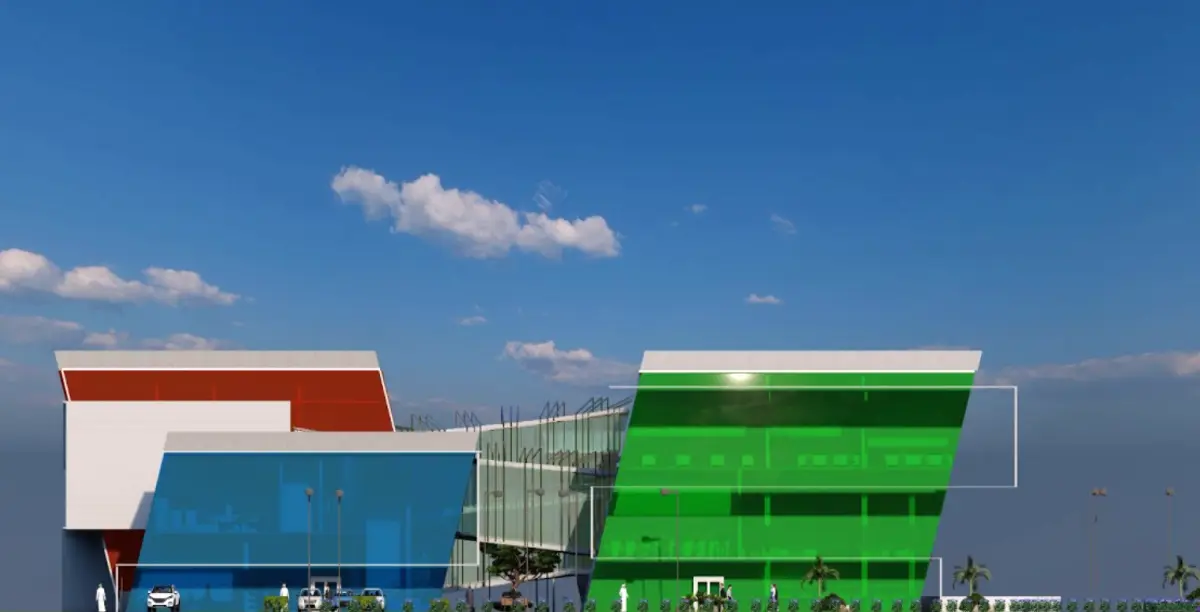
E-gaming centre
Concept Development

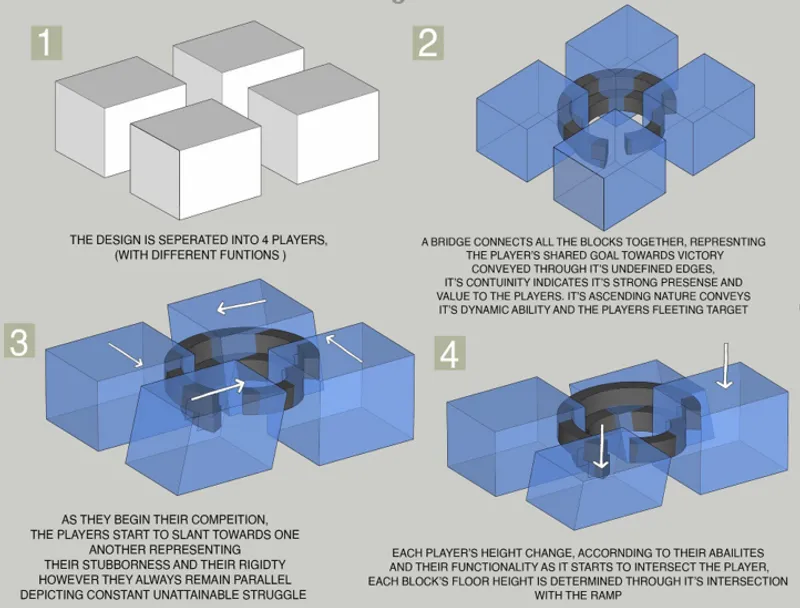
During the start of our concept development, we researched extensively the nature of e-gaming and it’s dynamics. We found that e-games connect strangers with one another with the objective to win. We additionally witnessed the stubbornness and rigidity the player’s presented when gaming either individually or in groups. Players would be keen and desperate to reach victory to the point where it’s reflected in their physical actions whether by screaming loudly or constant movement. This allowed us to imagine the players as rigid squared blocks, with identical expressions and concealed individualism. This dynamic allowed us to plan each block as a different entity, with different abilities. Subsequently, to reinforce the identity of the players as they begin their competition, the blocks start to slant towards one another representing their strong wills towards victory. Yet the blocks always remain parallel, depicting their constant unattainable struggle.
Afterwards, we tried identifying the players' shared objective, which is victory. Victory was identified as an aimless goal with no fixed destination, as it’s sweetness would soon melt away leaving an empty void in its place. Therefore we associated victory as a circle (a circle goes around without an end), with soft and undefined edges, denoting that it should represent a connection between all the blocks. We viewed victory as a dynamic character, constantly changing and ascending from player to player, rarely remaining with one individual. We represented this notion, through a ramp and its ability to move from one level to the next. Moreover, we matched each block’s floor height with its intersection to the ramp, conveying their will to conform towards victory despite its consequences. Finally, we begin differentiating each block by changing their height according to their abilities and functionalities.
Site Analysis
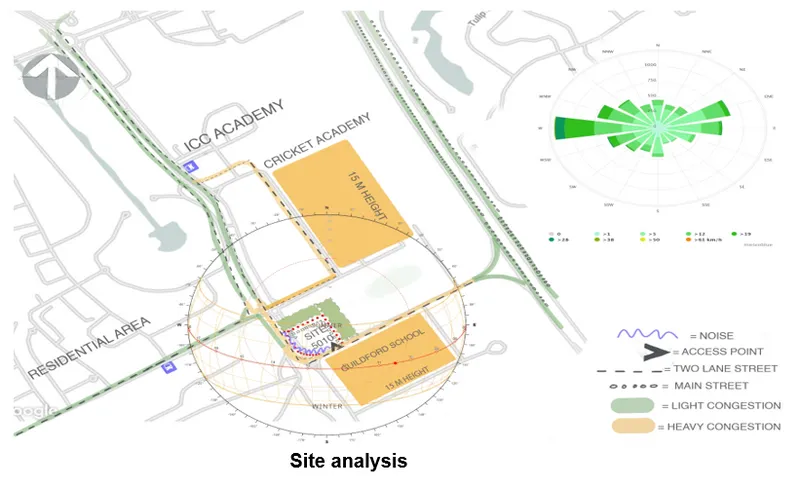
From our site analysis, we can see the buildings surrounding the site including two schools with a height of 15 metres and a variety of residential buildings designs. We were able to identify two points of access in the site and locations that allow vegetation. We also understood the sun path in winter and summer along with the location of the southern region, thereby acknowledging the possible negative impacts it may have. From the wind direction graph, we concluded that mostly, the western region has more wind exposure than other regions. This appeared beneficial since narrow pathways between the blocks can have natural ventilation.
Facade design
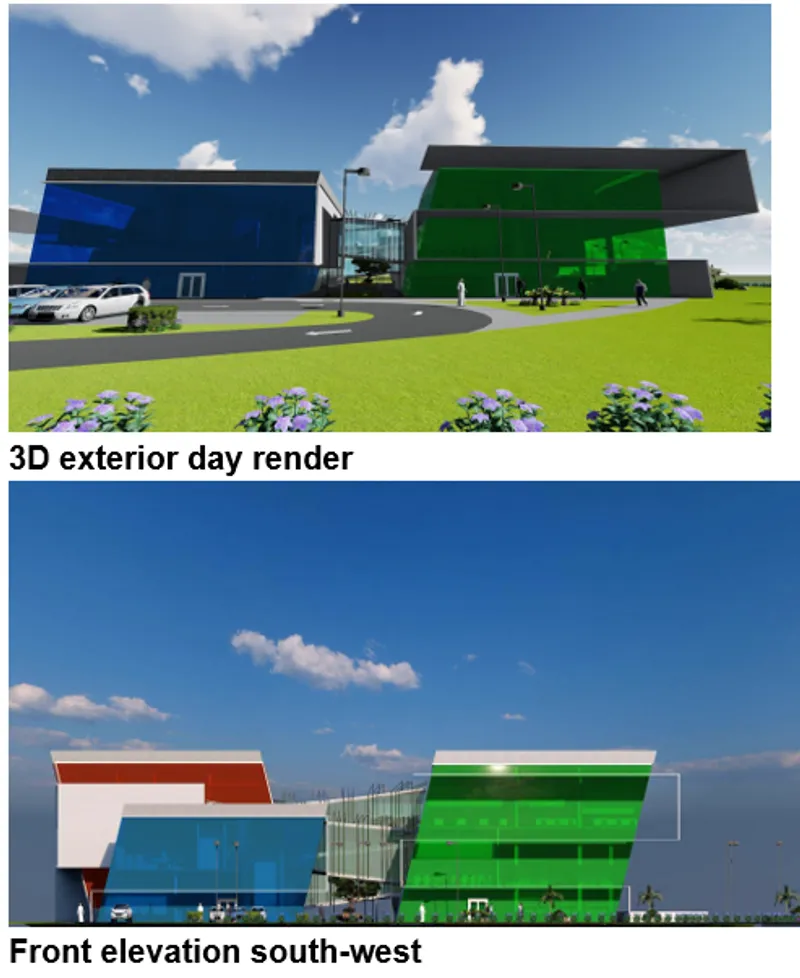
When designing the facade of the building, we wanted to emphasize the contrast between our blocks. In order to make each block stand out, we have decided to use various colourful glass facades. Strong individualistic colours such as green, blue, red and orange are chosen to convey e-gaming through their association of primary colours. This distinction is also done, to aid and inform visitors of the nature of each block and its contrast of functions.
When developing the facade, we recognized that the location of the site affects the thermal comfort of the building due to the block’s glass exterior walls. We began researching shading elements that would best match our building’s concept. A wrapped facade was appropriate to our concept since it signified the dynamic positions of the blocks.
A rib of louvres was additionally placed on the facade of the ramp, to highlight the ramp ascending movement while attempting to cage it.
Functions
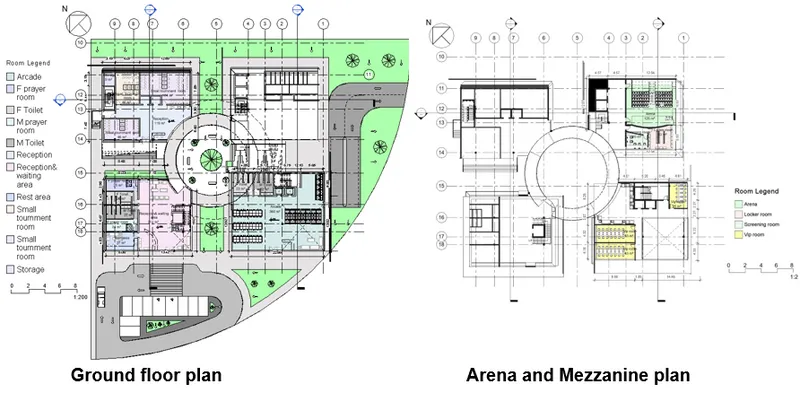
The ground floor comprises main reception (bottom left) and arcade (bottom right) are located on ground floor (0.00m height). While the small tournament (top left) is raised at a height of 1.3m. The small tournament rooms can be accessed through the reception to the ramp. The variation of heights on the ground floor has caused a change in the height of upper floors as well to accommodate the ramp entrance. For instance, the arena is at 2.35m height while the mezzanine is at 3.35m height.
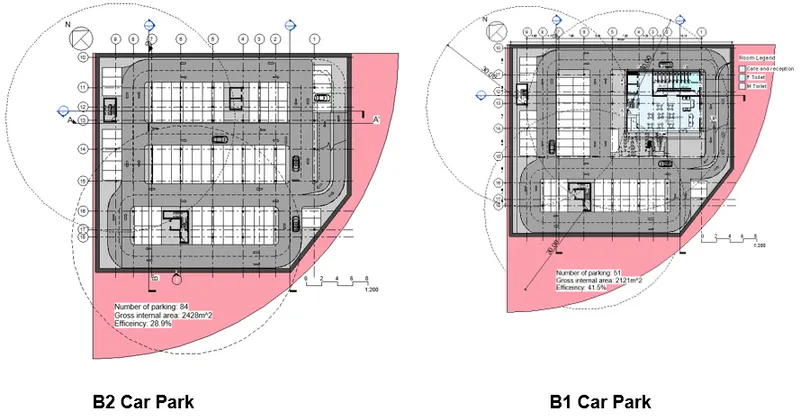
We have added 2 basement parking floors to accommodate the average numbers of visitors on a daily basis. B2 is located 6m underground while B1 is 3m underground. In B2 parking we have 84 parking with an efficiency of 28.9%. However, in B1 we have 51 parking spaces with an efficiency around 40%. The difference in the efficiency is caused by one of the blocks going underground and having an entrance straight away from the parking. This was caused by adjusting the levels to accommodate the ramp. From there, they can head upwards straight to the arena or any other destination they have in mind.
Sections
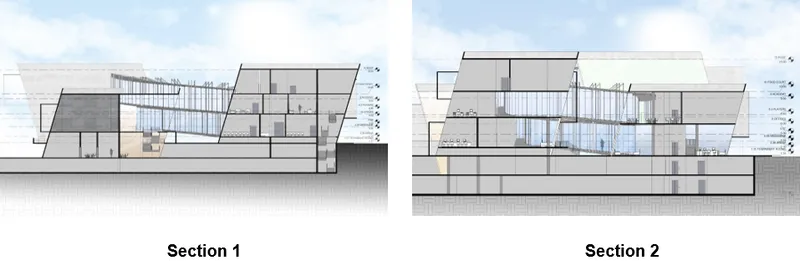
Both of our sections demonstrate effectively what we have tried to achieve with our concept. The ramp perfectly intersects every floor height, allowing communication between the two spaces. They also show the height of each floor and how it relates to the ramp. Additionally, the sections demonstrate the building’s slanted nature with the facade's linear grounded approach to fully portray the effect of struggle to victory.
We have used light grey paint as finishing interior material to cover the concrete material used for wall construction. However, in section 1, at the top left (arena), we have used a dark grey sound absorber as a finishing interior material to isolate the noise from leaking into the arena from the surrounding environment. This is implemented to offer the best auditory experience to the visitor, allowing them to immerse themselves in the experience provided, without the interference or disturbance of noise.
Additionally, section 1 is able to perfectly demonstrate the relationship between the car parking and the entrance to the arena block.
Construction
A 3D exploded view summarizes all the structural systems we have used to support our elements. Thin RCC columns are placed radially along with thin slanted beams, joining and merging the two ramps to one another giving them a more linear look. Meanwhile, four columns and two-way slabs are used in each slanted block to support them.
A waffle slab was used to strengthen the connection of the column and limit the number of columns needed. It was significantly helpful since each block has its unique dimensions with limited space. This has resulted in using four columns for each block.
Using a 3D representation of a waffle slab, beams are seen to be placed across one another with identical dimensions. It also conveys the location of the rebar and the way they interact with one another to support the beam.
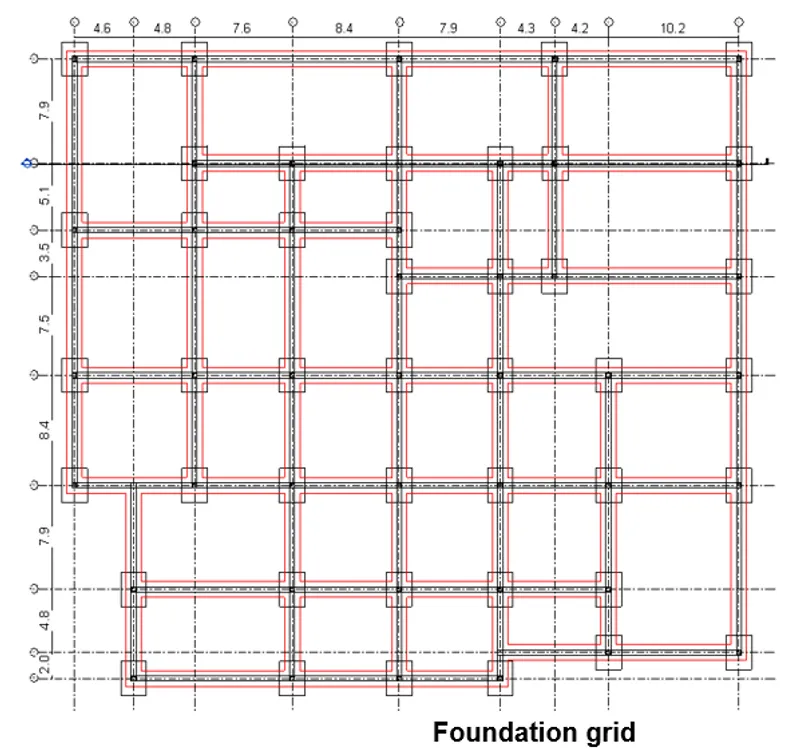
Our foundation plan shows plan footing, columns and beams and their relation to each other. The foundation grid is irregular due to not all the columns going through the whole structure. Some columns stop at the underground floor while the rest go up.


Popular Articles
Popular articles from the community


Opera on the Sea: Driftwood Logic Shapes a Timber Opera House on Estonia's Coast
Trevor Orgill's opera house translates the entangled drift of floating timber into a civic building where wood, water, and music converge.

Singing Woman: An Opera House That Performs Before the Curtain Rises
Ovidiu Cristian Pavel's conceptual opera house translates Estonia's choral identity into a sculpted waterfront landmark facing the Baltic Sea.

Extended Shell: Retrofitting Kolkata's Balconies as Living Urban Thresholds
A modular retrofit system recovers the social and environmental intelligence of Kolkata's historic verandas for contemporary Park Street residents.

Tsunami Convergenics: Turning Catastrophic Ocean Forces into Underwater Housing Infrastructure
A speculative underwater settlement off the coast of Onagawa, Japan, treats tsunamis and typhoons as energy sources rather than threats.

Similar Reads
You might also enjoy these articles

The Rhythm of Seasons
A Farmers' Market Connecting Nature and the City

More Than a Building-Designing a Living System
More Than a Building-Designing a Living System
Base Beyond
DESERT COMPOUND ARID: TOURISM OF ABSENCE AND ABUNDANCE

Explore E-Sport Arena Competitions
Discover active competitions in this discipline


Challenge to reimagine the Iron Throne

Photograph architecture without architects

Illustrate the lost glory of Angkor Wat - Render Challenge

Design challenge to reuse E-waste
Comments (0)
Please login or sign up to add comments
No comments yet. Be the first to comment!