
END WANDERING: An Innovative Shelter for Stray Dogs
This article explores innovative dog shelter architecture through the award-winning END WANDERING project by Xiaofan Li.


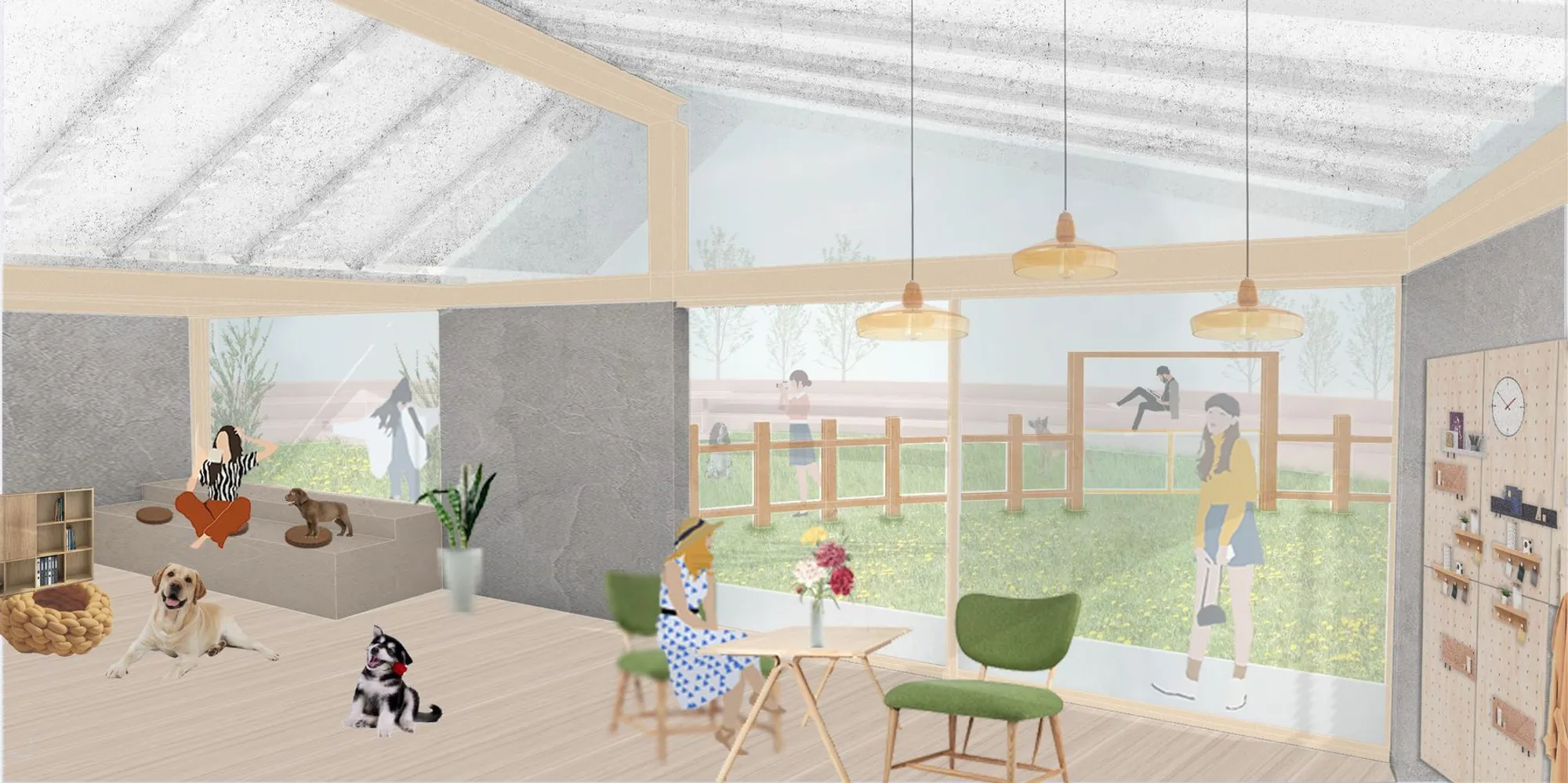
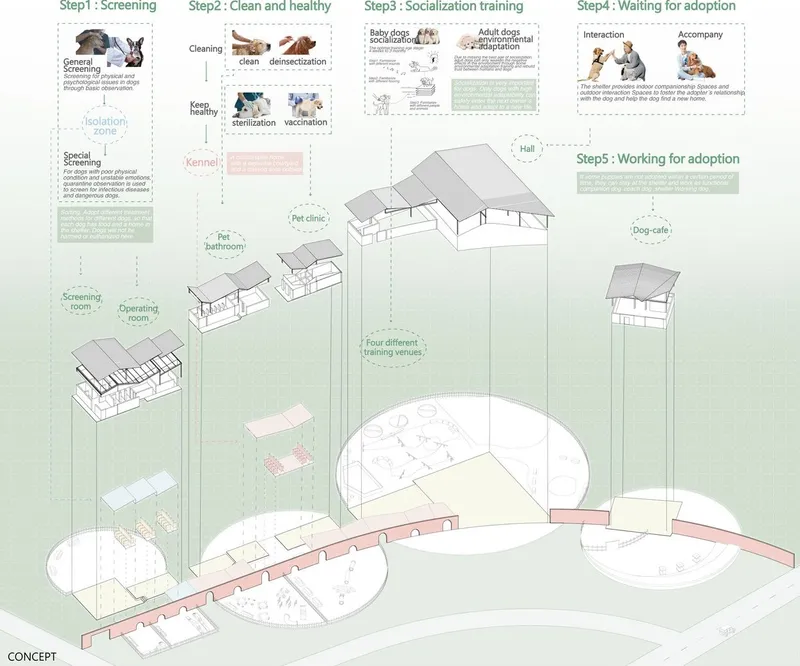
END WANDERING, created by Xiaofan Li, is the winner of the Strays competition, exemplifying innovative dog shelter architecture. This shelter is unique in that no dogs are euthanized, focusing instead on a complete socialization process to help reintegrate stray dogs into homes. The shelter also offers jobs for unadopted dogs, increasing human contact and improving their chances of being adopted.
Design Philosophy
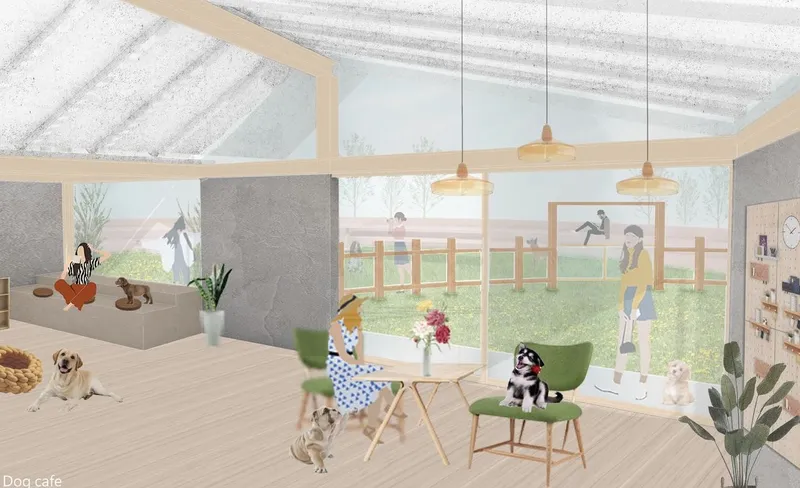
The primary concept behind END WANDERING is addressing the problem of stray dogs in urban environments. Unlike other wild animals, dogs have a close relationship with human life, originating from wolves that scavenged near human tribes. Without survival skills to hunt, stray dogs suffer without human care. Therefore, the solution should not be hunting, but helping dogs complete socialization and integrate into human social life.
The shelter’s design is based on this socialization process, organizing various functional spaces and providing numerous activity venues for interaction. A significant feature is the intervention of a wall that creates a happy land for stray dogs, allowing them to live well within the shelter and smoothly transition to new homes.
Architectural and Site Organization
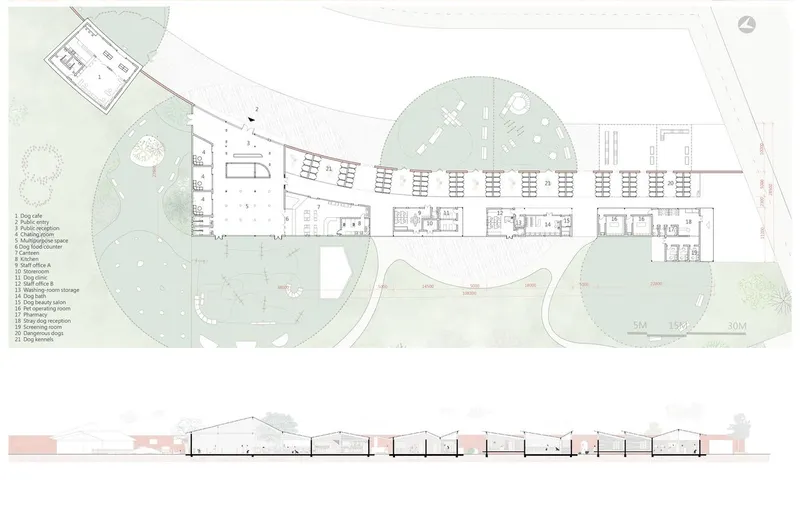
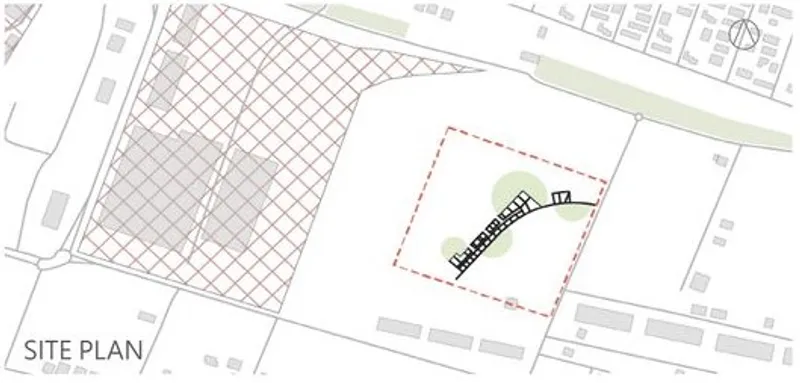
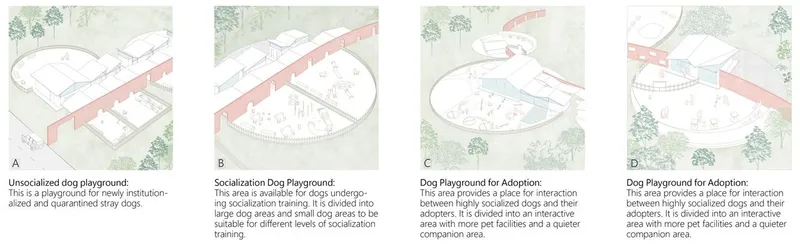
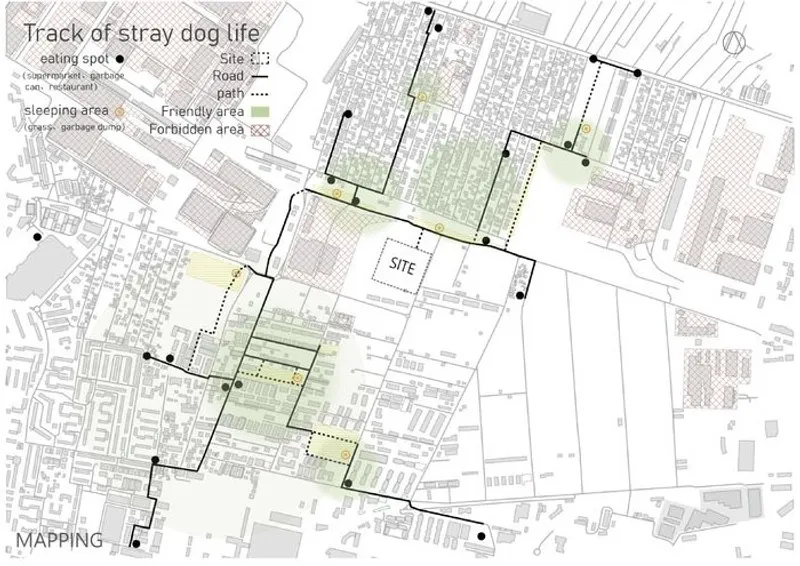
Given the emptiness and flatness of the site, the building was designed not to stand out excessively. A brick wall along the roadside handles the line of sight, and linear spatial organization minimizes fragmentation. The shelter includes different zones for isolation, socialization, and interaction with potential adopters.
The site’s core, behind the wall, offers various services and spaces for dogs, including woods and grassy areas for exercise. In front of the wall, near the road, is a small park or square for community gathering.
Iterative Design Process
The design underwent three major stages of iteration. Initially, various spatial organization modes were considered, including a single line mode and a multi-functional cluster mode. The relationship between dog living spaces and functional areas was refined to connect spaces for humans and dogs effectively. Lastly, different segmentation methods for the site landscape were explored to meet the needs of dogs at different stages of socialization.
Materials and Construction
The shelter is primarily supported by brick walls and steel columns, with a roof covered by corrugated panels. Brick was chosen as the main material due to its texture and natural, warm appearance, differing from industrial materials like concrete. This choice aligns with the surrounding architectural style and provides a more comforting environment for the dogs.

Future Expansion and Transformation
The project’s land use is divided into two main parts. The core behind the wall provides various services and venues for dogs, while the front near the road serves as a park or square for public use. Over time, END WANDERING is envisioned to evolve from a stray dog shelter to a dog park for enthusiasts, and eventually into an urban landscape integrated with the city.
Initially, the shelter fulfills its mission as a home for stray dogs. As it ages, the design of the dog park will attract nearby dog lovers, bringing additional functions to the site. Ultimately, the project can transform into an urban park, with its simple form and environment enduring the test of time.
END WANDERING is a testament to innovative dog shelter architecture, addressing the stray dog problem in cities through thoughtful design and socialization. By providing a structured yet flexible environment, the shelter not only saves dogs from euthanasia but also reintegrates them into society, fostering a harmonious relationship between humans and their canine companions.




Popular Articles
Popular articles from the community


Conexión: Biophilic Design Reimagines High-Rise Living in Hong Kong
Conexión reimagines high-rise living in Hong Kong through biophilic design, green facades, shared spaces, daylight, water and nature within.

Co-life: Sustainable Architecture for Age-Friendly Community Living
Co-life reimagines sustainable architecture for seniors through courtyards, rammed earth, shared gardens, and spaces designed for belonging.

Lunar Spiral: Space Architecture Shaped by the Mathematics of the Universe
Lunar Spiral reimagines space architecture through Fibonacci geometry, lunar regolith, levitating habitats, and self-sustaining Moon living.

The Musturak Paradise: Senior Living Architecture for a Connected Future in Temara, Morocco
The Musturak Paradise reimagines senior living architecture in Temara via private homes, social spaces, culture, community, and shared care.


Similar Reads
You might also enjoy these articles

Day and Night Park: A Time-Based Urban Newsstand in Beijing
A temporary urban newsstand in Beijing blending travel, light, and reading through poetic colors, compact form, and community-focused design.

Modernist Patio Renovation in El Masnou, Barcelona by Oliver Segura Arquitectura + Cebrià Arquitectura
Modernist patio renovation blending tradition and innovation with a movable pool, leveled floors, and Catalan materials in El Masnou.

Alto Residencial Coop: Cooperative Housing Development in Santiago de Compostela by Carbajo Barrios Arquitectos
A linear cooperative housing complex blending white volumes and perforated metal façades, enhancing community living, natural light, privacy, and urban integration.

Vil Genis School by BPA ARCHITECTURE – Massy, France
Vil Genis School in Massy, France, features sustainable design, south-facing classrooms, community integration, accessible spaces, and modern educational architecture.


Explore Dog Shelter Competitions
Discover active competitions in this discipline



Challenge to reimagine the Iron Throne


Photograph architecture without architects


Illustrate the lost glory of Angkor Wat - Render Challenge


Design challenge to reuse E-waste
Comments (0)
Please login or sign up to add comments
No comments yet. Be the first to comment!