
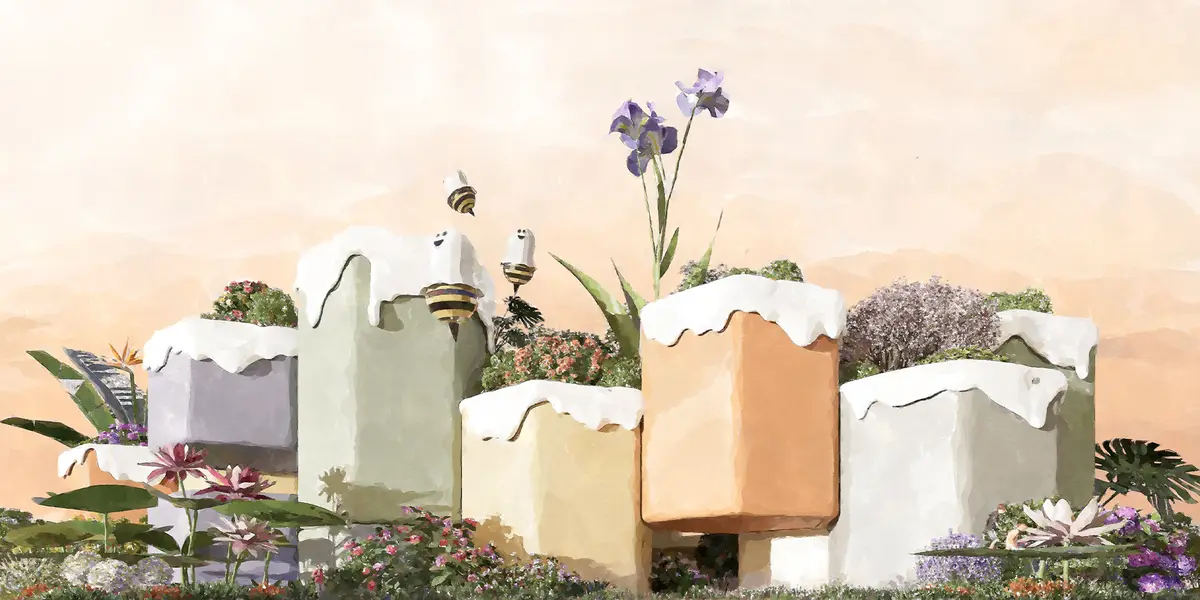
Honeybee Hospice
this hospice care center hope to encourage move-in children to spend their short and splendid time like lively little bees, in this care center with green plants and flowers.
In addition to providing patients with medical care to relieve the symptoms of their disease, delay the development of the disease, and basic psychological counseling, can the hospice care center do more for them?
We believe that the first thing we should provide is a home with a sense of belonging. Different from the cold and long corridor of the inpatient department, the wards here can be grouped, and the friends in the several wards have their own domains. Here, they share their toys and sunbathe together on the balcony.
The design hopes that through the creation of three-dimensional greening, children can be exposed to nature in every place nearby, increasing the natural vitality and weakening the cold feeling of the hospital. In addition to the exclusive balconies in each unit, the courtyard on the first floor is also full of green plants and playgrounds, where children can play. Terraces on each floor are arranged into gardens, and a flower house is specially set up for tropical plants on the roof terrace. It encourages children to go out to play and increase the possibility of meeting new playmates from other patient units.
There should also be a place with social relations. Before they became patients in the hospice care center, they were also school students, friends' favorite playmates, and outstanding neighbors in the community. Their social relations should not be completely wiped out because of illness. Under the tense land conditions, we vacate the northeast corner of the site as a street park. We hope that the local students can have good places to play after class, neighbors have a place to walk after dinner, and that children in the hospice center make new relationships again.
In the limited time, children can also arrange their own daily plans according to their own preferences and wishes. They can grow their favorite plants on the terraces and roof gardens; they can participate in the workshop’s manual courses, decorating their own home with hand-made craft or giving it to someone they love. Also, the children can actively interact with online volunteers and work together to achieve small goals. Through the realization of the plan and the dedication when participating in activities, children's daily lives will be enriched, and at the same time, children's self-worth identification will be enhanced.
The hexagonal shape, is the result of the evolution of the plan. As the motif of the plane, it has a smaller surface area than an equivalent rectangle or square, but has the same floor area. Less surface area means less heat and cooling load. At the same time, every room can make the best use of the scenery outside the window.
Children in the hospice have clear needs for social and group belonging, nature, and personal values, which are actually very similar to the behavioral patterns of bees. These insects fly around between flowers and nests, achieving their value. The motif of plane and shape is finally determined to be a hexagon due to the above consideration. Therefore, this hospice care center uses the little bee as a cartoon image, hoping to encourage move-in children to spend their short and splendid time like lively little bees, in this care center with green plants and flowers.

Popular Articles
Popular articles from the community


Co-Life: Senior Housing Design That Reconnects Older Adults With the City
Co-Life reimagines senior housing design through healing gardens, shared streets, workshops, and a sustainable community across generations.

The Musturak Paradise: Senior Living Architecture for a Connected Future in Temara, Morocco
The Musturak Paradise reimagines senior living architecture in Temara via private homes, social spaces, culture, community, and shared care.

Little Red Riding Hood: Architectural Design as a Journey Through Fear, Light, and Storytelling
Little Red Riding Hood reimagines the fairy tale through architectural design shaped by fear, light, scale, memory, uncertainty, and choice.

Lunar Spiral: Space Architecture Shaped by the Mathematics of the Universe
Lunar Spiral reimagines space architecture through Fibonacci geometry, lunar regolith, levitating habitats, and self-sustaining Moon living.

Similar Reads
You might also enjoy these articles
The Rhythm of Seasons
A Farmers' Market Connecting Nature and the City

More Than a Building-Designing a Living System
More Than a Building-Designing a Living System
Base Beyond
DESERT COMPOUND ARID: TOURISM OF ABSENCE AND ABUNDANCE

Comments (0)
Please login or sign up to add comments
No comments yet. Be the first to comment!