
pk_iNCEPTiON Lets Domestic Life Spill Across Courtyards in a Narrow Maharashtra Home
In the pilgrimage town of Vani, the House of Overlaps weaves four open-to-sky voids into a 180-square-meter plot shared with neighbors on both sides.


Most houses on narrow, party-wall plots treat the outdoors as leftovers: a light well here, a setback there. pk_iNCEPTiON, led by architect Pooja Khairnar, inverts that logic in Vani, a small pilgrimage town near Nashik in Maharashtra. The House of Overlaps threads four distinct open-to-sky voids through a long east-west strip, turning unbuilt space into the primary organizational device. Each void does different work: welcoming 50 to 60 daily visitors to the family's priesthood practice, pulling cross-ventilation through party walls, staging family meals, or simply letting the sky in.
What makes the project genuinely interesting is its refusal to fix rooms to single functions. The street-facing verandah is simultaneously an office, a living room, and a threshold between the town and the household. The kitchen connects to the parking court, the dining area, and two standing balconies, each oriented toward a different audience. Boundaries between public service and private life shift throughout the day, which is not a design conceit but a direct response to how a priestly family actually lives. The architecture acknowledges domesticity as temporal, layered, and social rather than static.
Terracotta Volumes and the Weight of Context
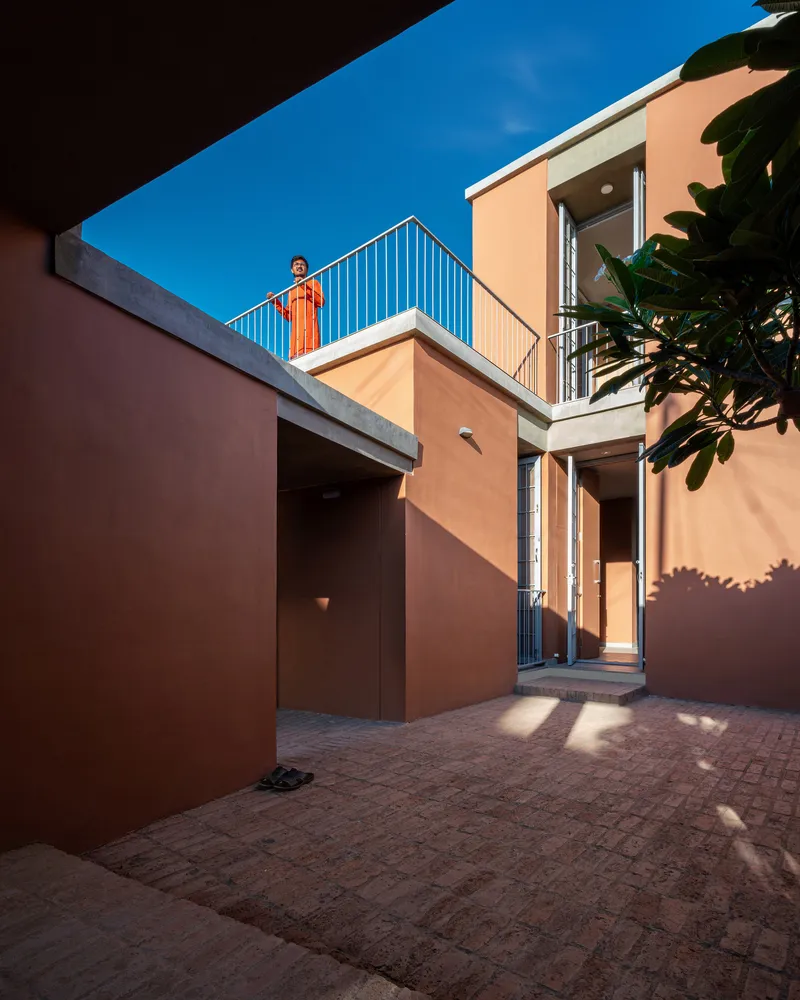
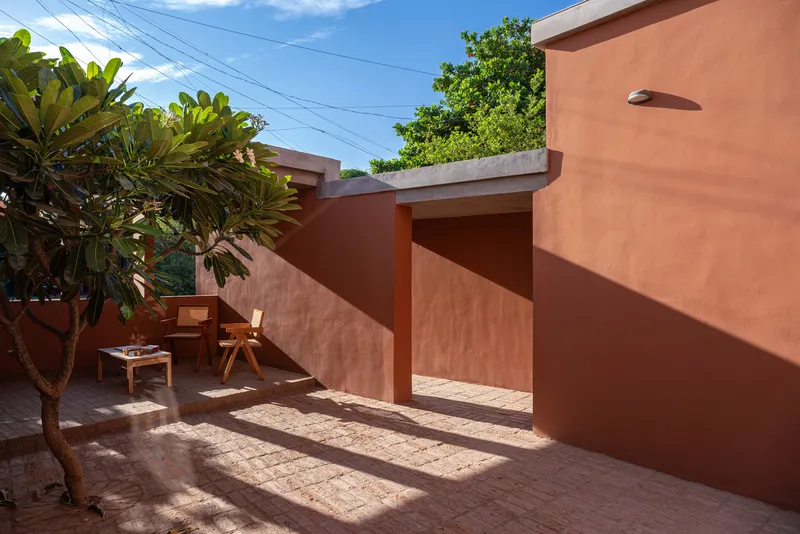
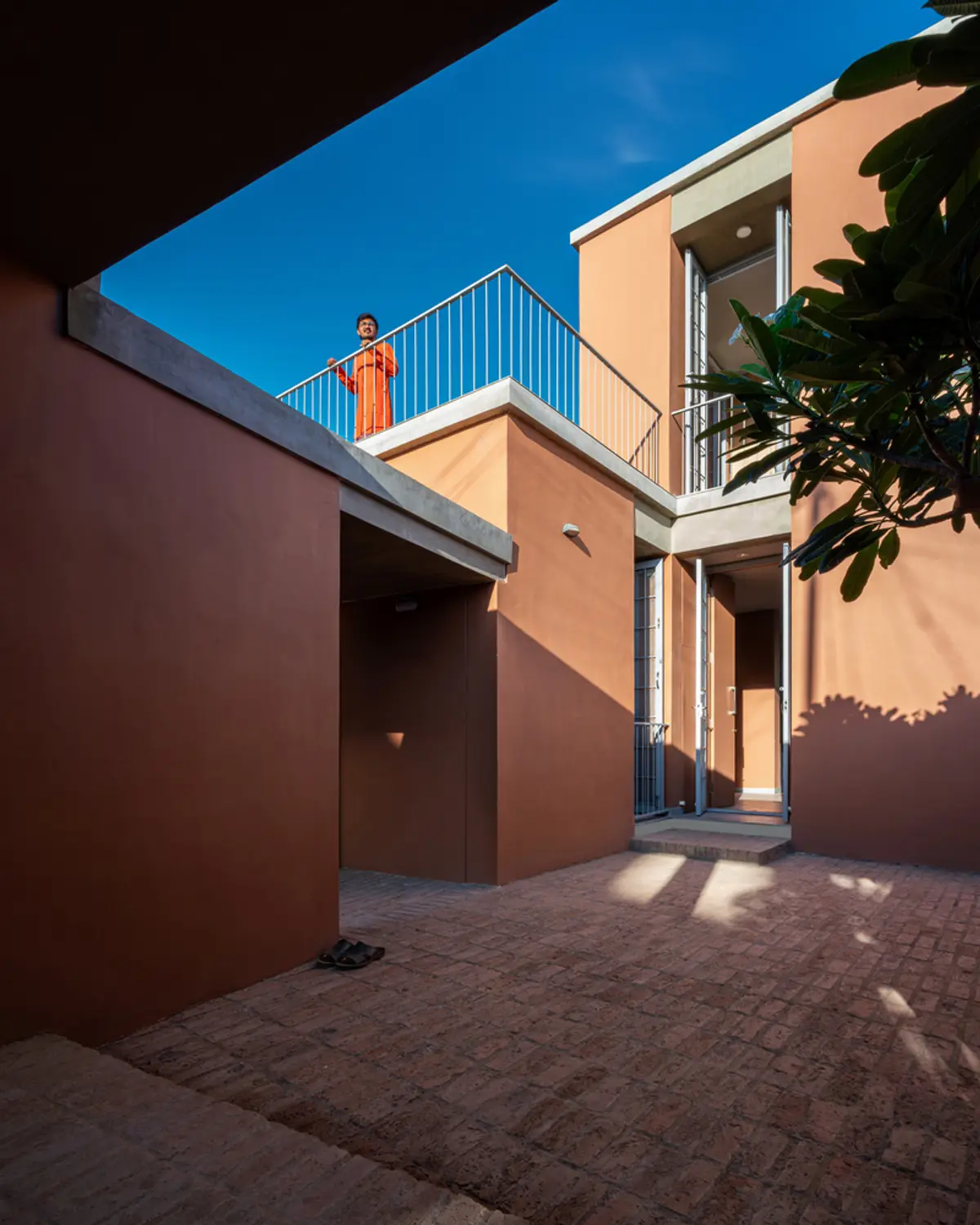
Seen from the courtyard, the house reads as a stack of terracotta-plastered volumes punched with deep openings and balconies. The material palette is deliberately restrained: warm earth-toned plaster, timber, and cane. Nothing competes with the spatial sequence itself. The rooftop terrace, shaded by surrounding trees and furnished with simple timber pieces, feels less like an add-on amenity and more like a fifth void, open to the sky and continuous with the domestic rituals below.
The upper balcony, visible from the courtyard with a figure standing in it, reveals the vertical relationship between floors. Bedrooms overlook the private court below, turning a narrow section into a double-height breathing space. In a semi-rural town where plots are tight and party walls are shared, this vertical porosity is how pk_iNCEPTiON negotiates between density and light.
Where the Public Meets the Domestic
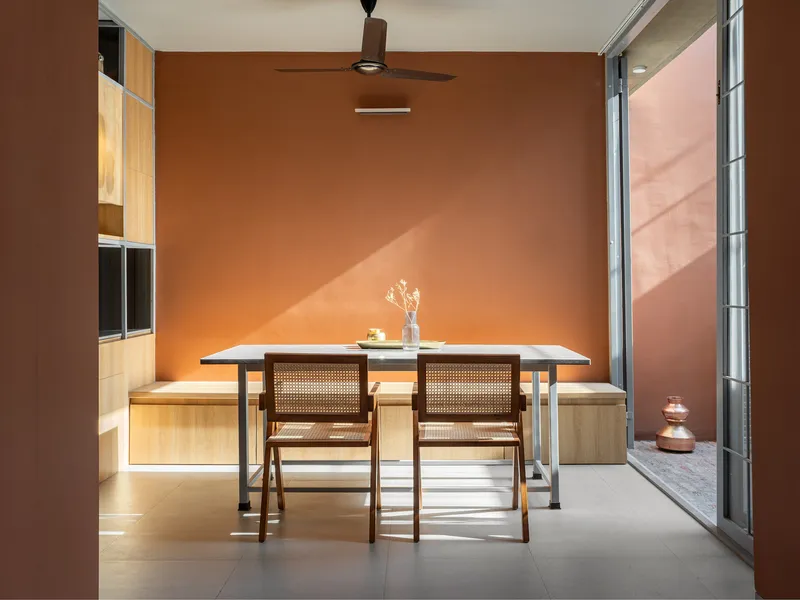
The dining area captures the project's central idea in a single frame. Cane-backed chairs sit on a terracotta-paved floor that extends without interruption into the courtyard beyond. There is no sliding door marking inside from outside, no change of ceiling height announcing a different zone. The court simply begins where the roof stops. Timber cabinetry lines the interior edge, anchoring the room in domestic function, while the courtyard pulls it toward openness and weather.
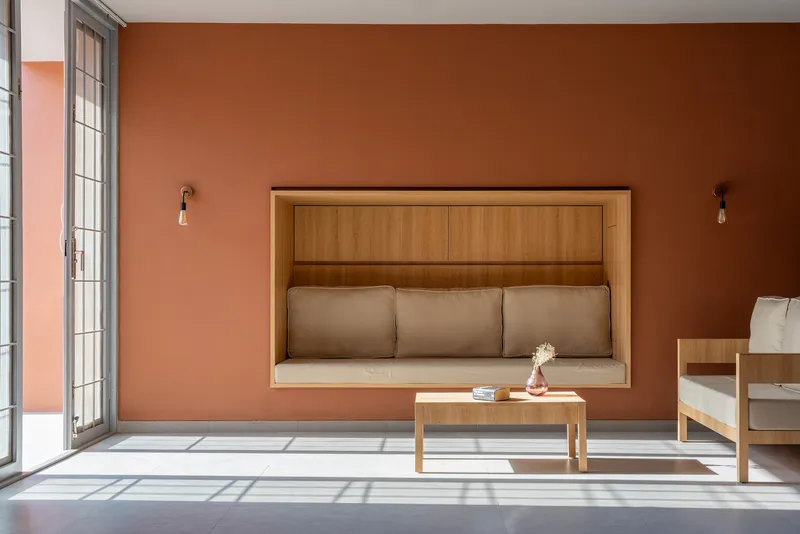
A built-in timber bench recessed into a terracotta wall operates at a more intimate scale. Morning light enters through gridded doors, casting a precise pattern across the seat. Moments like this, small, calibrated, and specific to the sun's angle, accumulate into a spatial quality that plans alone cannot convey. The house earns its atmosphere not through grand gestures but through the careful placement of thresholds and apertures.
Corridors as Rooms of Light
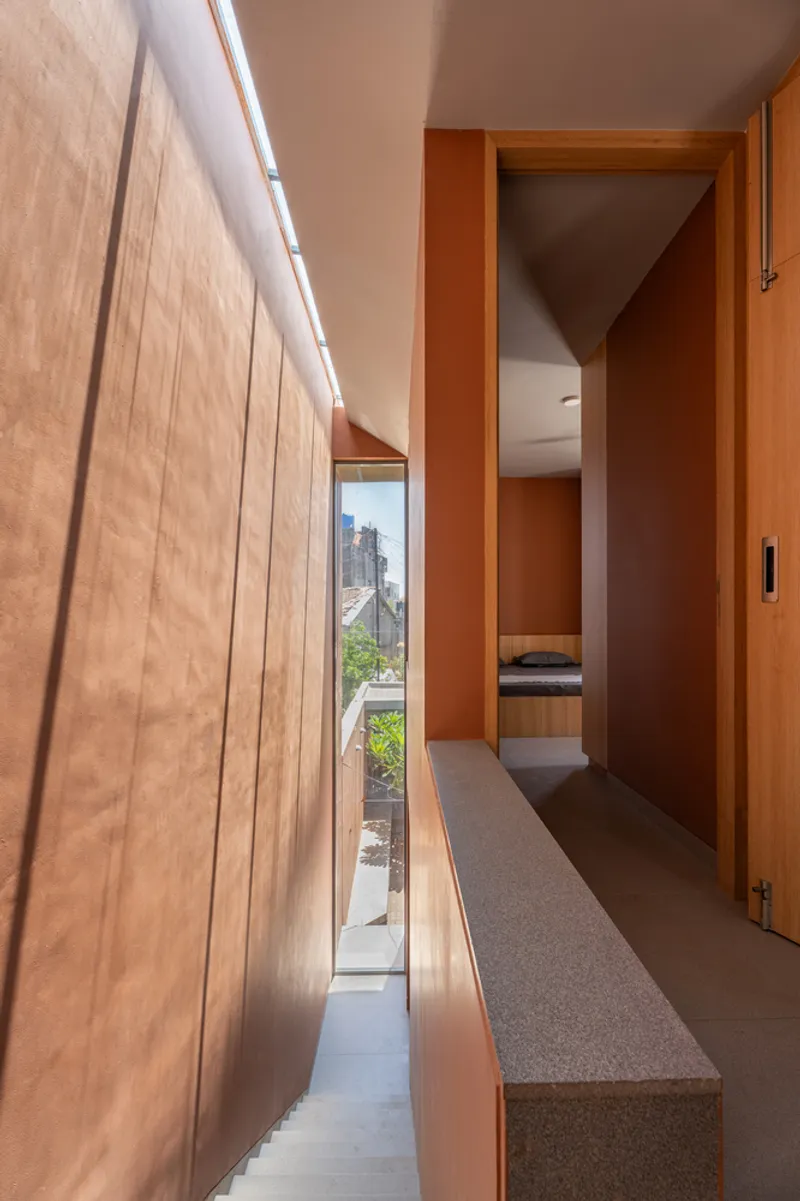
On a plot this narrow, corridors are unavoidable. pk_iNCEPTiON treats them as opportunities rather than residual space. A linear skylight runs the length of one passage, washing terracotta-painted walls in a blade of daylight that shifts with the hours. Timber cabinetry built into the corridor walls adds storage without widening the section. The result is a space that feels purposeful, almost meditative, rather than merely connective.
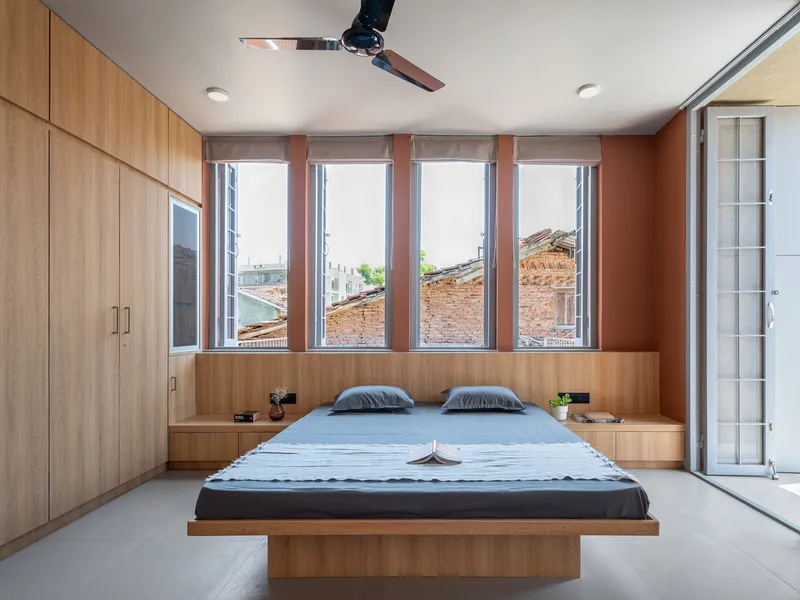
Upstairs, the bedroom demonstrates a similar economy. A platform bed sits below four vertical windows that frame views of terracotta rooftops, while a timber window seat occupies the depth of the wall. The hierarchical scaling that pk_iNCEPTiON employs, moving from seven-foot entrance heights to eight-foot verandah ceilings to nine-foot ground-floor rooms to double-height courts, gives each space a distinct atmospheric register despite the compact footprint.
Plans and Drawings
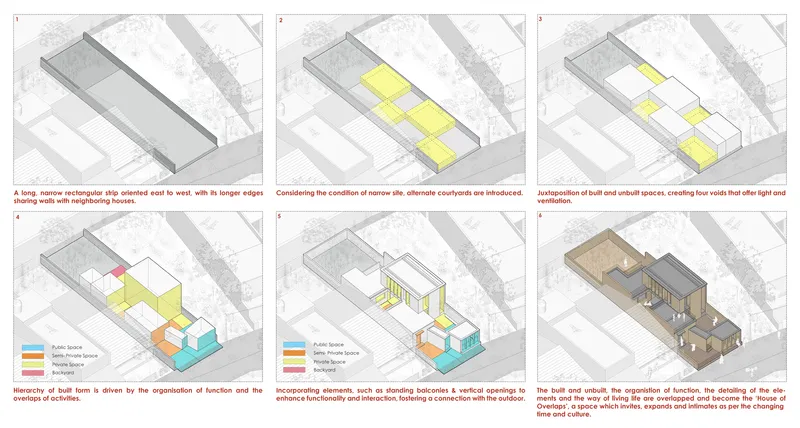
The axonometric diagram series traces the project's logic step by step: an elongated rectangular volume is carved and subdivided into programmed spaces punctuated by voids. Reading left to right, you can see how the four open-to-sky courts are not afterthoughts but the generative cuts from which every room takes its shape, light, and ventilation. The drawing makes explicit what the photographs only imply: that the unbuilt portions of this house do more spatial work than the built ones.
Why This Project Matters
The House of Overlaps matters because it takes the most ordinary condition in Indian residential construction, a narrow party-wall plot in a small town, and demonstrates that it can yield architecture of real spatial intelligence. pk_iNCEPTiON does not import a vocabulary from elsewhere or lean on expensive materials to generate interest. The project's richness comes from section, sequence, and the deliberate blurring of functional boundaries, strategies available to any practice willing to spend time rather than budget.
It also presents a convincing counter-argument to the idea that homes for religious practitioners must look traditional or that semi-rural clients cannot engage with contemporary spatial thinking. The family's priesthood practice, with its daily flow of visitors, is accommodated not through a formal office annexe but through the calibration of thresholds and overlaps. Architecture here is not a container for life; it is the mechanism by which public and private, ritual and routine, coexist on 180 square meters of shared ground.
House of Overlaps by pk_iNCEPTiON, Vani, Nashik, Maharashtra, India. 180 m². Photography by pranitborastudio.
About the Studio
Share Your Own Work on uni.xyz
If projects like this are the kind of work you want to make, uni.xyz is a place to publish your own, find collaborators, and enter design competitions.


Popular Articles
Popular articles from the community


graciastudio Turns a Viewless Tijuana Lot Inward Around a Courtyard of Concrete, Timber and Trees
In Tijuana, Jorge Gracia's GA2 House stacks a timber-clad private floor over exposed concrete and replaces a missing view with a planted interior patio.


Aquadapt: An Underwater Habitat That Rewrites Its Rooms by the Hour
Curved modules ring the seabed while one shell shifts from breakfast room to cinema, farm and football pitch as residents' needs change.

Juan García Correa, John González and Claudia Rueda Sink a Circular Amphitheater into a Manizales Engineering Building
On the La Nubia campus in Manizales, Colombia, the S1 Building folds labs and offices into a hillside of ramped lawns that double as a campus route.

Cube Design Draws an Ecological Corridor Between Two Shenzhen Hills with the Nankai Building
Beside Shenzhen's container docks, the Nankai Building pairs stacked balconies with a climbing green screen to connect two hillsides across its height.

Similar Reads
You might also enjoy these articles


Hodi-Mandai Geram
Project Function: Preservation and revitalization of the Intangible heritage and socio-spatial identity of the Hodi by Housing, Cultural Memory Center, Sacred Grove, landscape, local tourism economy


Olio Towers: A Mid-Rise for Performers That Fuses Housing, Rehearsal, and Stage
Located blocks from Houston's Theater District, this modular tower stacks living units around a central performance atrium.

Oasis: Modular Green Housing Carved into Dhaka's Urban Fabric
A shortlisted Plugin Housing entry reclaims unauthorized settlements in Dhaka with stepped concrete volumes, green roofs, and ventilation-driven design.

Black Hole: A Floating Megastructure for the Post-Physical Era
Emiliano Mazzarotto envisions a spherical, self-scaling arena where e-sports, digital hotels, and holographic stadiums replace traditional public space.

Explore Ooze Architects Competitions
Discover active competitions in this discipline

Challenge to reimagine the Iron Throne

Photograph architecture without architects

Illustrate the lost glory of Angkor Wat - Render Challenge

Design challenge to reuse E-waste
Comments (0)
Please login or sign up to add comments
No comments yet. Be the first to comment!