

Moon Base 2124: Pioneering Lunar Architecture with Project Artemis
Exploring Project Artemis's architectural innovations and sustainable technologies for Moon Base 2124's lunar habitation.


In the not-so-distant future, humanity is set to establish its first permanent settlement on the Moon. The "Moon Base 2124 - Project Artemis," a visionary project created by NA NA, Editor's Choice entry of Moon Base 2124, represents a monumental leap in extraterrestrial architecture and human ingenuity. This article explores the detailed planning, architectural innovations, and technological marvels that will bring Moon Base 2124 to life, setting the stage for a new era in space exploration.
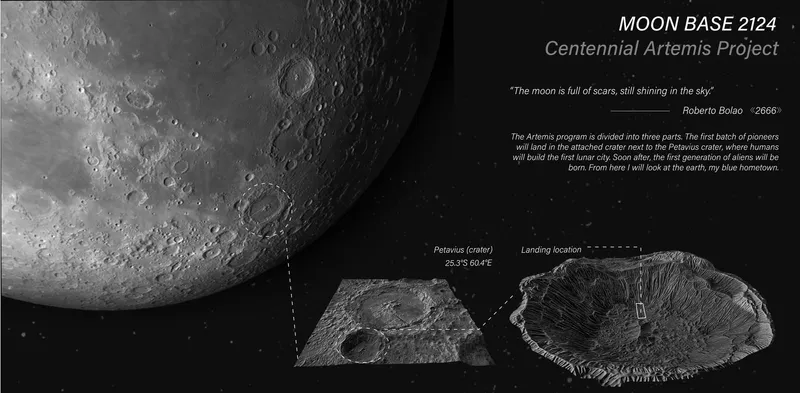
Project Artemis: A Comprehensive Overview
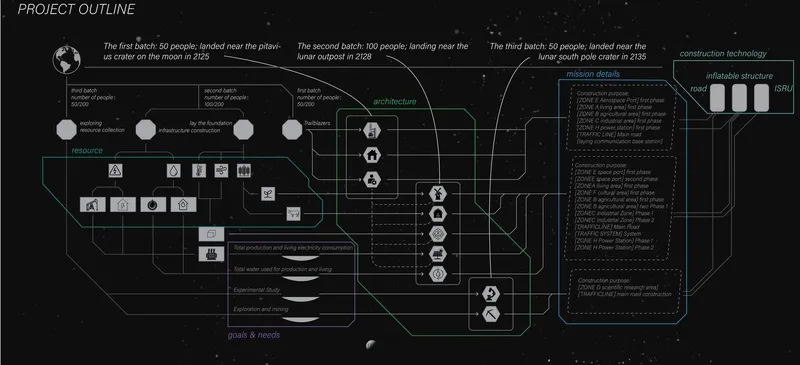
Project Artemis is structured into three meticulously planned phases, each targeting specific milestones to ensure the successful establishment and sustainability of the lunar base.
Phase One: Initial Settlement (2125)The first group of 50 pioneers will land near the Petavius Crater, setting up modular inflatable facilities. This initial phase focuses on resource collection and laying the groundwork for future expansion.
Phase Two: Expansion and Infrastructure (2128)The second group, consisting of 100 individuals, will arrive to construct additional infrastructure using lunar materials for 3D printing. This phase aims to create a self-sustaining environment, enhancing living conditions and operational capabilities.
Phase Three: Full-Scale Settlement (2135)The final group of 50 pioneers will focus on specialized construction, including independent power stations, water facilities, and residential areas. This phase will see the settlement grow to support 200 inhabitants.
Architectural Innovations and Design Principles
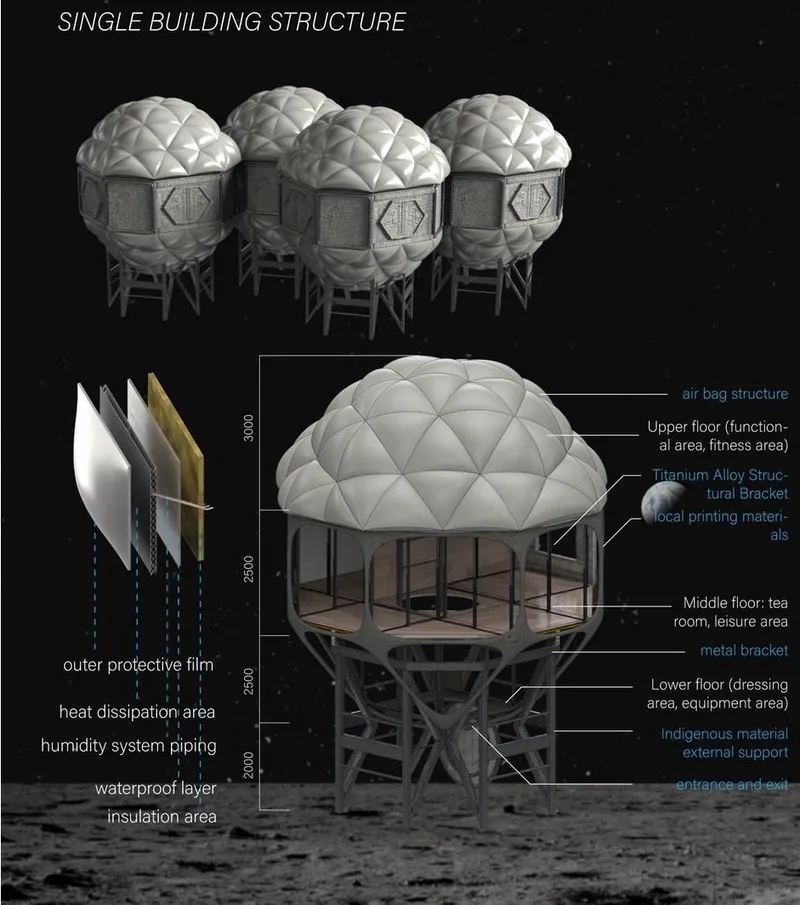
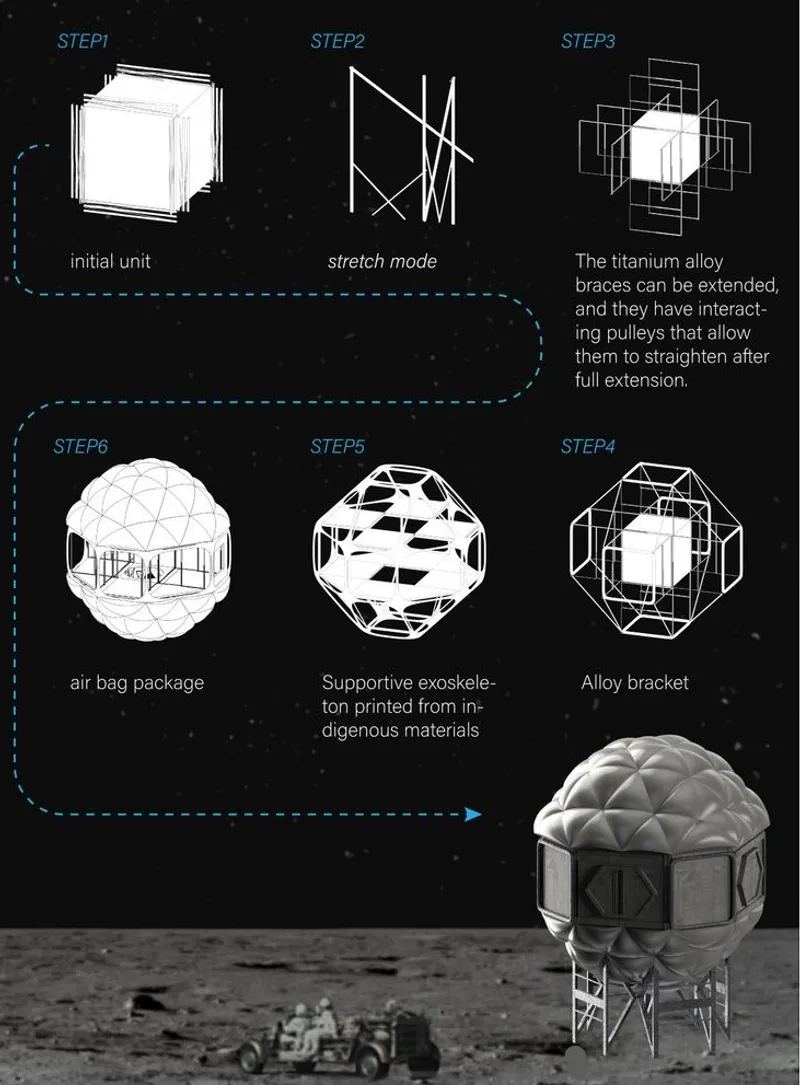
Modular Inflatable StructuresThe initial structures are modular inflatable units designed for easy deployment and transportation. These units provide immediate shelter and operational space, essential for the pioneers' survival and initial operations.
Utilization of Lunar MaterialsPhase two emphasizes the use of lunar materials for construction. By harnessing 3D printing technology, structures can be built using locally sourced materials, drastically reducing dependence on Earth-based resources and ensuring long-term sustainability.
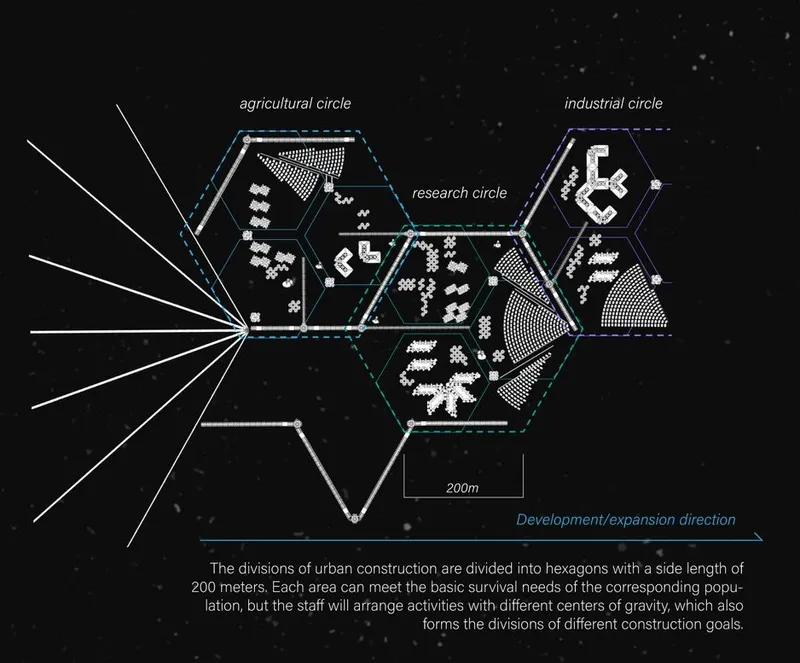
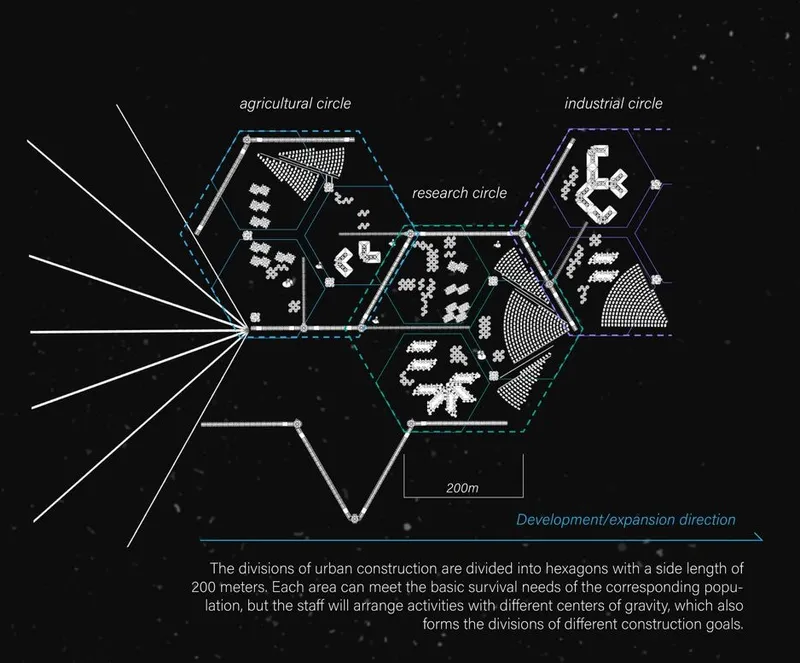
Urban Layout and Sector DesignThe urban design is based on hexagonal divisions, each with a side length of 200 meters. These hexagons are designated for different functions, such as agricultural, industrial, and research activities, ensuring efficient space utilization and fostering a self-sustaining environment.
Advanced Road SystemsThe road infrastructure is designed as a sunken, closed-loop system. This design ensures safe and rapid transportation across the base, comprising transit, border, and road components. The system is engineered to rotate and adapt to the lunar terrain, providing flexibility and reliability.
Multi-Layered Building StructuresResidential and operational buildings feature a multi-layered design:
Upper Floor: Functional and fitness areas.
Middle Floor: Leisure and common areas.
Lower Floor: Dressing and equipment storage.
These structures include protective layers to shield inhabitants from harsh lunar conditions, such as intense solar radiation and extreme temperature variations.
Sustainable Energy and Resource Management
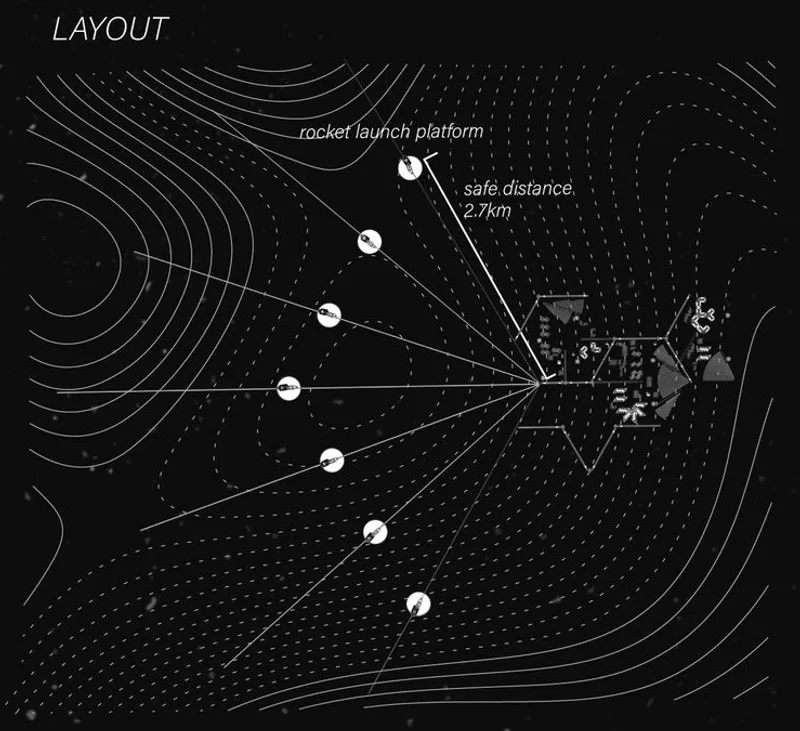
Solar Energy UtilizationSolar panels installed on the crater's ring wall will harness solar energy, providing a renewable power source for the base.
Helium-3 and Fusion PowerFuture plans include utilizing lunar helium-3 for fusion reactors. This abundant resource will enable the construction of tokamak devices, meeting the growing energy demands of the expanding settlement.
Technological and Environmental Considerations
Survey of Available TechnologiesA comprehensive survey of available technologies ensures that only the most advanced and suitable technologies are integrated into the project, enhancing its viability and efficiency.
Adaptation to the Lunar Environment The settlement's location at the bottom of a crater provides natural protection against solar winds and temperature extremes. This strategic choice helps maintain a stable environment, essential for long-term habitation.
Moon Base 2124 - Project Artemis is not just a dream but a meticulously planned reality that embodies human ingenuity and the spirit of exploration. By leveraging advanced technologies and innovative architectural designs, this project paves the way for sustainable lunar habitation and future interplanetary settlements. As we stand on the cusp of this new frontier, Moon Base 2124 serves as a testament to what humanity can achieve when it dares to dream beyond the stars.


Popular Articles
Popular articles from the community


Opera on the Sea: Driftwood Logic Shapes a Timber Opera House on Estonia's Coast
Trevor Orgill's opera house translates the entangled drift of floating timber into a civic building where wood, water, and music converge.

The Amber Palace Opera: A Geological Fiction Surfaces on Tallinn's Baltic Waterfront
Pierre Brillard reimagines a Baltic legend as a public landscape, opera house, and waterfront promenade rooted in Tallinn's coastal identity.

Manzana Morphosis: Stretching Barcelona's Grid into a Living Landscape for 2050
A radical reworking of the Eixample manzana turns density into a tool for generous public space, vertical ecology, and environmental performance.

Extended Shell: Retrofitting Kolkata's Balconies as Living Urban Thresholds
A modular retrofit system recovers the social and environmental intelligence of Kolkata's historic verandas for contemporary Park Street residents.

Similar Reads
You might also enjoy these articles

Day and Night Park: A Time-Based Urban Newsstand in Beijing
A temporary urban newsstand in Beijing blending travel, light, and reading through poetic colors, compact form, and community-focused design.

Modernist Patio Renovation in El Masnou, Barcelona by Oliver Segura Arquitectura + Cebrià Arquitectura
Modernist patio renovation blending tradition and innovation with a movable pool, leveled floors, and Catalan materials in El Masnou.

Alto Residencial Coop: Cooperative Housing Development in Santiago de Compostela by Carbajo Barrios Arquitectos
A linear cooperative housing complex blending white volumes and perforated metal façades, enhancing community living, natural light, privacy, and urban integration.
Vil Genis School by BPA ARCHITECTURE – Massy, France
Vil Genis School in Massy, France, features sustainable design, south-facing classrooms, community integration, accessible spaces, and modern educational architecture.

Explore Lunar Competitions
Discover active competitions in this discipline

Challenge to reimagine the Iron Throne

Photograph architecture without architects

Illustrate the lost glory of Angkor Wat - Render Challenge

Design challenge to reuse E-waste
Comments (0)
Please login or sign up to add comments
No comments yet. Be the first to comment!