
1+1>2 Architects Nestles a Thatched-Roof School into Vietnam's Rice Terraces
In Vietnam's northern highlands, a community-built school fuses ethnic building traditions with passive climate strategies for 78 students.


There is no shortage of architects willing to design schools in developing regions, but very few manage to produce a building that looks as though it grew out of the landscape rather than landed on it. 1+1>2 Architects, a Vietnamese practice with more than 52 completed school sites in remote mountainous areas, has built exactly that kind of structure in Lao Cai province: a steep-gabled pavilion roofed in hand-collected thatch, set among flooded rice terraces and serving 78 students from the Tay, Nung, Dao, and Mong ethnic groups. The project replaced an earlier school that was close to collapse, and it did so with materials sourced almost entirely from the surrounding commune.
What makes the project genuinely interesting is not its good intentions but the intelligence of its construction logic. Over 3,000 unburnt earth bricks were pressed on site from local soil mixed with hydraulic admixtures, producing a CO2-neutral wall system 15 centimeters thick. The roof is a bamboo frame carrying more than 4,000 dried leaves gathered from the mountains above the village. These are not aesthetic gestures; they are thermal strategies. The brick walls admit daylight and channel wind in summer, then seal against cold in winter through pivot-openable windows and ventilation bricks. The result is a school that functions passively through highland temperature swings without mechanical systems.
Landscape as Context, Not Backdrop
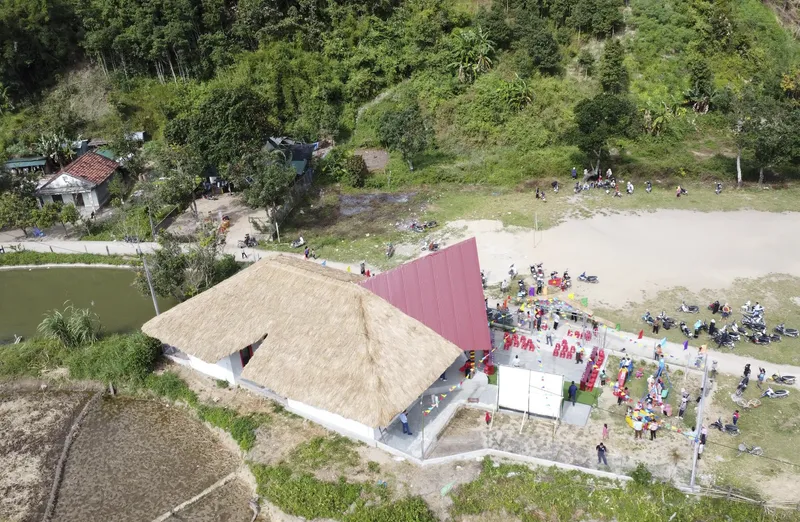
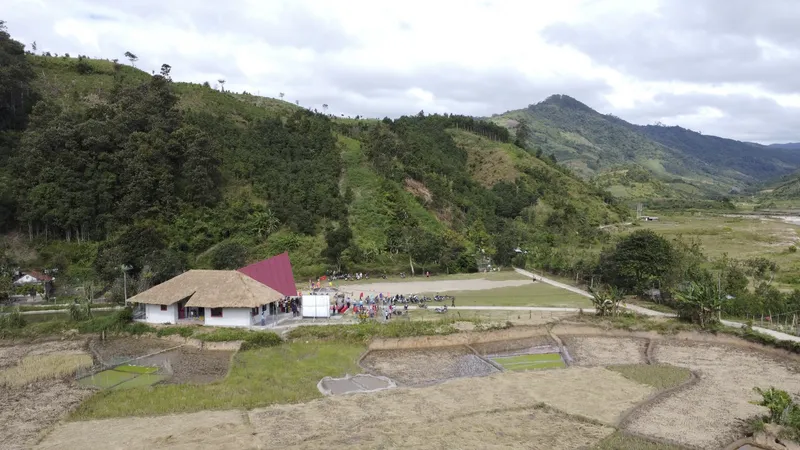
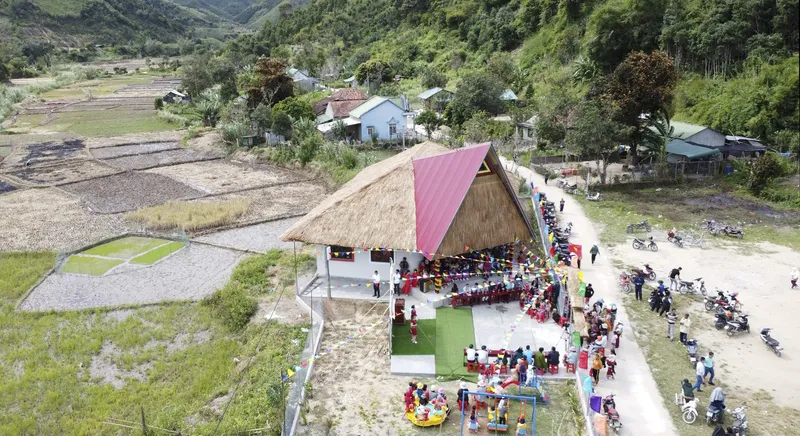
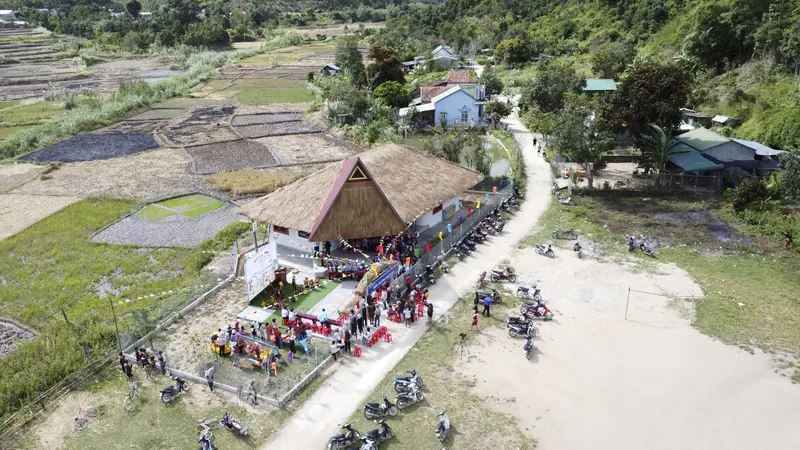
Seen from the air, the building barely registers against the terraced paddies that surround it. Its triangular roof profile echoes the mountain ridgelines behind, and its low footprint avoids dominating the agrarian landscape. The siting is deliberate: two classrooms sit under one large thatched roof, with the open space between them serving as a communal yard where children from different ethnic groups interact. The school is not a compound walled off from village life; it is continuous with it, its plaza doubling as a gathering space for community events.
The aerial views reveal how tightly the building is woven into the agricultural grid. Roads for material transport were paved by community members during construction, a detail that underscores the reciprocal relationship between the school and its surroundings. The building does not impose infrastructure; it absorbs it.
A Roof That Does Real Work
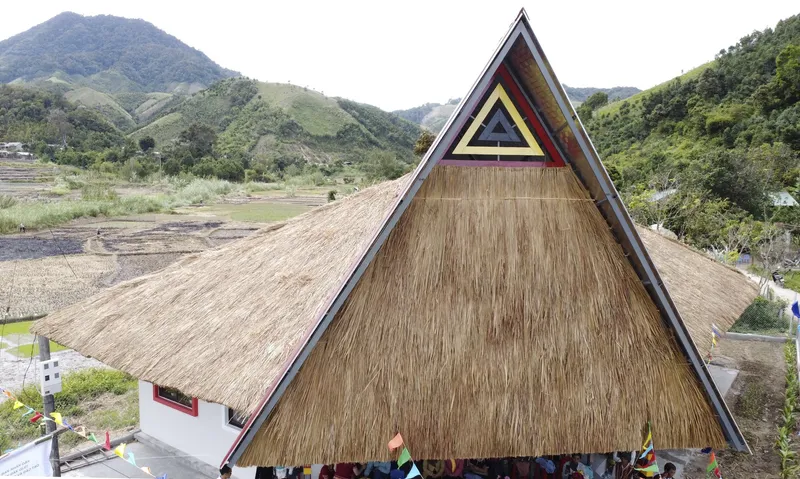
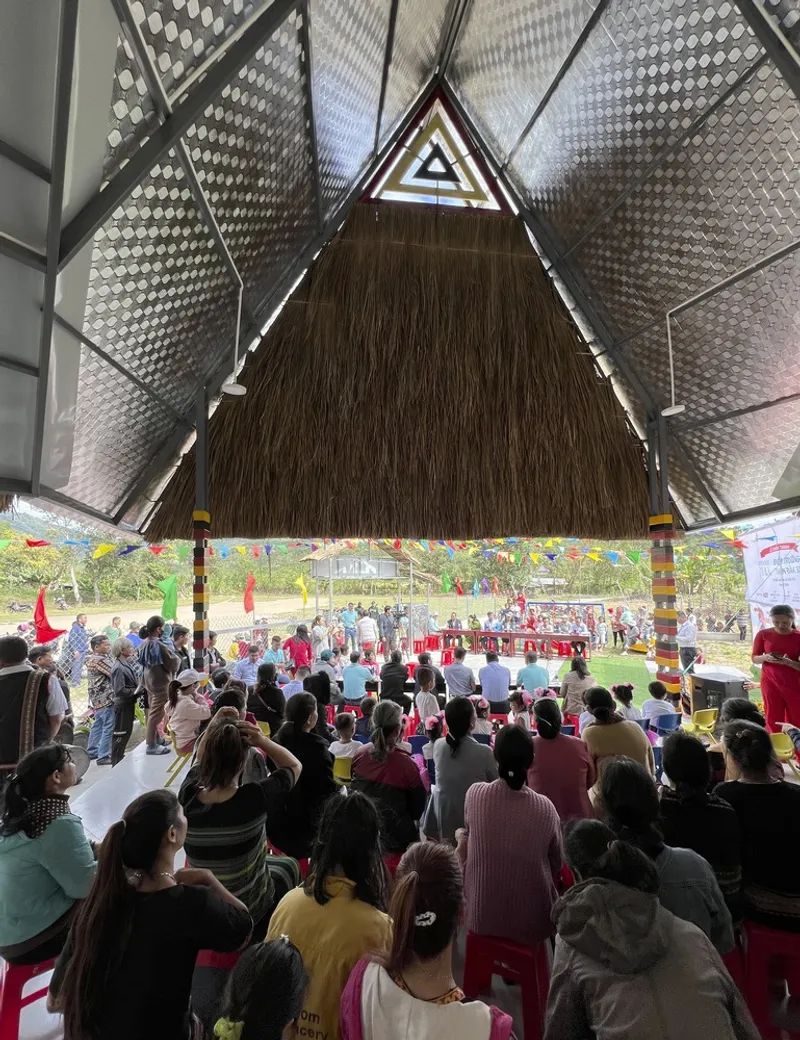
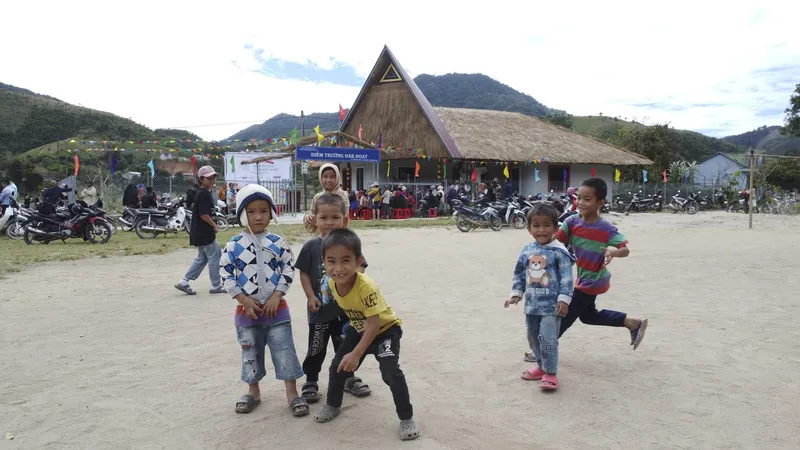
The steeply pitched thatched roof is the building's most visible element and its most functional one. The dual-layer system pairs a traditional thatch canopy over a waterproof metal base, achieving insulation, noise reduction, and durability in a single assembly. The pitch is not decorative: it sheds monsoon rain efficiently and creates a tall interior volume that allows hot air to rise and escape. Beneath the thatch, a perforated metal ceiling creates a secondary thermal buffer while permitting airflow through the section.
The triangular gable, decorated with geometric patterns drawn from local ethnic traditions, faces the open plaza and frames the entrance. It is the closest the project comes to ornament, and even here the gesture serves a ventilation purpose, allowing cross-breezes to pass through the upper volume of the building.
The Corrugated Metal Wing
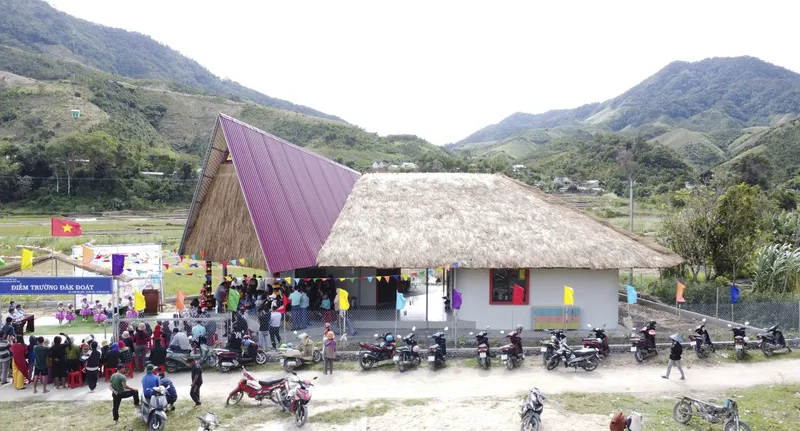
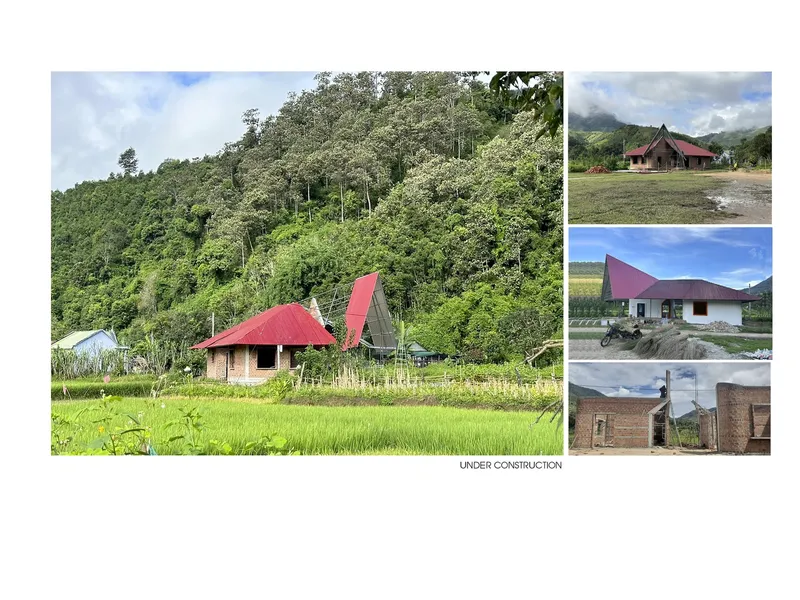
Not everything is thatch and bamboo. A secondary wing with pink corrugated metal roofing sits adjacent to the main pavilion, creating a split composition that distinguishes the two program areas while keeping them under a unified site strategy. The metal roof, supplied through partnerships with Vietnam Steel Corporation and Sumitomo Corporation, provides a more conventional weatherproofing solution for spaces that require it. The color, a warm pink that reads almost terracotta at a distance, avoids the clinical look of standard galvanized steel and fits comfortably against the reds and greens of the hillside.
The split between thatched and metal roofs is an honest expression of the project's material reality. Not every surface can be built from gathered leaves, and 1+1>2 does not pretend otherwise. The hybrid approach acknowledges that sustainability in remote construction is often about strategic choices rather than purist commitments.
Interior Clarity
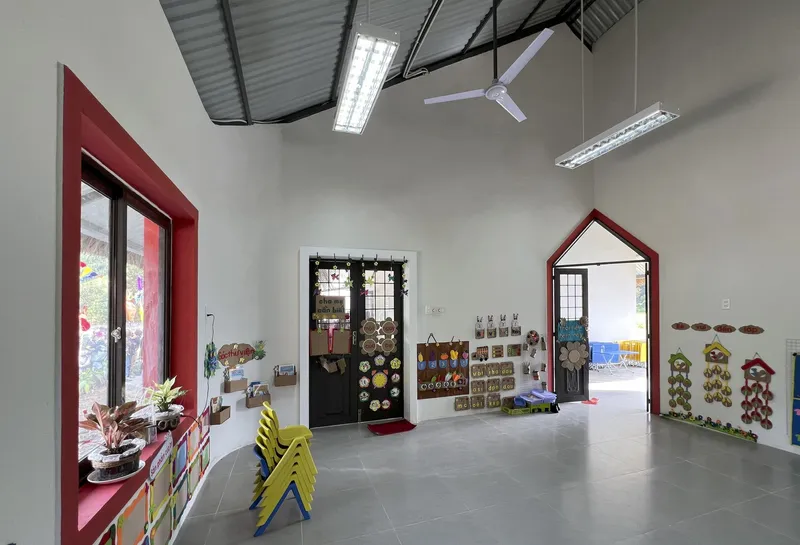
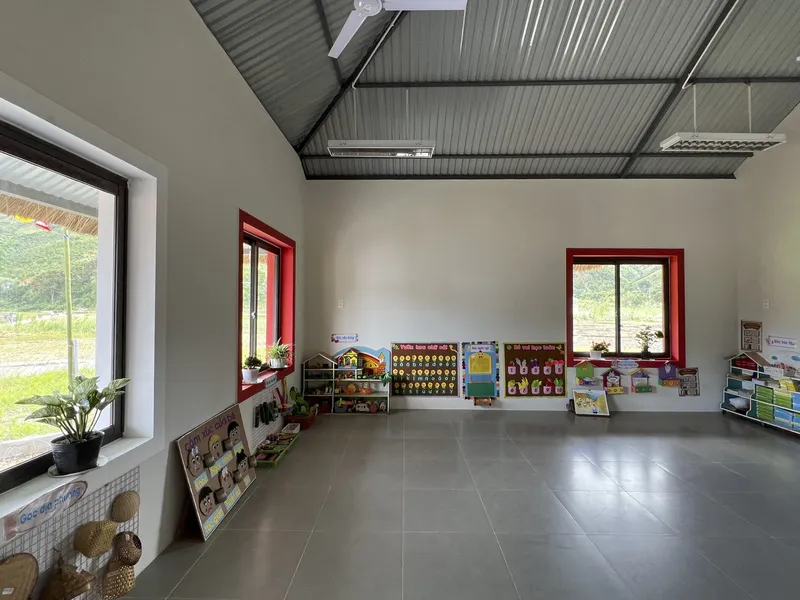

Inside, the classrooms are bright, straightforward spaces. White-plastered walls bounce daylight deep into the rooms through red-framed windows and doors that punctuate the long elevations. The exposed metal truss ceiling is left honest, its structure legible and its corrugated surface providing acoustic diffusion. Red paint on the window and door frames is the only color intervention, and it works: it defines openings clearly against the white walls and gives the interior a graphic coherence that helps orient young students.
The pivot windows deserve attention. They are not just operable but strategically paired with ventilation bricks set into the wall fabric, creating a layered system for controlling air and light. In summer, everything opens and the classroom becomes almost a covered outdoor room. In winter, the same elements close to retain warmth from the thermal mass of the earth-brick walls. It is a passive climate strategy that requires no instruction manual, only common sense.
Threshold and Transition

The moments between inside and outside are handled with care. A red-framed doorway beneath the corrugated ceiling opens directly onto the thatched gable wall, creating a layered threshold where two material systems meet. The transition is not abrupt; it is mediated by the depth of the wall, the shadow of the overhang, and the change in ceiling material. These are small architectural moves, but they give the building a spatial richness that belies its modest budget.
From the upper vantage point, the community gatherings visible below the thatched roof confirm that the school functions as more than a classroom block. It is a social infrastructure, a covered public space that belongs to the village as much as to the students. The open yard between the two classroom volumes becomes a stage, a market, a meeting ground: exactly the kind of flexible communal space that top-down school designs almost never provide.
Community Construction as Design Method

1+1>2 describes its construction process as a two-way data transmission: the architects guide local workers in new techniques while learning traditional indigenous methods in return. On-site clay brick machines were manufactured for the project, allowing villagers to produce the 3,000-plus earth bricks needed from their own soil. This is not voluntourism; it is a genuine knowledge exchange that leaves behind both a building and the capacity to maintain and replicate it.
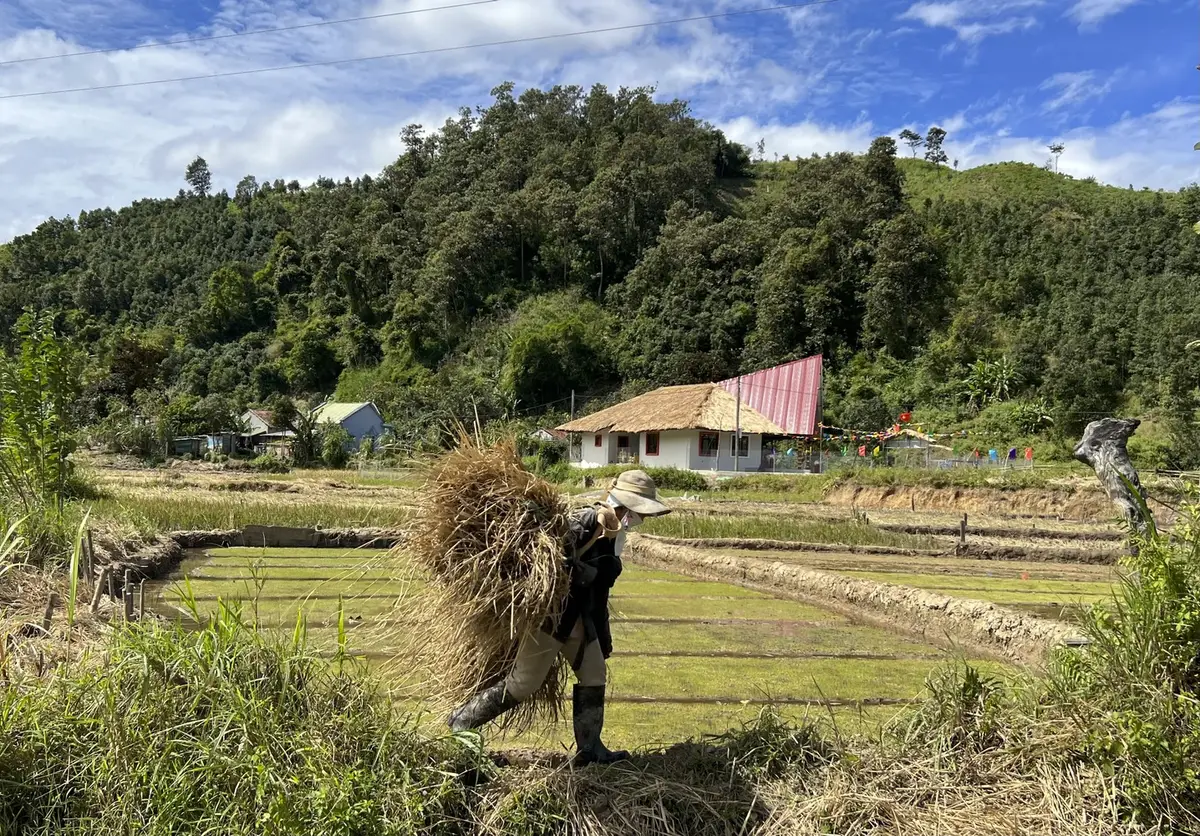
The image of a farmer carrying harvested rice stalks past the white pavilion, its reflection trembling in the flooded paddy, captures the project's essential quality. The building belongs to this place because it was made from this place, by the people who live here. That is a definition of sustainability that has nothing to do with certification systems and everything to do with continuity.
Why This Project Matters
The temptation with humanitarian architecture is to celebrate the intention and overlook the building. 1+1>2's school resists that reading because it is, on purely architectural terms, a well-resolved piece of work. The material palette is limited and honest. The passive climate strategy is legible in the plan. The relationship between the building and its landscape is specific, not generic. Transsolar's advisory role on daylighting and climate concept confirms that rigorous environmental analysis underpins the vernacular aesthetic, which makes the project a useful counter-example to the idea that local materials and technical performance are somehow at odds.
More broadly, the project demonstrates that the most impactful school architecture in developing regions is not the one that imports the most sophisticated technology but the one that extracts the most performance from what is already available. Earth, bamboo, thatch, and community labor are not concessions to poverty; they are design resources. 1+1>2 treats them as such, and the result is a building that 78 children from four ethnic groups walk into every morning knowing, on some level, that it was made for them and by their neighbors. That is what sustainable school architecture actually looks like when the word sustainable means something.
Sustainable School Architecture by 1+1>2 Architects, Lao Cai Province, Vietnam. Photographs by 1+1>2 Architects.
About the Studio
Share Your Own Work on uni.xyz
If projects like this are the kind of work you want to make, uni.xyz is a place to publish your own, find collaborators, and enter design competitions.


Popular Articles
Popular articles from the community


Play: Fragments of Their World
Familiar architecture becomes modular playground design, creating safe spaces where displaced children can learn, connect, imagine and play.

Lunar Spiral: Space Architecture Shaped by the Mathematics of the Universe
Lunar Spiral reimagines space architecture through Fibonacci geometry, lunar regolith, levitating habitats, and self-sustaining Moon living.

Co-life: Sustainable Architecture for Age-Friendly Community Living
Co-life reimagines sustainable architecture for seniors through courtyards, rammed earth, shared gardens, and spaces designed for belonging.

Little Red Riding Hood: Architectural Design as a Journey Through Fear, Light, and Storytelling
Little Red Riding Hood reimagines the fairy tale through architectural design shaped by fear, light, scale, memory, uncertainty, and choice.

Similar Reads
You might also enjoy these articles

Maya Harvest: A Cacao Resort Village Rooted in Mayan Tradition and Local Craft
Situated within a Tabasco cacao plantation, this shortlisted resort proposal merges vernacular materials with hands-on cultural immersion.
Harmonia: A River-Shaped Community That Grows Over Decades in Boa Vista
Curved pathways and modular grid structures along the Branco River create a phased settlement designed to evolve from 2030 to 2050.

The Architecture of Bathing: A Mughal Hammam Reimagined Across the Yamuna
Charlotte May's honorable mention entry for The Black Taj reinterprets Agra's bathing rituals through red sandstone, water, and framed views of the Taj Mah
Om-1: A Wall-Hung System That Moves Your Workspace Off the Desk
Modular plywood boards, magnetic pegs, and utility elements migrate clutter from the horizontal surface to the vertical plane.

Explore Educational Building Competitions
Discover active competitions in this discipline

Challenge to design public laboratory

Challenge to reimagine the Iron Throne

Photograph architecture without architects

Illustrate the lost glory of Angkor Wat - Render Challenge
Comments (0)
Please login or sign up to add comments
No comments yet. Be the first to comment!