TABULA RASA: A New Vision for Urban Regeneration Architecture in Delhi
Connaught Place reimagined—demolished and reborn as a people-centric landmark in Delhi's urban regeneration architecture.


Delhi, the capital of India, has stood as a living palimpsest of power, culture, and transformation for over two millennia. Among its most iconic urban spaces, Connaught Place represents a layered narrative—once a colonial centerpiece, now a decaying relic burdened with heritage obligations. The proposal titled Tabula Rasa by Romain Conti-Granteral, a shortlisted entry of the Neo Delhi competition, offers a provocative reimagination: demolish, redesign, and rebuild Connaught Place as a radical act of urban regeneration architecture.
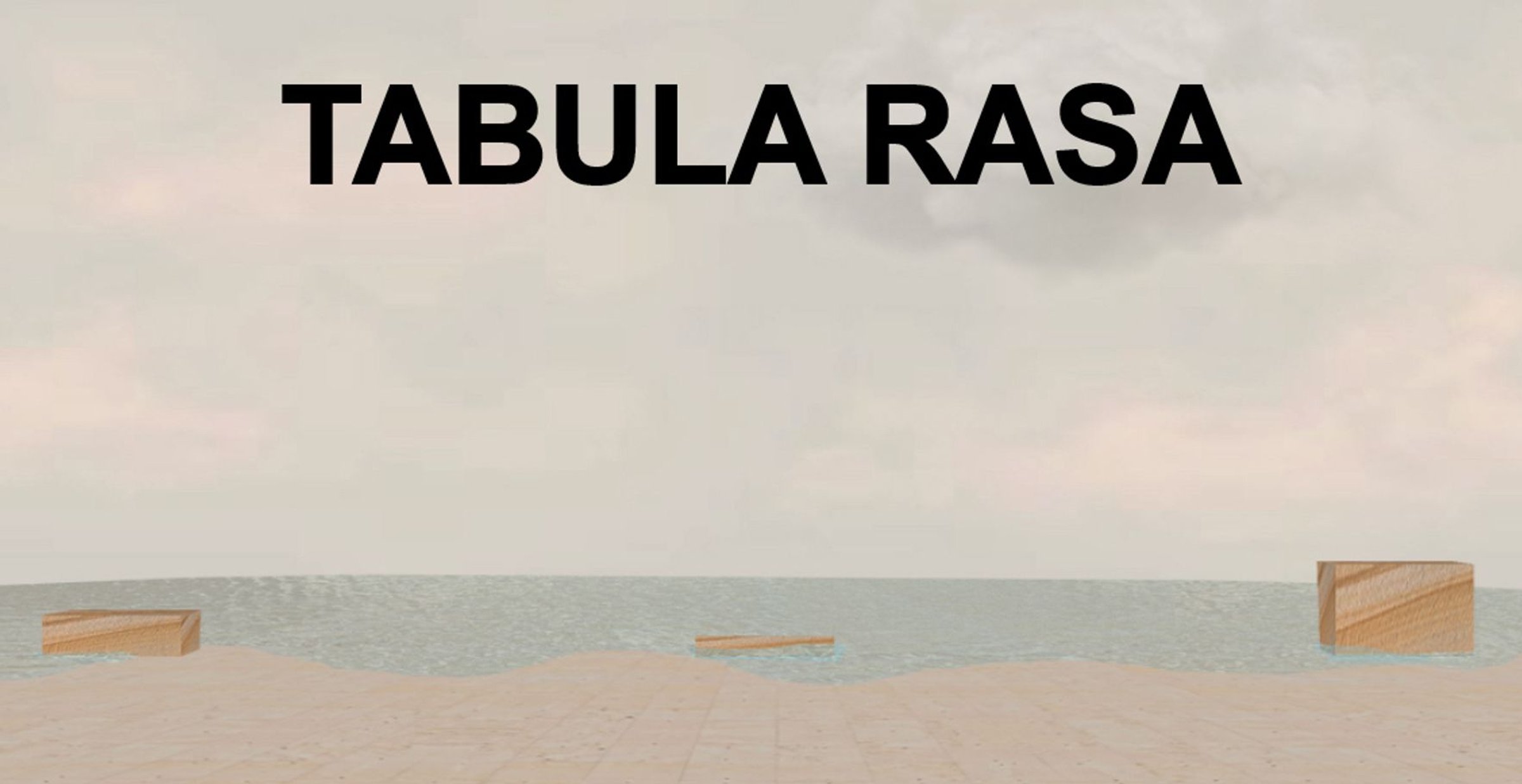
At the heart of this concept lies a bold argument: rather than preserving a built form rooted in colonial submission and structural decay, Delhi must write its own future. This means transcending the micro-rewrites—small fixes and patches that attempt to maintain the unsalvageable—and embracing a mega-rewrite. In this vision, Connaught Place becomes a clean slate, a "tabula rasa," enabling a democratic architectural response that prioritizes usability, inclusivity, and adaptability.
The Urban Regeneration Strategy
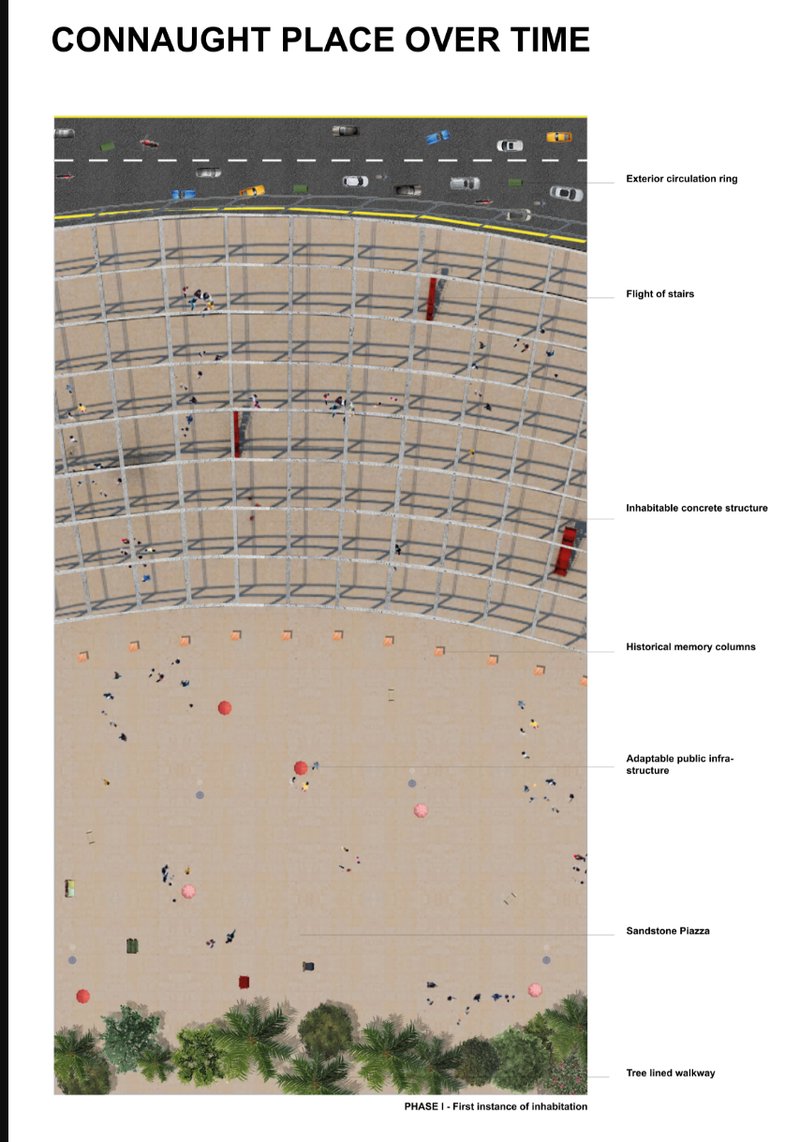
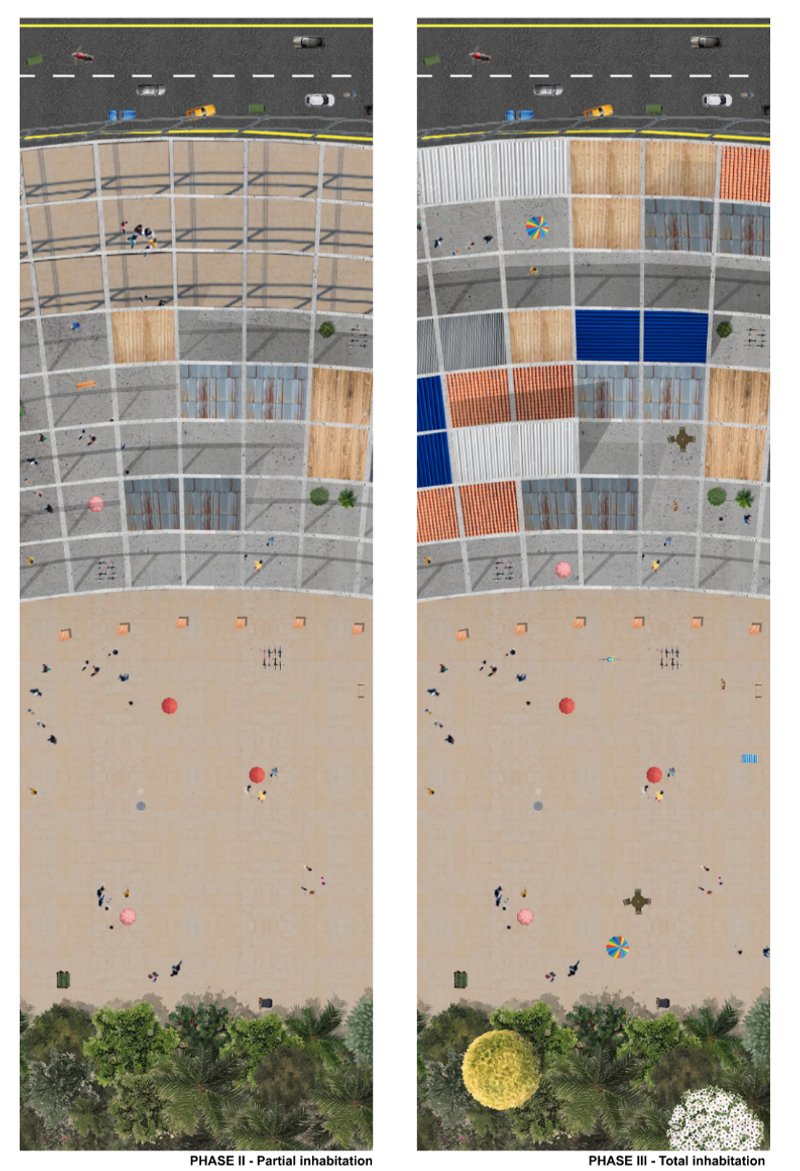
Connaught Place today stands like a fossilized ruin. Its architecture, while historically symbolic, no longer serves the people functionally. The project proposes to demolish the existing colonial facades and replace them with an inhabitable, modular concrete structure that reflects both local materiality and future-centric design. This approach aligns with contemporary principles of urban regeneration architecture, where cities prioritize resilience, flexibility, and cultural relevance over historical mimicry.
This new structure does not replicate tradition. Instead, it uses humble materials like local stone, concrete, and timber in open-ended ways—allowing users to adapt and evolve spaces over time. The skeletal grid, built at ground level, accommodates both public and private functions, transforming Connaught Place into an inclusive urban forum.
Ground-Level Activation & Public Infrastructure
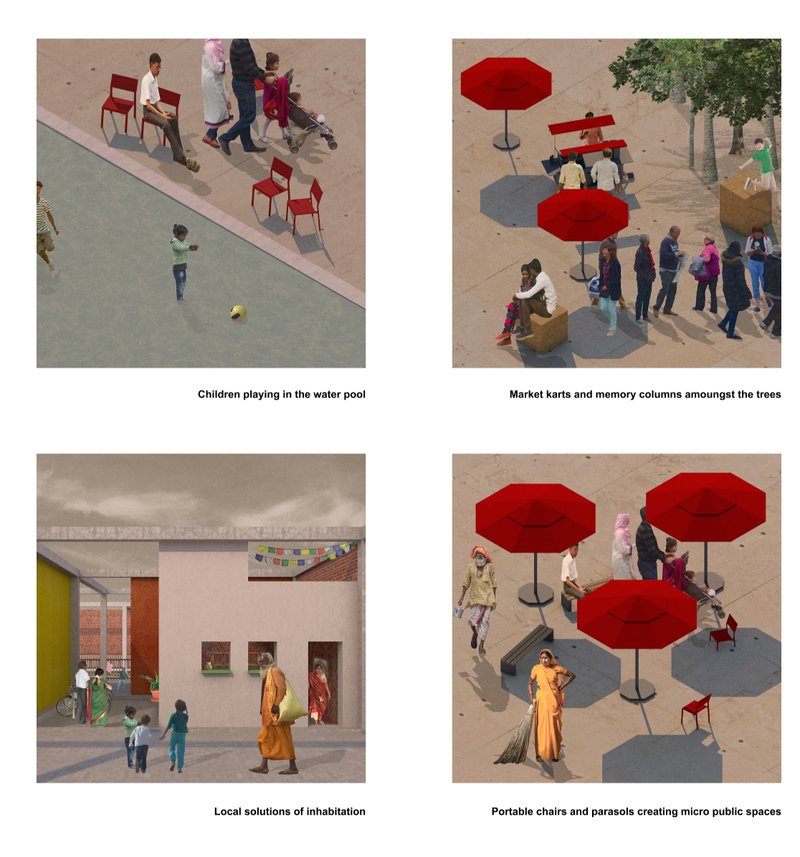
The redesigned site retains the exterior circulation ring, while the central piazza is reimagined as an expansive pedestrian zone paved with sandstone. A tree-lined walkway bisects the site, forming a strong visual and functional corridor from East to West Delhi. At the center, a large water pool—serving as both a mirror and a community hub—becomes a space for reflection, interaction, and play.
The piazza is dotted with adaptable urban infrastructure: public benches, drinking fountains, bike racks, market carts, parasols, and lamp posts. These elements enable spontaneous gatherings, informal economies, and social cohesion, acting as the connective tissue of the redesigned urban space.
Phased Inhabitation & Human-Scaled Design
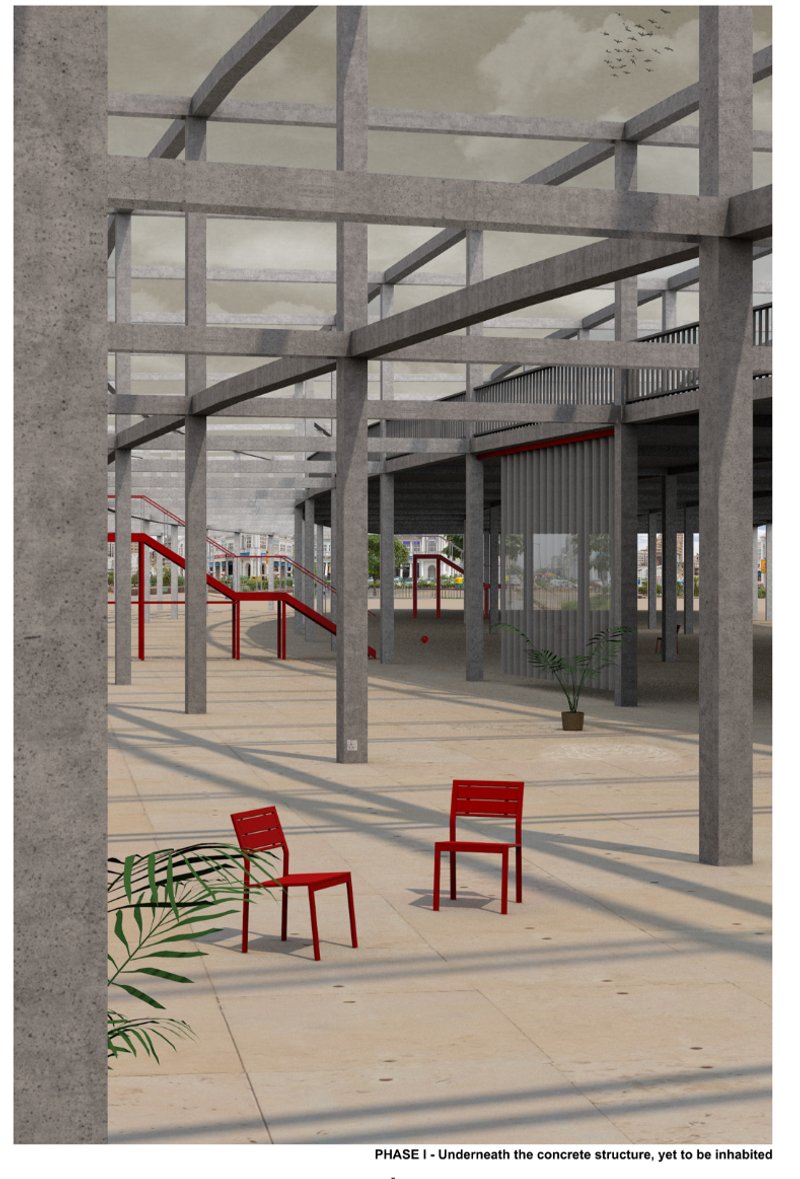
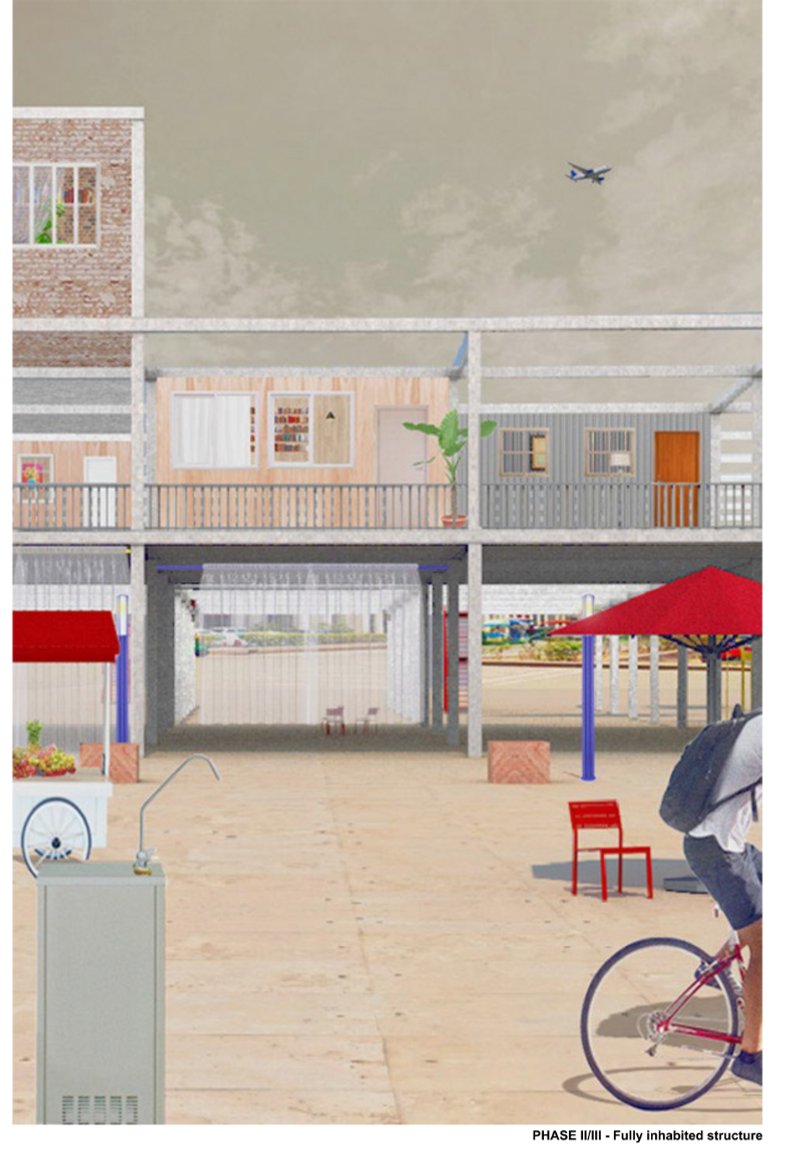
A standout element of the proposal is its flexible phasing. The inhabitable concrete skeleton is introduced as a non-invasive structure, gradually filled in by occupants over time. Whether for single users, families, or communal living, each unit can grow vertically and horizontally, supporting diverse patterns of habitation. The framework allows for individual expression while maintaining a cohesive architectural language.
Public and private domains are delicately interwoven. The lower level remains open and porous, accessible via multiple staircases. Above, residential and working units emerge organically—crafted with a mix of locally sourced materials and self-built interventions.
Honoring Memory, Not Mimicry
While the colonial architecture is removed, memory is not erased. Select heritage elements—such as the original colonnades—are abstracted and reinterpreted as structural memory columns dispersed throughout the site. These act as silent witnesses to the past, enriching the future without imposing it.
The Tabula Rasa proposal frames urban regeneration architecture as both an act of critique and creativity. It acknowledges that preserving heritage is not always synonymous with progress. Sometimes, to build forward, we must begin again.
Project by: Romain Conti-Granteral
Shortlisted Entry of: Neo Delhi Competition