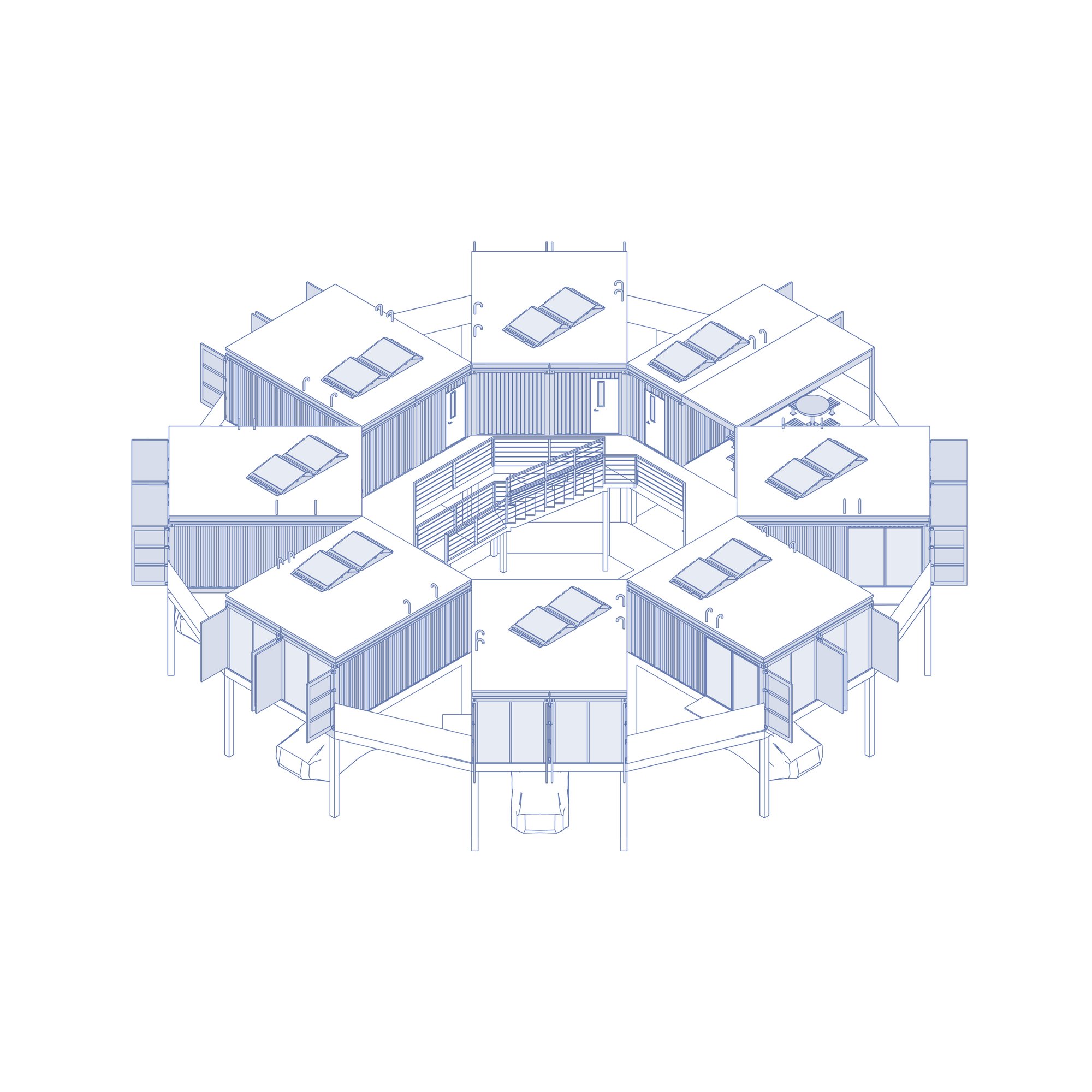
The Nest
Design decisions explained

The nest looks to alleviate many of the problems associated with the housing crisis occurring throughout the world. With thoughtful design, the vision is to create a quality living environment that not only provides affordable shelter but seeks to create meaningful connections between its residents. This project specifically aims at addressing the issues of quality of living, container utility, and balance between indoor and outdoor spaces.
There was one main goal and a constraint that began the design process. That is the aim to create a communal environment and utilizing the strengths of the containers. The main reason to utilize shipping containers as an affordable housing option is for the prebuilt structure. Structural modifications that come from puncturing holes for components such as windows, doors, and louvers lead to higher cost. It was important to utilize minimize the hampering the structural integrity of the containers to minimize cost.
It was evident from the beginning that the openable ends of the containers had to be utilized for glazing. This allows for a substantial amount of daylighting into the home without compromising the structural integrity of the containers. The other main issue with containers is their load distribution. If the corners of the containers are not grounded and are cantilevering, then significant and expensive alterations to the containers would have to be made. Cantilevering the containers was thus ruled out from the beginning. Merging at least two containers into one space is also a costly affair, but one that is practically unavoidable to design a humane living space. This led to the use of the 20’ x 8’ x 8.5’ containers as opposed to their larger counterparts. This minimized the amount of welded in waterproofing that would have to be done. The use of containers for affordable housing would have become redundant if these design decisions were not taken.
To achieve a comfortable living environment, there needed to be a merging of containers. With each of the containers chosen having roughly 150 sq ft of usable space, it was best to merge two containers along their longer ends to add width to the housing unit for a total of 300 sq ft for each housing unit.. 15 containers would allow for seven housing units with one container being used for communal amenities such as a laundry room.
Having a shared space that was quickly accessible and had a visual connection from each housing unit was essential to achieve the goal of designing housing that fostered community. Through several iterations of spatial organization, while recognizing the structural constraints of the containers, a radial organization of the containers to create an inner courtyard was found to be ideal. The courtyard could provide a common green space for communal activities and gathering. There’s several projects similar to this housing scheme that utilize containers to form a courtyard but there's still a disconnect between each unit due to the orientation of the containers and the stacking of containers on several levels. Orientating the containers so that the entrance to each unit directly faces the courtyard was essential. Although stacking can be a great strategy for efficient use of land, it hinders the connections between neighbors for a community environment. Due to this the decision to have all the housing units on one level. The radial organization of the containers does well to minimize the land use that comes with this decision.
These decisions led to the short faces of each unit being oriented toward the inner courtyard. This housing design spatial layout requires 5,000 sq ft. The spaces left after organizing each of the 7 housing units provided an opportunity to further enhance the living conditions for the residents. This allowed for a connection to nature and a relieving space from the relatively confined living conditions of the containers. This was possible to achieve without adding to the footprint of the housing. There was 160 sq ft of usable space for this, providing significant space for outdoor private leisure.
Land is costly so it was important to utilize it to its maximum potential. Utilizing a structural grid to lift the housing units off the ground level is a necessary strategy to free up the ground space for other uses such as parking. This structural grid provided opportunities to incorporate it into the idea of designing spaces that promote wellbeing. Connections to nature and natural materials have been found to improve wellbeing and reduce stress. Timber is an ideal material to use for the structure for this and it adds a textural contrast to the environment created by the containers. The timber structure and walkways created accumulate to just under 15% of the total square footage of the 15 containers.
All of these design decisions led to the creation of the nest. A series of living spaces that allow for essential activities for wellbeing on a communal and private level. The merging of the metallic container with the timber structure and extensions architecturally inform and promote this environment. It’s a simple and straightforward design that adds simplicity and ease to our busy lives.