
The Singularity
a mangrove peculiarity
Case study has consisted of exploring key facts about the wetland ecosystem, which further opened new doors to interesting concepts and the logistics of their coalescence.
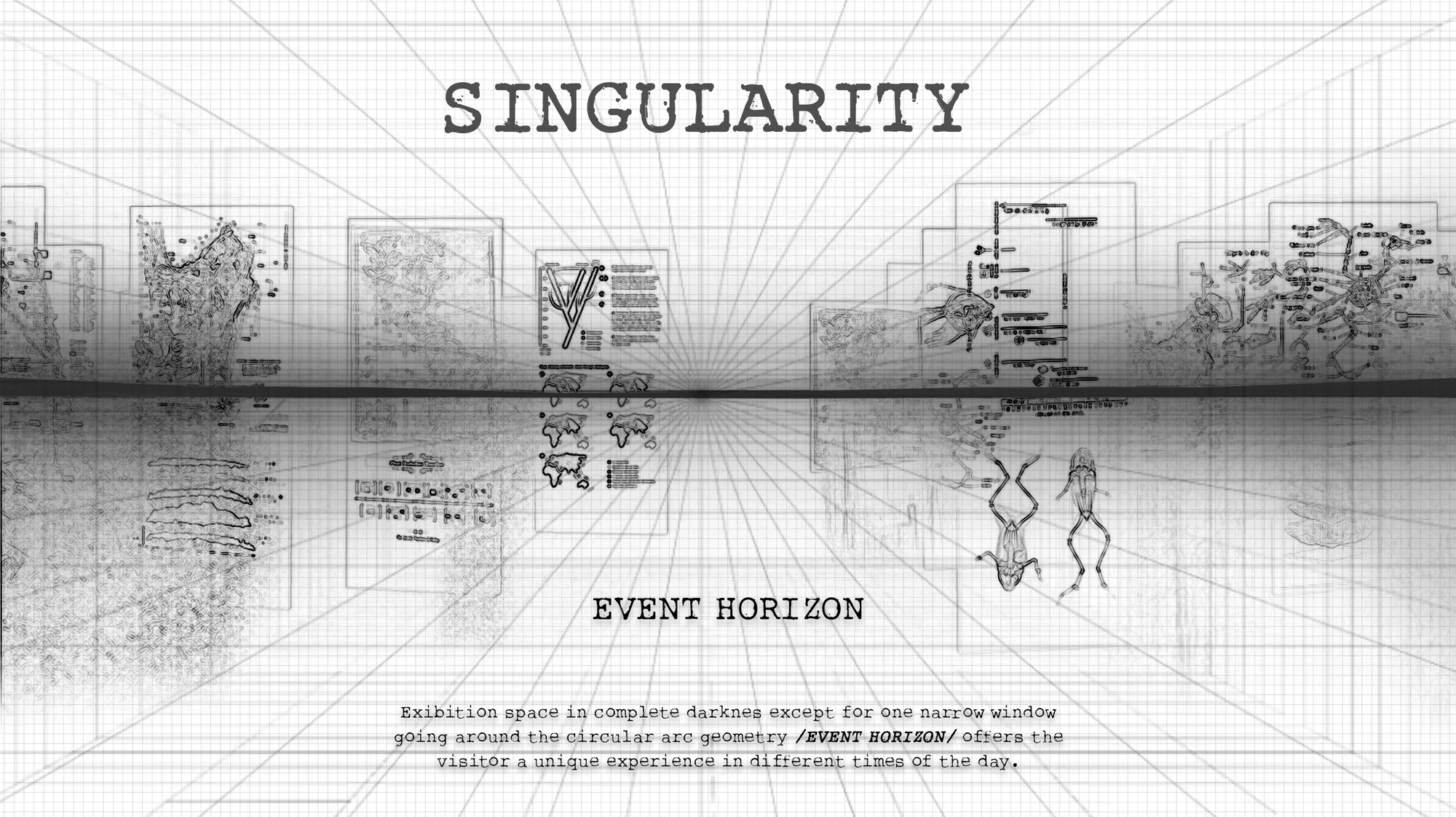
The mangrove or wetland is the most widely spread biome on the planet. It appears everywhere regardless of weather conditions or longitude. It has specific biochemical properties, for example decomposition functions differently in a mangrove- dozens of naturally mummified carcasses have been found on the UK grounds dating back several millennia. The mangrove preserves objects in their almost original form, it keeps the memory - this will be the key program point in the design of this project.
The mangrove itself is posing a frame through which we should observe it. The horizon in this frame, where all the perspective guides lead, is the water level. We could say that all the bio, chemical, and biochemical processes occur in the vertical range from the water level to the mangrove bed - and the same height above the water. The water level has variations depending on season but the frame stays the same.
Concept
Although this centre is primarily designed for researchers, it's attempting to create a space that is not only for the ones that directly engage with biology sciences, but also attracts people to create opportunities for that first stepping stone into the waters of studies in conservation. Considering the dense urban fabric of UK's cities, placing such an interpretation centre outside of the built environment aims at pulling users out of their capitalism driven rushed everyday lives and into the blissful nature reservation of the wetlands.
Design
Aimed to prioritise access to all potential users, the uses are placed inside a single envelope on different levels.
The social and scientific exploration uses are placed in the central and bottom area of the building. The learning partition, consisting of a walk through library and an exhibition gallery, is placed in the peripheral layer. The entire experience is easily accessible by a ramp that extends along the perimeter. Just by the act of moving through the space in a curvilinear manner the user can choose their own narrative in this fiction of space.
The principle of use
The visitors should enter the building and enjoy a continuous viewing and learning experience while descending along the ramp, to approach the main central space that houses the wetland interpretation hub, reading zone, chill-out zone, and the entrance to the Horizon space.
The space has a great capacity to adapt to changing functional uses without losing one bit of its original intention. The continuous ramp to the main bottom floor can house a great number of functional iterations. It's a walk-through space, its main use is to let you pass through it, it can cope with any future changes, whatever you choose to put in it can find its proper place. The continuity and adaptiveness takes the space to its multifunctionality potential.
The envelope structure is composed of several layers. Firstly the underground partition had to be a concrete mass. When we rise into the open air space, the structure morphs into a aluminium double ventilated curtain wall on the inside, and a light bearing clt wood construction that carries independent lightweight equitone panels used for shade that interact with each other forming a well ventilated mesh resembling fish scales but with perforations
The main activities can be classified as passive, dynamic, and immersive. All of which are focused on learning, interpretation, and observation. Passive activities refer to the one sided experiences such as reading in the athenaeum, walking the exhibition etc. We can observe the dynamic behaviours in the research atelier and the phototheque. The phototheque offers the experience of capturing wildlife and mangrove scenery via film, then developing photos in a dark room, and subsequently hanging them for show in the phototheque's gallery. Immersive experiences have both the qualities of passive and dynamic activities, they are focused on observation and learning but with an emphasis on experiencing the ambience (singularity, observation frames). Singularity's event horizon effect is accomplished by forming a half oval space. At the base - the entry point - ceiling height is set at 4m, and at the periphery - curved horizon - just 1m height. Aiming for an enclosure feeling, both the floor and ceiling are tilted so the perspective effect is enhanced.


Popular Articles
Popular articles from the community


Co-Life: Senior Housing Design That Reconnects Older Adults With the City
Co-Life reimagines senior housing design through healing gardens, shared streets, workshops, and a sustainable community across generations.

Riyadh For All: Intergenerational Urban Design for Active Aging in Rabat
Riyadh For All reimagines urban design in Rabat with intergenerational co-living, adaptive courtyards, and Moroccan cultural exchange today.

The Earth Pod: 3D Printed Homes for Resilient Refugee Communities
The Earth Pod reimagines refugee housing through 3D printed homes made from clay, combining resilience, self-sufficiency, and rapid shelter.

Conexión: Biophilic Design Reimagines High-Rise Living in Hong Kong
Conexión reimagines high-rise living in Hong Kong through biophilic design, green facades, shared spaces, daylight, water and nature within.


Similar Reads
You might also enjoy these articles
The Rhythm of Seasons
A Farmers' Market Connecting Nature and the City

More Than a Building-Designing a Living System
More Than a Building-Designing a Living System
Base Beyond
DESERT COMPOUND ARID: TOURISM OF ABSENCE AND ABUNDANCE

Explore Architecture Competitions
Discover active competitions in this discipline




Challenge to reimagine the Iron Throne


Photograph architecture without architects


Illustrate the lost glory of Angkor Wat - Render Challenge


Design challenge to reuse E-waste
Comments (0)
Please login or sign up to add comments
No comments yet. Be the first to comment!