
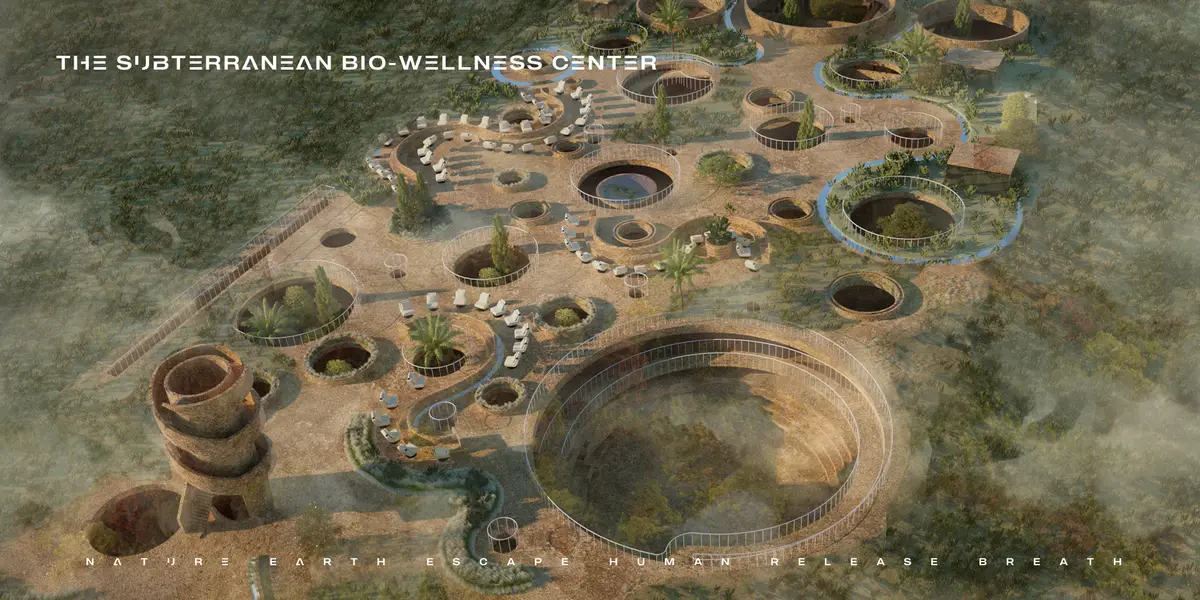
The Subterranean Bio-Wellness Center
Explore a new way for architecture to respond innate human instinct, biophilia, and desire to be connected with nature and other living things.

Biophilia is the innate human instinct and desire to be connected with nature and other living things. In large cities, it is difficult to find vast green spaces for mental healing and relaxation. Even though more and more public parks are being constructed, it is impossible to fully get away from the heat, noise and polluted air of cities. How can architecture provide complete isolation from these harmful factors and allow coexistence of human and nature?
Yaodong is a form of underground cave dwelling that was birthed more than 4000 years ago in Northern China. The ancestors built these underground homes by digging courtyards and terraces on both flat and sloped land to protect them from wind and rain. With limited construction technology and materials, the solution was to build within nature’s body; the earth. The multi-level housing creates a sectional condition that is unique. The negative courtyards naturally give privacy between houses. The concept of isolation and protection is something that we need and desire as human beings, and this project takes the idea of underground housing to modern context, to generate a biophilic environment within isolated space.
The underground concept of living guaranteed steady shelter in the past. When this concept is applied to today’s context, it should be able to tackle the problems of today. The site is located nearby Melbourne Airport, Australia.The site plays a buffer zone between the highway that connects from airport to the city, and a residential neighborhood. Even though the site is accompanied by green land on both North and South, the highway noise from the South and the airplane noise from the North had to be dealt with. The concept of underground living of Yaodong is applied to the context of the project.
The design abides by the theory that humans are inseparable from nature. It is as though the project does not have a site boundary as nature seamlessly flows in and out of the site on ground level. The architecture and nature work closely together to create an organic yet curated experience for the users. There is one evident architectural component on ground level; the viewing tower. It is the tallest moment of the building with minimum footprint, to be able to minimize the existence of architecture, and maximize the presence of nature. It is also an architecture that can look into itself, to allow users to view the entirety of the project from one position, and also navigate themselves from the ground level. If the project has sacrificed view in exchange for isolation, this viewing tower compensates for the lost view of the underground. The circular voids on ground level blend into the landscape to provide light, ventilation and view towards the sky for the programs below. The different sizes of voids are made suitable for various programs that would require different lighting conditions. In addition, all of the residential units would have part of its roof overlap with the void, to receive sufficient lighting and to provide view towards the sky. The units are accompanied by sheltered outdoor spaces with greenery to maximize privacy and trigger biophilia. Earthy material of red brick is used for the interior to mimic the stereotomic environment of underground living. It triggers our instinct of wanting to be protected and surrounded by natural elements, to truly get away from vastly polluted cities and to find peace in the coexistence of nature and architecture.

Popular Articles
Popular articles from the community


Lunar Spiral: Space Architecture Shaped by the Mathematics of the Universe
Lunar Spiral reimagines space architecture through Fibonacci geometry, lunar regolith, levitating habitats, and self-sustaining Moon living.

The Ocean Hive: Sustainable Architecture for a Self-Sufficient Civilization at Sea
The Ocean Hive imagines sustainable architecture at sea, where modular habitats, algae, wave power and ocean waste sustain a growing colony.

Play: Fragments of Their World
Familiar architecture becomes modular playground design, creating safe spaces where displaced children can learn, connect, imagine and play.

Hill & Cross Opera: Sculptural Opera House Architecture Shaped by Tallinn’s Landscape and Identity
Hill & Cross Opera reimagines opera house architecture in Tallinn through its sculptural hill, civic plaza, glass wave and a luminous cross.

Similar Reads
You might also enjoy these articles

Day and Night Park: A Time-Based Urban Newsstand in Beijing
A temporary urban newsstand in Beijing blending travel, light, and reading through poetic colors, compact form, and community-focused design.

Modernist Patio Renovation in El Masnou, Barcelona by Oliver Segura Arquitectura + Cebrià Arquitectura
Modernist patio renovation blending tradition and innovation with a movable pool, leveled floors, and Catalan materials in El Masnou.

Alto Residencial Coop: Cooperative Housing Development in Santiago de Compostela by Carbajo Barrios Arquitectos
A linear cooperative housing complex blending white volumes and perforated metal façades, enhancing community living, natural light, privacy, and urban integration.
Vil Genis School by BPA ARCHITECTURE – Massy, France
Vil Genis School in Massy, France, features sustainable design, south-facing classrooms, community integration, accessible spaces, and modern educational architecture.


Comments (0)
Please login or sign up to add comments
No comments yet. Be the first to comment!