

A Park in the Shade: Climate as the Generator of an Industrial Village in Palakkad
Hisham Sulaiman's thesis rebuilds a Kerala industrial park around shade, airflow and water, from wind corridors to a kinetic umbrella canopy.


Industrial parks are rarely designed for the people who work in them. They are laid out for trucks, setbacks and floor area, and the heat, glare and dead air that follow are treated as someone else's problem. A Park in the Shade starts from the opposite position. It treats Palakkad's climate as the brief itself, and lets solar paths, wind directions and monsoon water decide where things go, how tall they are, and what they are made of.
The project is an undergraduate thesis by Hisham Sulaiman, titled "A Park in the shade; Climate responsive industrial village at Palakkad." It is set within an existing industrial park in Kerala, a region of intense solar radiation, high humidity, heavy monsoon rainfall and seasonal winds. Sulaiman proposes an adaptive intervention rather than a clean-slate estate. Computational methods, environmental analysis and passive strategies are applied at every scale, from the master plan and worker housing down to facade systems and a kinetic shading device. The aim is an industrial village that stays productive without making its residents pay for that productivity in heat stress.
A Master Plan Drawn Along Wind Corridors and Water
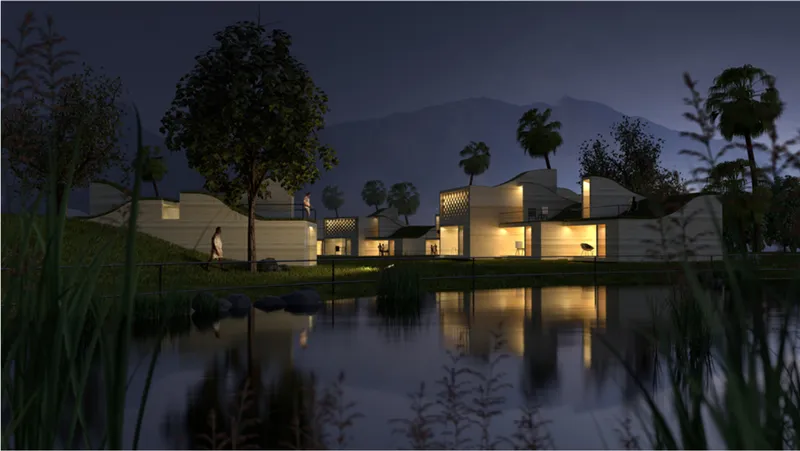
The dusk view across the pond sums up the plan's priorities. Low, wavy-roofed volumes sit close to the water, palms break up the skyline, and the mountain ridge stays visible behind. That openness is deliberate. Roadways and building clusters follow natural vistas and airflow corridors so that wind can move across the site without interruption. Taller structures, including high-rise apartments, are pushed to the periphery to avoid casting wind shadows, while lower housing clusters take the shaded, protected interior zones.
Water does more than decorate the scene. Artificial lakes and water-harvesting systems are placed along daily movement paths, so the route to the market or the community center passes cooling surfaces rather than hot tarmac. Landscaped buffers and earth berms handle heat gain and noise, which matters in a setting where housing and industry share ground. The result is porous and walkable, a plan in which landscape does real climatic work instead of filling leftover space.
Worker Housing That Sinks Into the Ground
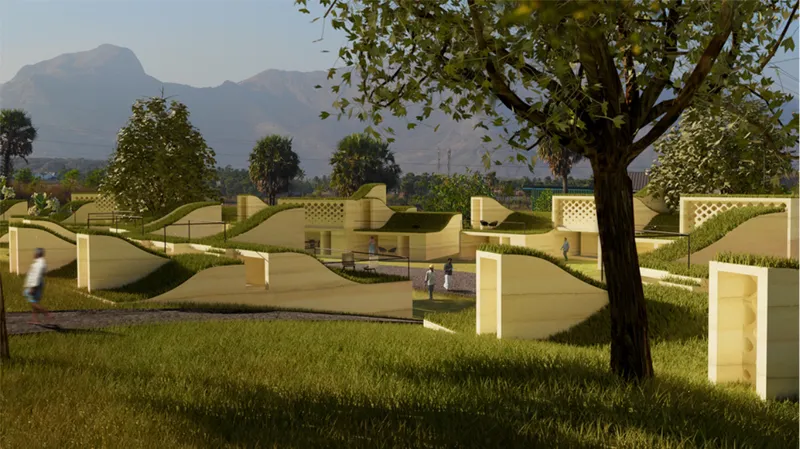
The grass-topped, curving wall units scattered across the lawn show the project's most convincing move: housing that reads less as buildings and more as landform. Green roofs and earth berms cut heat gain, while lattice screens let air through and keep out direct sun. Behind those surfaces, the units are built from compressed earth blocks chosen for their low U-values, a material that suits both the thermal brief and the region's construction culture.
The plans are modular and expandable, designed to grow with changing family needs, and each unit is oriented to reduce solar exposure while drawing in cross-ventilation. Courtyards act as thermal buffers and social rooms at the same time, and wind towers and solar chimneys push the passive cooling further. Sulaiman's sectional studies show sleeping areas, living spaces and sit-outs arranged around these shaded courtyards so the interiors stay comfortable without mechanical cooling. For worker housing, where running costs fall on residents, that is the core of the argument, not an extra.
A Community Center Under a Canopy of Umbrellas
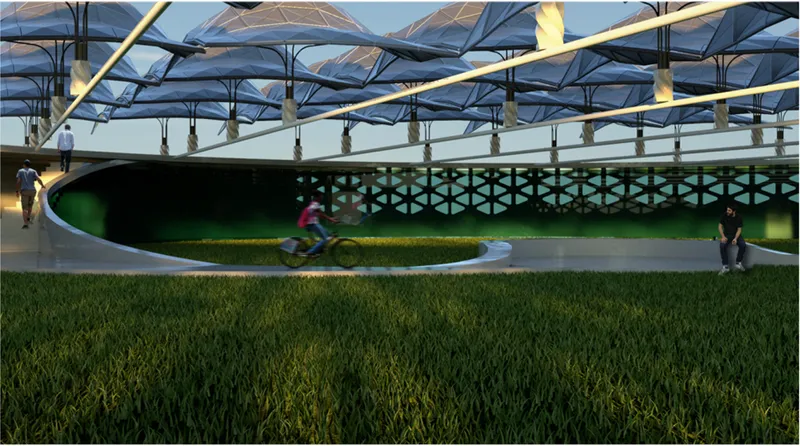
The community center is the social and climatic anchor of the village, and the render shows why. A field of faceted, umbrella-like roofs floats above a lawn and a spiral ramp, producing a large shaded zone that stays open on all sides. A cyclist passing through makes the point: this is a covered public ground, not an enclosed hall. The roof filters daylight and cuts glare, and the courtyard beneath is intended to stay naturally cool throughout the year.
What is hidden matters as much as what is visible. Rainwater harvested across the site is stored beneath the structure and reused for construction and cooling, so the building that gathers people also gathers the monsoon. Microclimate becomes social infrastructure here. People are drawn to the center because it is the most comfortable place to be, and the design relies on that simple pull.
Testing Kinetic Shade at the Scale of a Circuit Board


The physical model brings the umbrella canopy down to a single unit: a mesh canopy on a threaded steel stem, mounted above an exposed circuit board and wiring. The close-ups go further into the mechanism, pairing an Arduino board with a glowing red light and a small blue servo positioned beside a threaded rod. This is the project's automatic shading device, and the prototype makes clear that the kinetic idea was tested as hardware, not left as a diagram.
Including this level of fabrication in an undergraduate thesis is a strong choice. It moves the computational strand of the project from analysis into actuation, suggesting a canopy that can respond to conditions instead of being fixed for an average day. The raw wiring and off-the-shelf components are honest about the prototype's status, and they invite the obvious next questions about durability, maintenance and monsoon exposure that a built version would have to answer.
Why This Project Matters
Much climate-responsive work in South Asia focuses on individual houses or showpiece institutions. Sulaiman takes on the industrial park, a typology that houses large numbers of workers and is usually designed with almost no attention to comfort. By making wind corridors, building height, water and earth construction the organizing logic of the master plan, the project shows that passive design can operate at the scale of a settlement, not only at the scale of a single wall section.
The thesis is also consistent. The same concern for shade and airflow runs from the placement of high-rises at the edge of the site, to compressed earth block housing around courtyards, to a servo-driven canopy prototype on a workbench. That continuity across scales is the real achievement. It treats Palakkad's heat as a design problem to be resolved through architecture, and it gives the people who keep an industrial economy running a place they can actually live in.
View the Full Project
About the Designers
Designer: Hisham Sulaiman
Enter a Design Competition on uni.xyz
uni.xyz runs architecture and design competitions year-round that reward proposals with spatial conviction and real site intelligence.
Project credits: A Park in the shade; Climate responsive industrial village at Palakkad." by Hisham Sulaiman.


Popular Articles
Popular articles from the community


The Amber Palace Opera: A Geological Fiction Surfaces on Tallinn's Baltic Waterfront
Pierre Brillard reimagines a Baltic legend as a public landscape, opera house, and waterfront promenade rooted in Tallinn's coastal identity.


graciastudio Turns a Viewless Tijuana Lot Inward Around a Courtyard of Concrete, Timber and Trees
In Tijuana, Jorge Gracia's GA2 House stacks a timber-clad private floor over exposed concrete and replaces a missing view with a planted interior patio.

David Ortega Stacks a Two-Story Mexico City Penthouse Around a Steel Stair and a Pergola-Shaded Roof Terrace
In Colonia Roma, a 300 m² penthouse uses oak joinery, a planted steel stair and a slatted roof pergola to make a new-build apartment feel like a house.

Aquadapt: An Underwater Habitat That Rewrites Its Rooms by the Hour
Curved modules ring the seabed while one shell shifts from breakfast room to cinema, farm and football pitch as residents' needs change.

Similar Reads
You might also enjoy these articles

Maya Harvest: A Cacao Resort Village Rooted in Mayan Tradition and Local Craft
Situated within a Tabasco cacao plantation, this shortlisted resort proposal merges vernacular materials with hands-on cultural immersion.
Harmonia: A River-Shaped Community That Grows Over Decades in Boa Vista
Curved pathways and modular grid structures along the Branco River create a phased settlement designed to evolve from 2030 to 2050.

The Architecture of Bathing: A Mughal Hammam Reimagined Across the Yamuna
Charlotte May's honorable mention entry for The Black Taj reinterprets Agra's bathing rituals through red sandstone, water, and framed views of the Taj Mah

Om-1: A Wall-Hung System That Moves Your Workspace Off the Desk
Modular plywood boards, magnetic pegs, and utility elements migrate clutter from the horizontal surface to the vertical plane.


Comments (0)
Please login or sign up to add comments
No comments yet. Be the first to comment!