

Nano Nest | Vast Ego: Courtyard Living Compressed into a Narrow Tabas Lot
A multi-generational house in Iran's desert city channels wind, light, and water through a vertical courtyard wrapped in palm mesh.


Take a lot barely wider than a corridor in one of Iran's hottest cities, then stack three generations of a family inside it without losing daylight, breeze, or privacy. That is the provocation behind Nano Nest | Vast Ego, a residential design that treats the courtyard not as a luxury of sprawling land but as a vertical engine compressed into a narrow urban section. Every passive strategy the house deploys, from curved wind corridors to rainwater harvesting to a breathable palm mesh envelope, descends directly from the Persian vernacular, yet the result reads as unmistakably contemporary.
Designed by Babak Khabaz for the Nano Nest 2020 competition, the project is sited in Tabas, a hot and arid city in eastern Iran where summer temperatures regularly exceed 40°C. The house serves a six-member, three-generational household: grandparents, parents, and two children. Within that program brief, Khabaz negotiates a dense set of cultural expectations around privacy, communal gathering, and hierarchical spatial order, all while pushing the building to perform as its own climate machine.
Seven Strategies on a Single Diagram

The opening diagram lays out the project's logic with surgical clarity. Site position, plan layout, light, wind, water, soil, and contextual factors each receive their own panel, mapping the environmental forces at play before a single wall is drawn. What is striking is how each strategy feeds the next: the curved front façade that funnels wind also defines the building's sculptural identity; the central void that admits daylight also channels rainwater toward a garden below. Reading the diagram left to right, you can see a design process that treats climate data as the primary form generator rather than an afterthought applied to a predetermined shape.
A Courtyard That Grows Upward
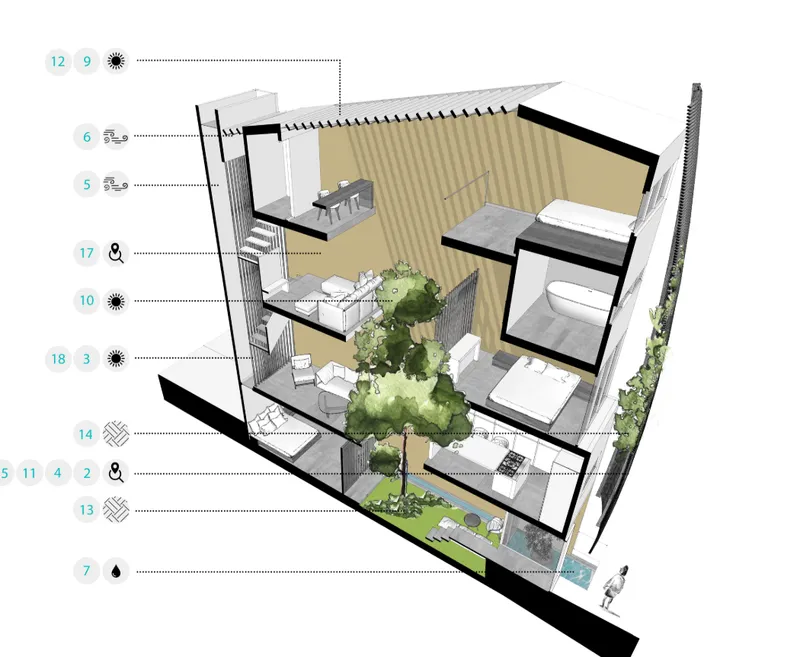

The axonometric section reveals how the central courtyard operates across four levels. A tree anchors the void at its base, and numbered annotations trace the path of environmental features: wind corridors, solar louvers, green façade zones, and greywater lines. Rather than sitting beside the house in the traditional manner, the courtyard punches vertically through the section, linking every floor visually and thermally. This move is what allows the narrow lot to breathe; without it, the deep plan would trap heat and cut off interior rooms from natural light.
The interior rendering of the double-height living room makes the strategy tangible. Grey sofas sit beneath a timber slat ceiling that filters light from above, while a tree rises beside a floating staircase, blurring the boundary between courtyard and living space. The room feels generous despite the lot's tight dimensions, a direct consequence of the vertical void pulling the eye upward and pulling cooled air downward.
Generational Layers: Ground to Third Floor

Four floor plans, paired with interior renderings of each level, show how the house distributes program according to a clear hierarchy. Public and communal areas occupy the lower floors, ensuring accessibility for the grandparents, while private bedrooms migrate upward. Designated zones for working parents, elderly rest areas, and shared family gathering spots coexist without collision. The courtyard void appears on every plan as a consistent anchor, acting as the spatial unifier that keeps the generations connected even when they retreat to separate floors.
Palm Mesh Skin and Urban Air Corridors
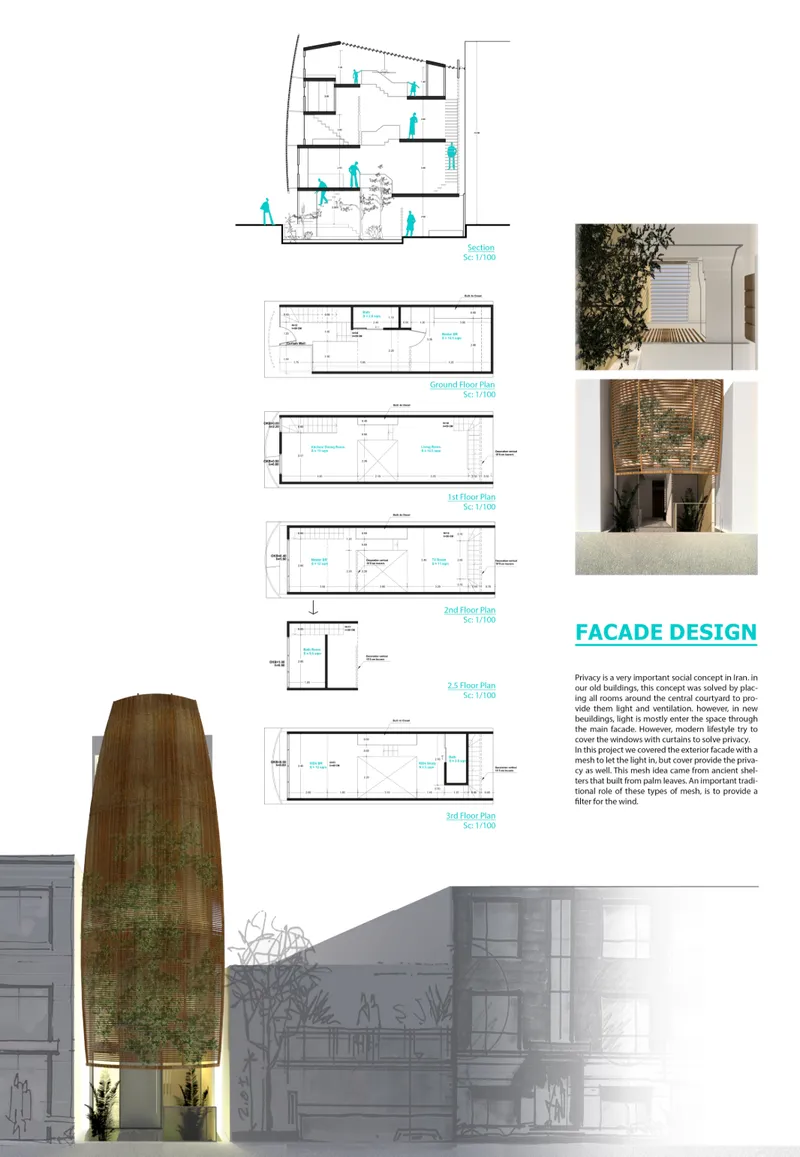
The section drawing and street elevation rendering expose the building's relationship to its neighbors. The façade, constructed from locally sourced palm tree mesh and bamboo, wraps the narrow vertical form in a breathable skin that filters light, regulates privacy, and channels airflow simultaneously. Planted zones climb the exterior, cooling the surface through evapotranspiration and softening the building's presence on the street. Uplighting at the base transforms the mesh into a lantern at night, giving the house a distinctive urban identity without resorting to ostentatious gesture.
Equally important is the gap the building leaves on its flanks. Khabaz shapes the structure to allow wind corridors between densely packed buildings, contributing to a broader neighborhood ventilation strategy. In a city where the microclimate between buildings can be punishing, this decision turns a single house into an urban actor, improving conditions beyond its own property line.
Why This Project Matters
Nano Nest | Vast Ego demonstrates that the courtyard house, often romanticized as a typology requiring generous footprints, can be reinvented for the compressed lots of contemporary Iranian cities. By stacking the courtyard vertically and wrapping the envelope in a climate-responsive mesh derived from local materials, Khabaz keeps the environmental and cultural intelligence of the Persian prototype intact while discarding its spatial extravagance.
The project also serves as a quiet argument against mechanical dependency. Wind corridors, rainwater harvesting, greywater reuse, and green façades collectively reduce the building's energy load without a single photovoltaic panel in sight. For designers working in hot arid climates, the lesson is clear: the most effective technologies are often the oldest ones, provided you are willing to rethink the section, the skin, and the space between buildings.
View the Full Project
About the Designers
Designer: Babak Khabaz's
Enter a Design Competition on uni.xyz
uni.xyz runs architecture and design competitions year-round that reward proposals with spatial conviction and real site intelligence.
Project credits: Nano Nest|Vast Ego by Babak Khabaz's.


Popular Articles
Popular articles from the community

Extended Shell: Retrofitting Kolkata's Balconies as Living Urban Thresholds
A modular retrofit system recovers the social and environmental intelligence of Kolkata's historic verandas for contemporary Park Street residents.
Cloaked Colonization: A Mobile Underwater Habitat That Moves Like a Fish
Micah Abaya's shortlisted EHC Pacific entry reimagines ocean settlement as a dispersed network of self-sustaining architectural organisms.

Manzana Morphosis: Stretching Barcelona's Grid into a Living Landscape for 2050
A radical reworking of the Eixample manzana turns density into a tool for generous public space, vertical ecology, and environmental performance.

Temporary Home for Dogs: A Reversed Zoo Rethinks Animal Shelter Architecture
In Bucharest, a sinuous corridor and freed landscape flip the logic of containment, designing a shelter that works to make itself unnecessary.

Similar Reads
You might also enjoy these articles

Shakur's House: Exposed Brick as an Interior Organiser in a 168 m² Mashhad Residence
Brick moves indoors in this Mashhad residence, where masonry walls, glass partitions and teal planes sequence a compact home without closing it off.

Day and Night Park: A Time-Based Urban Newsstand in Beijing
A temporary urban newsstand in Beijing blending travel, light, and reading through poetic colors, compact form, and community-focused design.

Modernist Patio Renovation in El Masnou, Barcelona by Oliver Segura Arquitectura + Cebrià Arquitectura
Modernist patio renovation blending tradition and innovation with a movable pool, leveled floors, and Catalan materials in El Masnou.

Alto Residencial Coop: Cooperative Housing Development in Santiago de Compostela by Carbajo Barrios Arquitectos
A linear cooperative housing complex blending white volumes and perforated metal façades, enhancing community living, natural light, privacy, and urban integration.

Comments (0)
Please login or sign up to add comments
No comments yet. Be the first to comment!