
Anemone
Mobile architecture
Intention
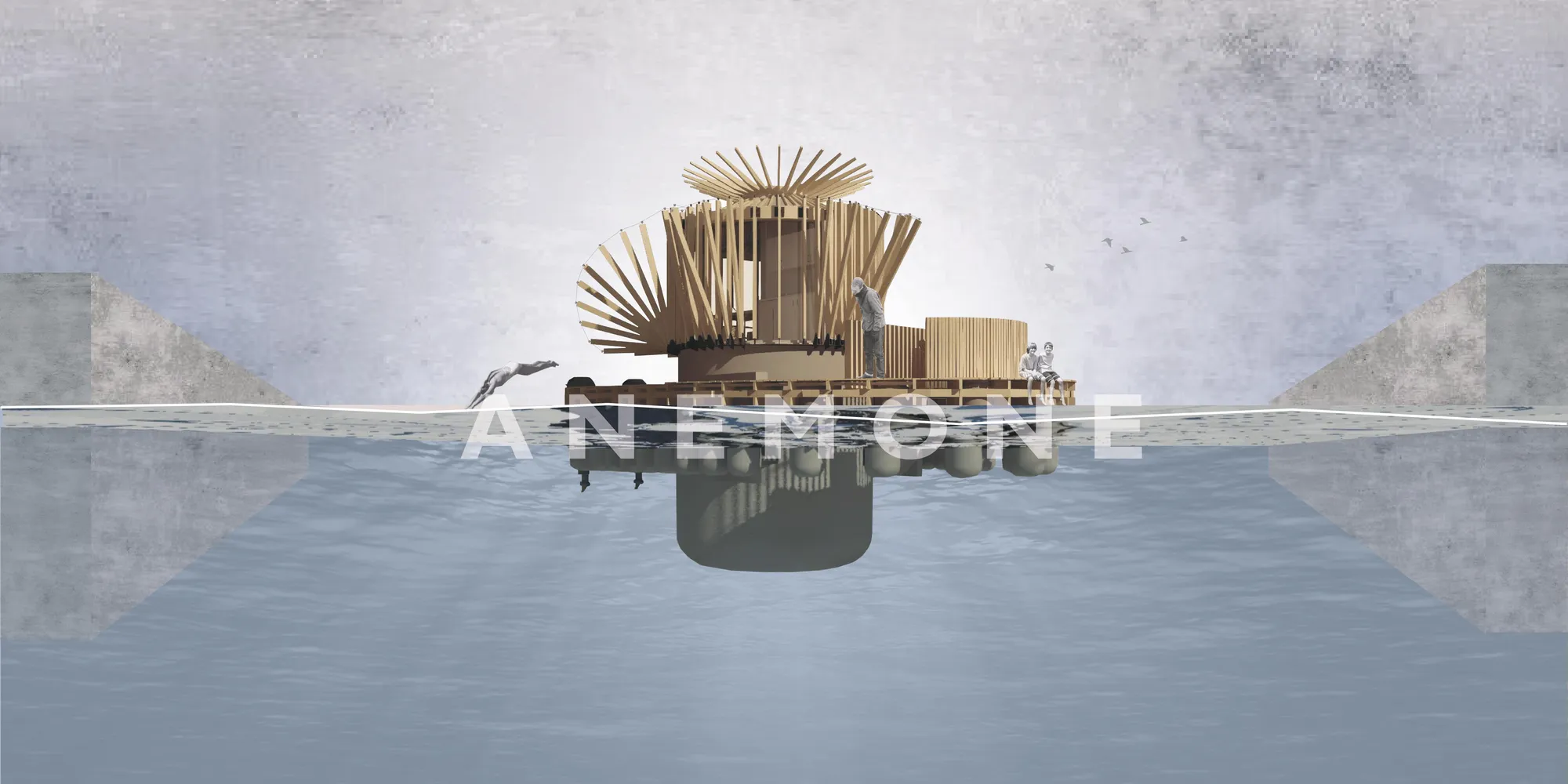
Humans have long inhabited our environment at the expense of nature. This mobile home intends to prioritize nature, as a source of formal inspiration and as a home in itself, one that must be nurtured, they way that nature has nurtured us for so many years.
Concept
The mobile home is inspired by the sea anemone and its relationship with the clown fish, which is a form of mutualism. Mutualism describes a symbiotic relationship where both species benefit from co-existing. The clownfish receives shelter and protection, whilst the sea anemone receives food by consuming the clown fish’s scraps. The mobile houseboat follows a similar principle. It provides shelter for its human inhabitants, whilst consuming plastic waste from the rivers leading into the ocean.
Function
The home caters to the basic needs of a family of four. The home is split into two levels, lower and upper. The upper level contains the living spaces for eating, preparing food, cleaning, eating, washing etc. These can all be enjoyed with panoramic views made possible by the glass façade. The lower level is reserved for sleeping and storage. It is accessed vertically by ladder.
Service practicality
The boat is driven by solar power, with PV solar panels situated along the circumference of the boat. The rounded form, inspired by the sea anemone, allows for the solar panels to rotate around the circumference of the boat. This means the solar panels are always in a desirable position for the sun to reach them. This is especially important in a mobile home where the suns position varies greatly with respect to the home.
The central structural system that supports the timber envelope is designed in conjunction with the allocation for water services. There is a pipe inside each of the 2 hollow steel structural columns. One is a waste water pipe for sewerage and the other allows for rainwater to be collected and stored at the base of the boat.
The bathroom is made spatially efficient by having one floor level throughout. The floor does not slope down to the shower drain, nor does the shower have a raised base. Instead the floor slats allow water that lands anywhere in the bathroom to fall to the sloped platform below. The use of natural soaps means that grey water from the shower is safe to exit directly into the water body on which the houseboat is located.
Adaptive space
The home is not limited to one location, nor is it limited to one form. Inside and out the home is adaptive and flexible. The façade consists of glass sliding panels can be shifted into a variety of compositions, to perfectly cater to the natural ventilation requirements of an ever shifting environment. Additionally the façade is given two solid panels that slide along its circumference and shade the interior no matter the location of the sun. The table is raised and lowered by a pulley system, transforming an open sitting space into a dining room. The lower bunk beds can be folded away to allow for a more open space.
Mobile, static and built space
The outer timber façade is inspired by the sea anemone. In its mobile state it is closed, as the sea anemone closes up when floating to a new location. In its static state it opens up, as a cable running along the top is allowed to increase in circumference, enabling some members to fall, whilst the structural members remain in place. Some of the members are allowed fall to a horizontal plane. Tarpaulin webs between these members are stretched out to form a deck that is accessible via the upper level. This expands the living space and magnifies the views. Thus the opening of the “anemone” is both a poetic expression of organic form and a practical strategy for expanding the living space. The base of the boat is built from recycled plastic. It is the base of the boat that consumes the plastic waste and stores it on its two sides. In the built state the houseboat is docked and the plastic waste is offloaded. This plastic is then used to build another anemone houseboat.
The anemone is a means of finding a home in nature, without harming it but instead nurturing it. By collecting plastic waste the anemone not only cleans its environment it creates potential for a new anemone to be produced. Thus one anemone breeds another, fostering a generative cycle of inhabitation.


Popular Articles
Popular articles from the community


The Earth Pod: 3D Printed Homes for Resilient Refugee Communities
The Earth Pod reimagines refugee housing through 3D printed homes made from clay, combining resilience, self-sufficiency, and rapid shelter.

The Ocean Hive: Sustainable Architecture for a Self-Sufficient Civilization at Sea
The Ocean Hive imagines sustainable architecture at sea, where modular habitats, algae, wave power and ocean waste sustain a growing colony.

Co-life: Sustainable Architecture for Age-Friendly Community Living
Co-life reimagines sustainable architecture for seniors through courtyards, rammed earth, shared gardens, and spaces designed for belonging.

Hill & Cross Opera: Sculptural Opera House Architecture Shaped by Tallinn’s Landscape and Identity
Hill & Cross Opera reimagines opera house architecture in Tallinn through its sculptural hill, civic plaza, glass wave and a luminous cross.


Similar Reads
You might also enjoy these articles

Day and Night Park: A Time-Based Urban Newsstand in Beijing
A temporary urban newsstand in Beijing blending travel, light, and reading through poetic colors, compact form, and community-focused design.

Modernist Patio Renovation in El Masnou, Barcelona by Oliver Segura Arquitectura + Cebrià Arquitectura
Modernist patio renovation blending tradition and innovation with a movable pool, leveled floors, and Catalan materials in El Masnou.

Alto Residencial Coop: Cooperative Housing Development in Santiago de Compostela by Carbajo Barrios Arquitectos
A linear cooperative housing complex blending white volumes and perforated metal façades, enhancing community living, natural light, privacy, and urban integration.

Vil Genis School by BPA ARCHITECTURE – Massy, France
Vil Genis School in Massy, France, features sustainable design, south-facing classrooms, community integration, accessible spaces, and modern educational architecture.






Comments (0)
Please login or sign up to add comments
No comments yet. Be the first to comment!