

Aranya North Shore Community Sports Center by Atelier XÜK
Atelier XÜK’s Aranya North Shore Community Sports Center transforms an industrial riverside site into a vibrant, flexible, community-oriented recreational hub.


Transforming Industrial Heritage into Vibrant Community Space
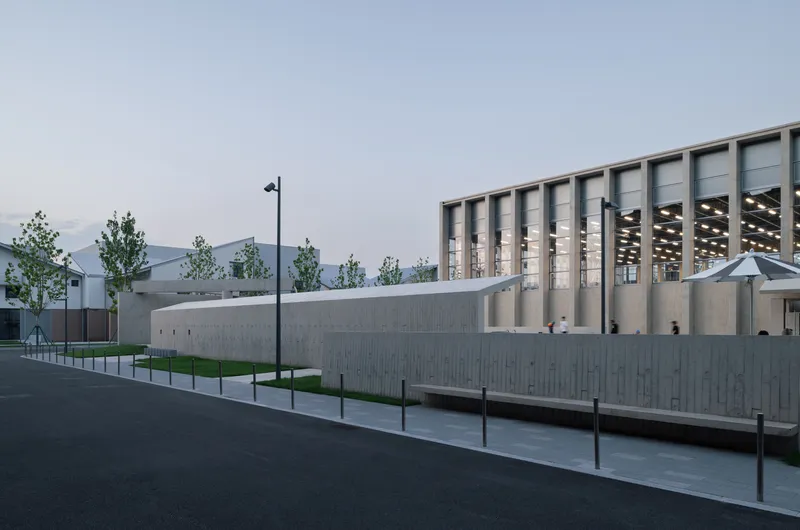
The Aranya North Shore Community Sports Center is strategically located within the riverside precinct of the Aranya Ninth Phase development, approximately three hours from Beijing. Once an underdeveloped industrial plot, the site has been revitalized into a multi-functional community sports hub that bridges the past and present. Drawing inspiration from the industrial waterfront context, Atelier XÜK has created a facility that evokes collective architectural memory while providing modern, adaptable spaces for community engagement.

Reimagining Industrial Heritage for Community Recreation
The Aranya North Shore Community Sports Center, designed by Atelier XÜK, is located in Qinhuangdao, a coastal city three hours from Beijing. Positioned within the riverside area of the Aranya Ninth Phase development, the project transforms a formerly underdeveloped industrial site into a vibrant public space that reconnects residents with the area’s architectural memory.
Drawing inspiration from the industrial identity of the waterfront, the architects sought to create a building that bridges the past and present, using architecture as a medium for collective remembrance and social engagement. The center is envisioned as a community anchor, providing an inclusive, adaptable venue for recreation, fitness, and public events.
Contextual Design and Spatial Mediation
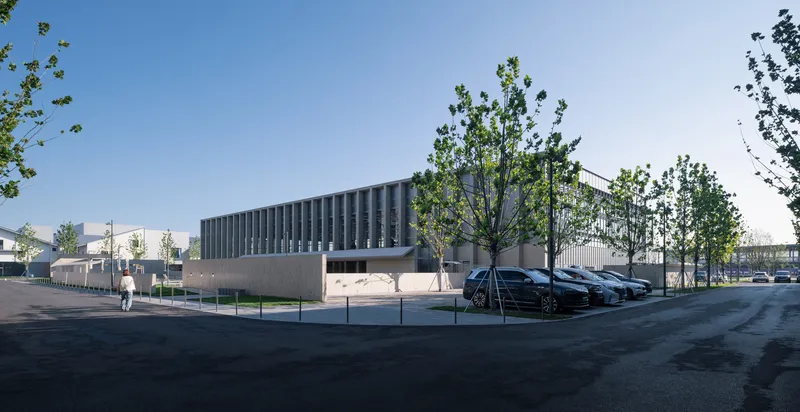
Situated between a planned residential neighborhood and a public riverside park, the sports center acts as a spatial buffer between private and public domains. Through its massing, orientation, and open circulation, the building negotiates the different scales of its surroundings, enhancing the continuity between community life and the natural landscape.
The design adopts a portal-frame structural system, referencing the robust, functional language of riverside industrial buildings. This typology evokes a familiar sense of place, grounding the new structure in the site’s historic and cultural context while supporting modern recreational needs.
Program and Architectural Composition
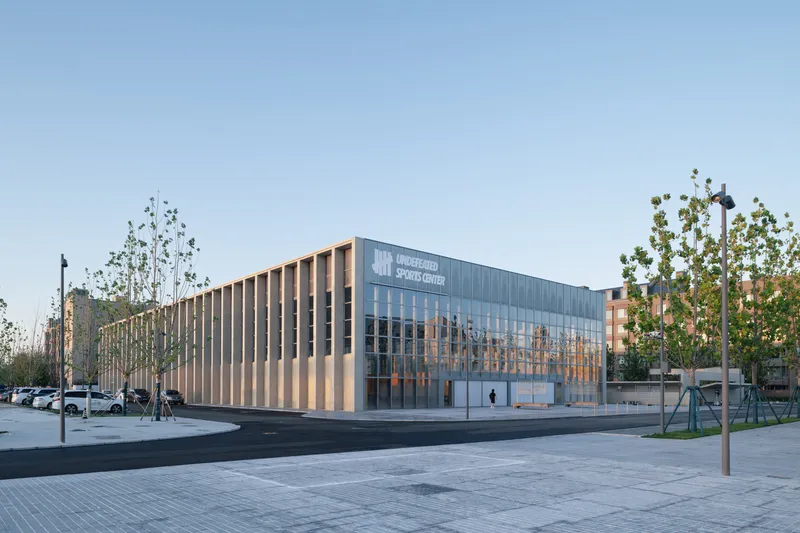
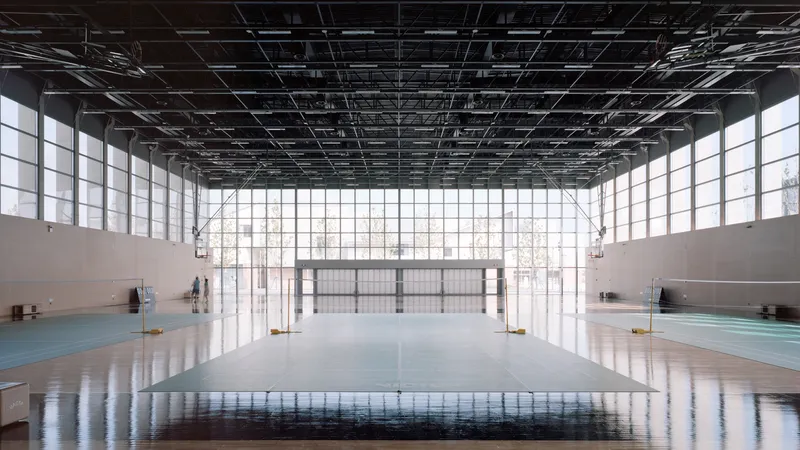
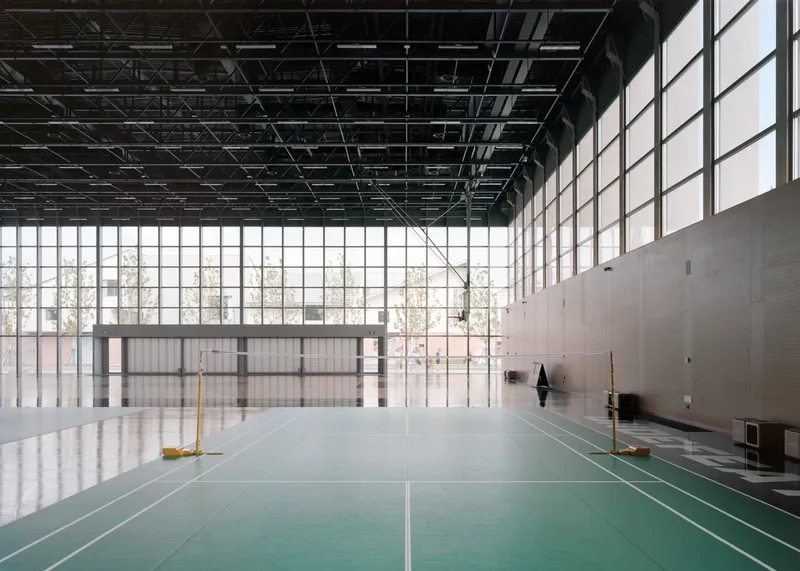
The building is a rectangular monolith measuring 78.2 m × 35.5 m × 12.7 m. Its spatial organization reflects both efficiency and flexibility. The north façade, entirely glazed, reveals the double-height space housing two full-sized basketball courts, creating a visual dialogue between the interior and the public realm.
Two 18-meter-wide operable doors allow the courts to open directly to the outdoors, blurring boundaries between interior and exterior spaces and supporting spontaneous community use. The south side introduces a mezzanine structure that accommodates diverse programs:
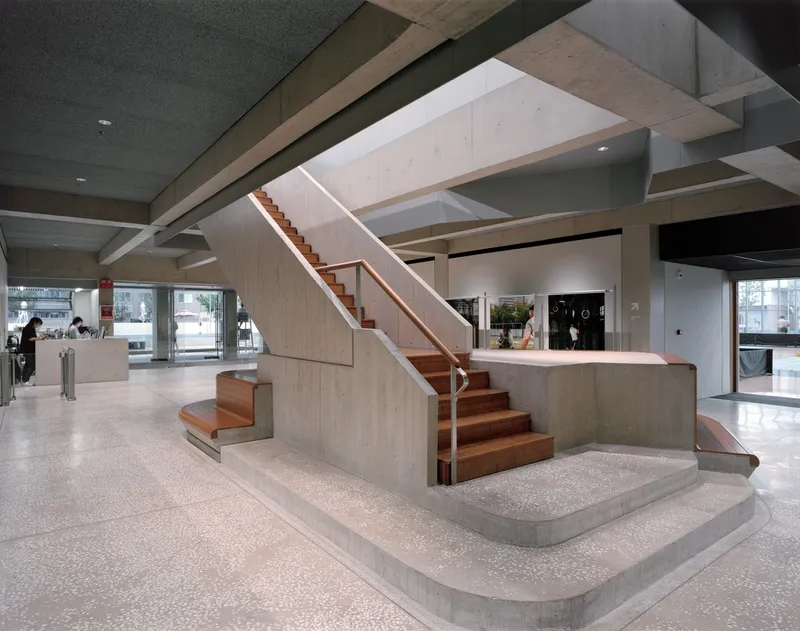
- Ground floor: lobby, jiu-jitsu studio, changing rooms, and water treatment facilities.
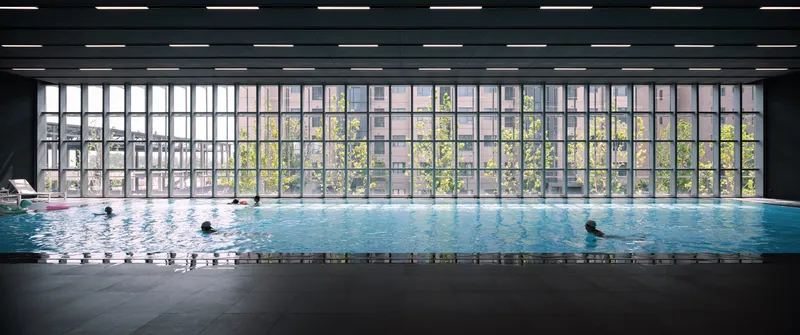
- Upper floor: fitness area and an indoor swimming pool overlooking the outdoor landscape.
This thoughtful layering enables multi-functional flexibility, allowing the facility to adapt to a variety of scales and types of public gatherings, from sports tournaments to cultural events.
Structure and Material Expression
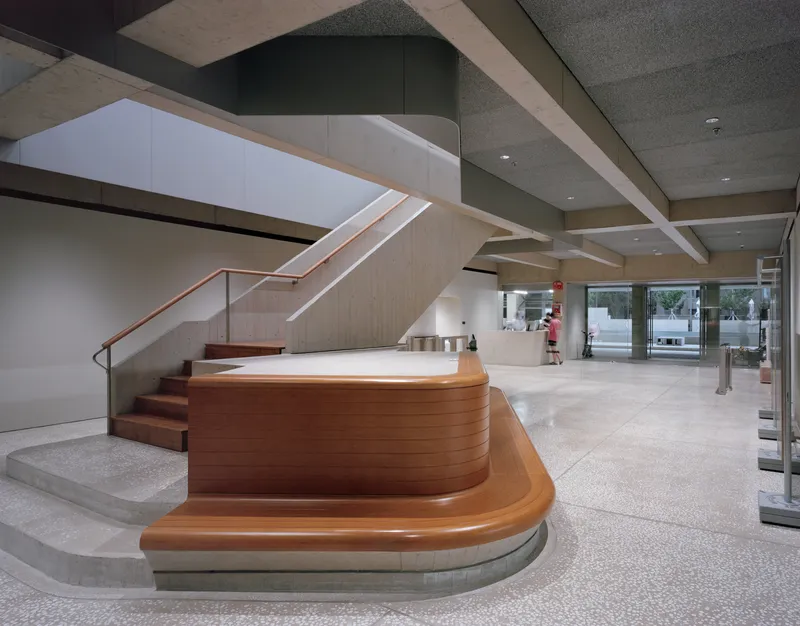
Atelier XÜK utilizes a prefabricated concrete and steel truss system, echoing industrial construction methods while ensuring structural efficiency. The mezzanine is independently supported, inserted within the main frame to create dynamic sectional relationships.
Each program zone—basketball courts, gym, and pool—is designed as an independent climate zone, optimizing comfort and reducing energy consumption. The non-structural interior columns serve as glass frames and conceal vertical drainage systems, aligning with the façade’s structural grid to enhance spatial rhythm and visual coherence.
Light, Transparency, and Spatial Clarity
Natural light and transparency are central to the project’s spatial experience. The north façade’s curtain wall and carefully aligned interior lighting establish a sense of openness and structural legibility. In the courts, the exposed truss roof emphasizes the industrial aesthetic, while the gym and pool adopt suspended ceilings for a softer, more refined atmosphere.
A uniform overhead lighting grid unifies the entire composition, reinforcing the clarity and precision of the architectural framework.
A Catalyst for Community and Public Life
When the north gates open, the interior seamlessly extends into the surrounding plaza, transforming the courts into an open-air event space. Since completion, the sports center has become an active social hub, hosting community sports, performances, and seasonal events.
Through its minimalist form, industrial logic, and contextual sensitivity, the Aranya North Shore Community Sports Center redefines the relationship between architecture, community, and memory—revitalizing an industrial landscape into a shared civic destination.
All photographs are works of Hao Chen


Popular Articles
Popular articles from the community

AL-JANNAH: Sustainable Architecture and Permaculture for Afghan Widows
AL-JANNAH uses sustainable architecture and permaculture to create resilient oasis of housing, learning, work and renewal for Afghan widows.

Co-Life: Senior Housing Design That Reconnects Older Adults With the City
Co-Life reimagines senior housing design through healing gardens, shared streets, workshops, and a sustainable community across generations.
EW PARK: Sustainable Architecture Reimagines the Future of Urban Parking
EW PARK reimagines city parking as a modular wooden tower combining automation, solar energy, electric mobility, and adaptable urban design.

The Ocean Hive: Sustainable Architecture for a Self-Sufficient Civilization at Sea
The Ocean Hive imagines sustainable architecture at sea, where modular habitats, algae, wave power and ocean waste sustain a growing colony.


Similar Reads
You might also enjoy these articles


Hodi-Mandai Geram
Project Function: Preservation and revitalization of the Intangible heritage and socio-spatial identity of the Hodi by Housing, Cultural Memory Center, Sacred Grove, landscape, local tourism economy


Olio Towers: A Mid-Rise for Performers That Fuses Housing, Rehearsal, and Stage
Located blocks from Houston's Theater District, this modular tower stacks living units around a central performance atrium.

Oasis: Modular Green Housing Carved into Dhaka's Urban Fabric
A shortlisted Plugin Housing entry reclaims unauthorized settlements in Dhaka with stepped concrete volumes, green roofs, and ventilation-driven design.

Black Hole: A Floating Megastructure for the Post-Physical Era
Emiliano Mazzarotto envisions a spherical, self-scaling arena where e-sports, digital hotels, and holographic stadiums replace traditional public space.


Explore Architecture Competitions
Discover active competitions in this discipline



Challenge to reimagine the Iron Throne


Photograph architecture without architects


Illustrate the lost glory of Angkor Wat - Render Challenge


Design challenge to reuse E-waste
Comments (0)
Please login or sign up to add comments
No comments yet. Be the first to comment!