
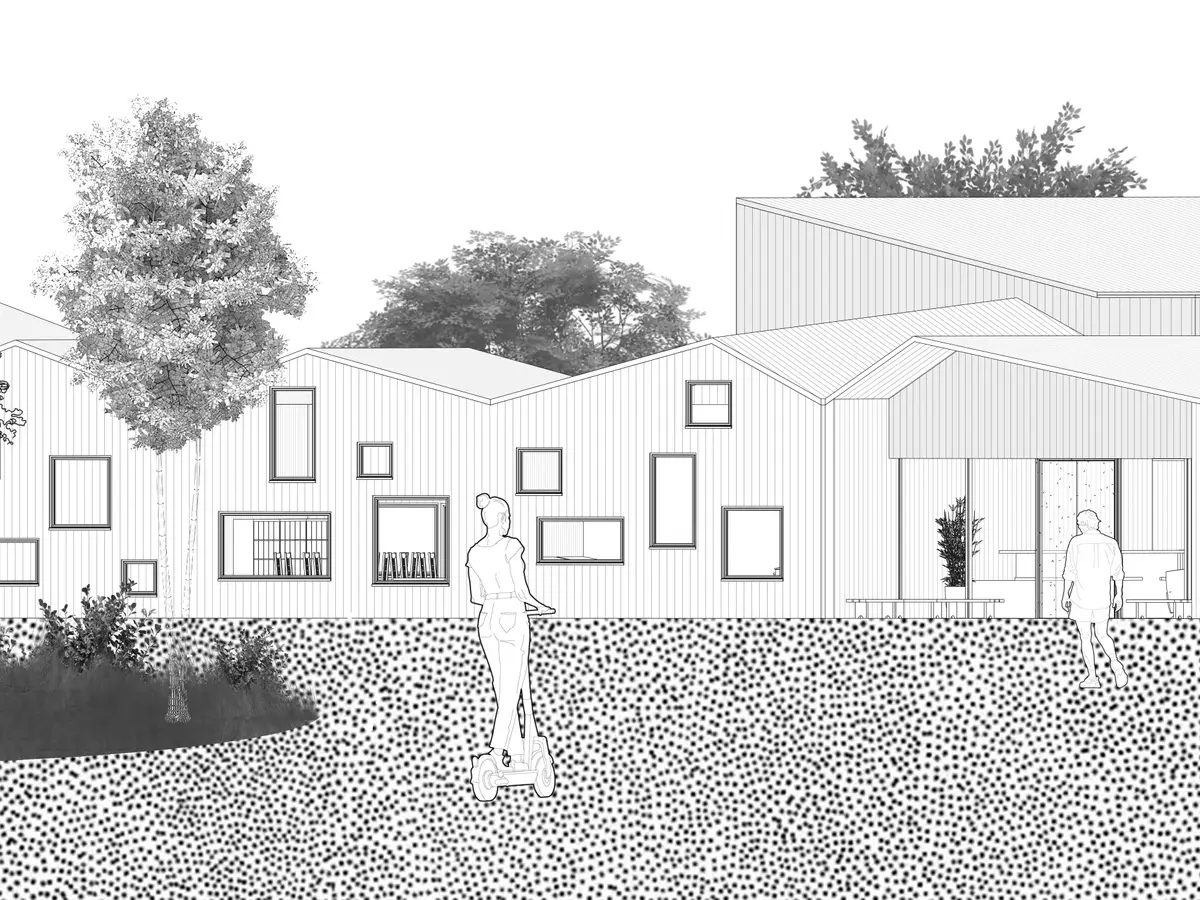
art-ium / art therapy center in Pleasington
architecture as a friendly environment for people struggling with chronic stress, anxiety, trauma, by art therapy

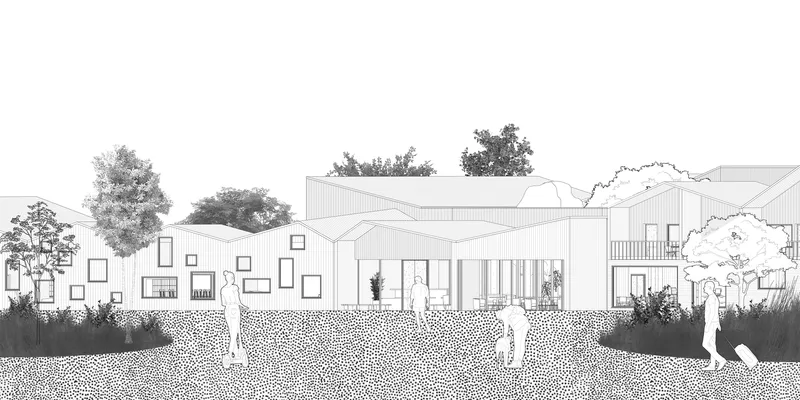
"The idea of the project is to create an accessible, two-storey building, which will refer to the surrounding architecture of Pleasington by its material but above all by its shape. The main element of the project is the centrally located atrium, which introduces light into the space in the central zones of the building. The atrium also creates natural connections and exits to spaces such as exhibition areas, workshop spaces, a residential module, and service and support spaces. During the design process, it was also important to position the building not only in relation to the world's directions (the workshop spaces are located to the east) but also to fit the building into the slightly hilly terrain."
land use:
plot area: 8450m2 - 100%
building area: 1430m2 - 16.9%
hardened area: 2090m2 - 24.7%
biologically active area: 4934m2 - 58.4%
the subject
The subject of study is an art therapy (therapy through art) center in Pleasington. The architectural competition is to design a therapeutic space for painting, sculpture and music as part of an art therapy program. The goal of the project is to create a space that will provide a platform for people to practice these art forms in groups, and its architecture will not only enable their work process but also create a healing and relaxing environment. This environment includes not only the building, but also the design of the therapeutic green space outside, but also inside the center, as well as parking spaces. The building must meet the requirements of the art therapy center but also fit well into the established architectural canons of Pleasington and the surrounding area.
site analysis
The site within which the site was selected for the art therapy center project is located in Pleasington, a village in the Borough of Blackburn, Lancashire, England. It is a village situated on a hill above the River Darwen, surrounded by beautiful views and scenery ideal for self-reflection and art practice. The location is far from the urban life filled with stress and responsibilities of everyday life. An important factor entering into the analysis of the location is the hilly terrain of the plot, which strongly influences the development possibilities of the area. Access to the parcel is from the south side of the Pleasington. . The contextual analysis also shows that public transportation in Plesington itself relies solely on rail transportation. A commuter train regularly passes through the town, running to the town of Blackburn. There are no bus stops in the Plesington town itself and the nearest option for this transport is to travel to the aforementioned town of Blackburn. The cycling infrastructure is much better developed. Two important cycle routes, WW and WW6, pass through Pleasington itself. The following is an analysis of the location such as transportation, travel time to important points, public transportation, ground elevations and cross-sections through the parcel showing ground elevations.
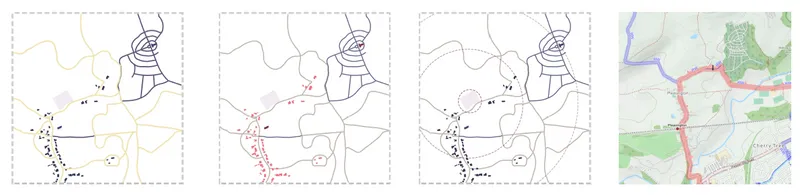
road analysis / building height analysis / time analysis / cycle path analysis
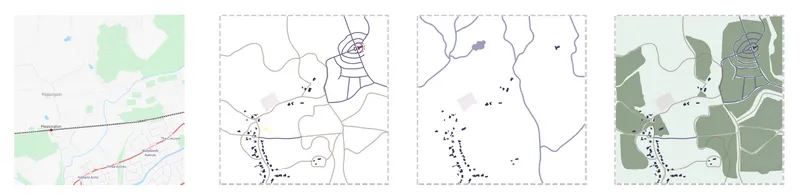
transport / functional structure / water bodies / greenery
analysis of the issue
Today's economic growth is a result of the development of people around the world. The pace of life has increased, and people are sacrificing their private lives to work in order to meet their daily needs and expectations. This progress and development also come at a price. More progress requires longer working hours during the week, which has significantly affected the time we spend at home - it has decreased it. All in all, it affects our private lives and interpersonal relationships.
From recent observations of IHME (Institute for Health Metrics and Evaluation) data, we can read that there has been a 60% increase in the overall number of mental health problems worldwide, most of which are work-related. This brings with it a great need for centres that focus on mental health, therapy centres, or psychotherapies, which include art therapy.
Art therapy is therapy conducted through art. More specifically, it is a type of psychotherapy that uses a variety of artistic disciplines to help combat the scourge of mental illness that we have been facing especially since the early 21st century. Sculpture, painting, dancing or singing give us access to our inner self, stimulate our emotions, help us see our needs and minimize our fears. Art therapy is crucial not only for the mentally ill - it can also be particularly helpful in treating physical illness. Art therapy has no age limits - children, adults and seniors can benefit from it.
user analysis
The art therapy center facility itself has no limitations when it comes to the user profile. Art therapy itself is used for children, adults as well as the elderly. Therefore, the building was designed with everyone in mind and accessible to all. The needs of both physically healthy people and those with mobility problems have been considered in the design.
site design
Due to the specific shape of the plot and slightly hilly terrain, the building itself was designed in a way which minimized interference in the terrain as much as possible. In order not to completely level height differences the building was partially hidden. This also shaped two outdoor spaces with a separate microclimate inside - one belonging to the part with studios, where classes such as painting, sculpture, drawing or singing take place, where practically right away from the studio we can go out into the courtyard full of greenery, and another space on the right side of the building looking from the entrance, next to the restaurant and the emergency exit. This also shaped two spaces with a separate microclimate inside - one belonging to the part with studios, where classes such as painting, sculpture, drawing or singing take place, where practically right away from the studio we can go out into the courtyard full of greenery, and another space on the right side of the building looking from the entrance, next to the restaurant room and the emergency exit. An important element that was included in the landscaping design was a rain garden located by the slope on the right side of the building, which could be exposed to washing away during heavy rainfall combined with the slope's inclination.
functional solutions
The first floor of the building was divided into zones such as the entrance zone, classroom zone, technical rooms zone, atrium as a green center of the building providing natural lighting, administration zone and exhibition zone. On the right side of the first floor, we can find the catering zone, which includes a restaurant and kitchen facilities.
The second floor has a completely different function and it contains the accommodation zone, which can accommodate up to 25 people at a time. In addition to the hotel zone, the floor also consists of many common spaces facing the atrium.
The idea of separating the daily use areas such as the restaurant, the exhibition area and above all the art therapy spaces from the hotel area is to create a natural zone of calm, undisturbed by visitors, a space in which patients feel comfortable even after classes. The space has been designed to be accessible also to people with disabilities, taking into account as many dysfunctions as possible that the user may have. The hotel zone not only has living rooms but also common areas facing the green atrium to bring users together.
pro-ecological solutions
As a pro-environmental solution used in the facility, we can certainly consider the atrium, which allows a significant amount of natural light into the building. Another element that works in favour of nature is the rain garden, which creates an arrangement with the relief of the land and gives the benefits of a sustainable retention system. The main purpose of a rain garden is to collect rainwater and gradually return it to the ecosystem.
material solutions
The two main elements used to finish the façade are red-fired brick, referencing the local Pleasington architecture, and the dominant linear oak wood planks. A slab-on-grade foundation was used as the foundation and the primary structure was based on a sandstone masonry system.


Popular Articles
Popular articles from the community


The Ocean Hive: Sustainable Architecture for a Self-Sufficient Civilization at Sea
The Ocean Hive imagines sustainable architecture at sea, where modular habitats, algae, wave power and ocean waste sustain a growing colony.

Hill & Cross Opera: Sculptural Opera House Architecture Shaped by Tallinn’s Landscape and Identity
Hill & Cross Opera reimagines opera house architecture in Tallinn through its sculptural hill, civic plaza, glass wave and a luminous cross.

Play: Fragments of Their World
Familiar architecture becomes modular playground design, creating safe spaces where displaced children can learn, connect, imagine and play.

Little Red Riding Hood: Architectural Design as a Journey Through Fear, Light, and Storytelling
Little Red Riding Hood reimagines the fairy tale through architectural design shaped by fear, light, scale, memory, uncertainty, and choice.

Similar Reads
You might also enjoy these articles

Day and Night Park: A Time-Based Urban Newsstand in Beijing
A temporary urban newsstand in Beijing blending travel, light, and reading through poetic colors, compact form, and community-focused design.

Modernist Patio Renovation in El Masnou, Barcelona by Oliver Segura Arquitectura + Cebrià Arquitectura
Modernist patio renovation blending tradition and innovation with a movable pool, leveled floors, and Catalan materials in El Masnou.
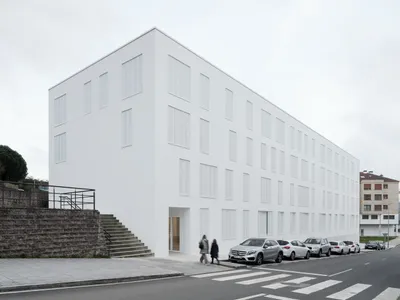
Alto Residencial Coop: Cooperative Housing Development in Santiago de Compostela by Carbajo Barrios Arquitectos
A linear cooperative housing complex blending white volumes and perforated metal façades, enhancing community living, natural light, privacy, and urban integration.
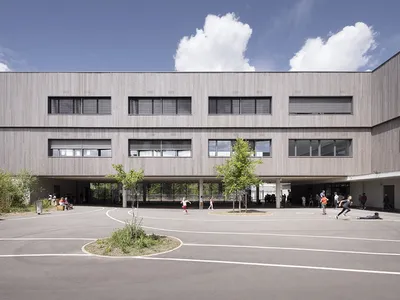
Vil Genis School by BPA ARCHITECTURE – Massy, France
Vil Genis School in Massy, France, features sustainable design, south-facing classrooms, community integration, accessible spaces, and modern educational architecture.

Explore Healthcare Building Competitions
Discover active competitions in this discipline


Challenge to reimagine the Iron Throne

Photograph architecture without architects

Illustrate the lost glory of Angkor Wat - Render Challenge

Design challenge to reuse E-waste
Comments (0)
Please login or sign up to add comments
No comments yet. Be the first to comment!