Courtyard Living
Weaving Life & Livelihood Block by Block


Introduction
With a major housing crisis in Ghana, households of an average of ten people live in one room, in which most do not have access to infrastructural water and electricity services. According to Ghana’s government, the housing deficit across the country in 2020 exceeds 5.7 million. Although annually Ghana needs over 100,000 housing units, only 35,000 to 40,000 houses are built. To address the housing crisis, the project proposes a mixed-development multi-family apartment complex that incorporates the spatial arrangement of Ghana’s traditional compound house with central courtyard spaces. The project is constructed with cost-effective, locally sourced Earth blocks and responds to local environmental conditions.
Urban and Cultural Landscape
Bolgatanga, part of Ghana’s Upper East Region, is undergoing rapid urbanization, with development – markets, churches, hospitals, banks, commerce, and schools – occurring along the three major roads central to the city. Buildings along the main roads are predominantly mixed used. Most of these places are easily accessible by walking and public transportation. The city has a commerce-oriented economy that focuses on arts and crafts and agriculture. Residents weave Bolga baskets and farm major food crops in their courtyards or unoccupied land adjacent to their houses for subsistence and income. Bolgatanga's desertic, savannah climate makes it hot all-year round with two seasons – a rainy and a dry season.
A predominant feature of Bolgatanga’s architecture is the courtyard, which can either be confined within the building as a central void or be any form of large open space connecting a cluster of buildings. The courtyards embody the inhabitants’ culture and lifestyle. For instance, a variety of social and economic activities typically take place in these spaces: cooking food, drying clothes, laundry, resting, socializing, playing, hosting events and rituals, basket weaving, knitting, farming, and more. The project incorporates the courtyard into the core of its concept.
Program
Organized by an irregular grid system created based on the spatial arrangements of its surrounding buildings, the project consists of a series of solid forms and voids.
The voids, or public courtyards, connect with enclosed communal spaces and promote social interactions among the community on multiple scales. For instance, the front courtyard responds to the commerce that occurs along the main road by transforming into a market space when indoor stalls flexibly expand outwards on a busy day. The playground, adjacent to the daycare, allows parents to drop off their children when they are working or shopping. The multipurpose courtyard in front of the communal building connects to the adjacent enclosed event space and allows for large community gatherings and events. Lastly, the community garden forms a connection between the complex to its adjacent empty land and the city’s agricultural periphery. In addition to the public spaces, the private residential spaces encompass a series of semi-public courtyards and balconies.
Public courtyards, which host larger social events, connect the scattered buildings and internal, semi-private courtyards throughout the complex. Amenities not only address the inhabitants’ needs, but also the needs of the surrounding communities. This is exemplified by the shops and workshops that complement the region’s arts and crafts lifestyle industry.
Materials, Construction and Sustainability
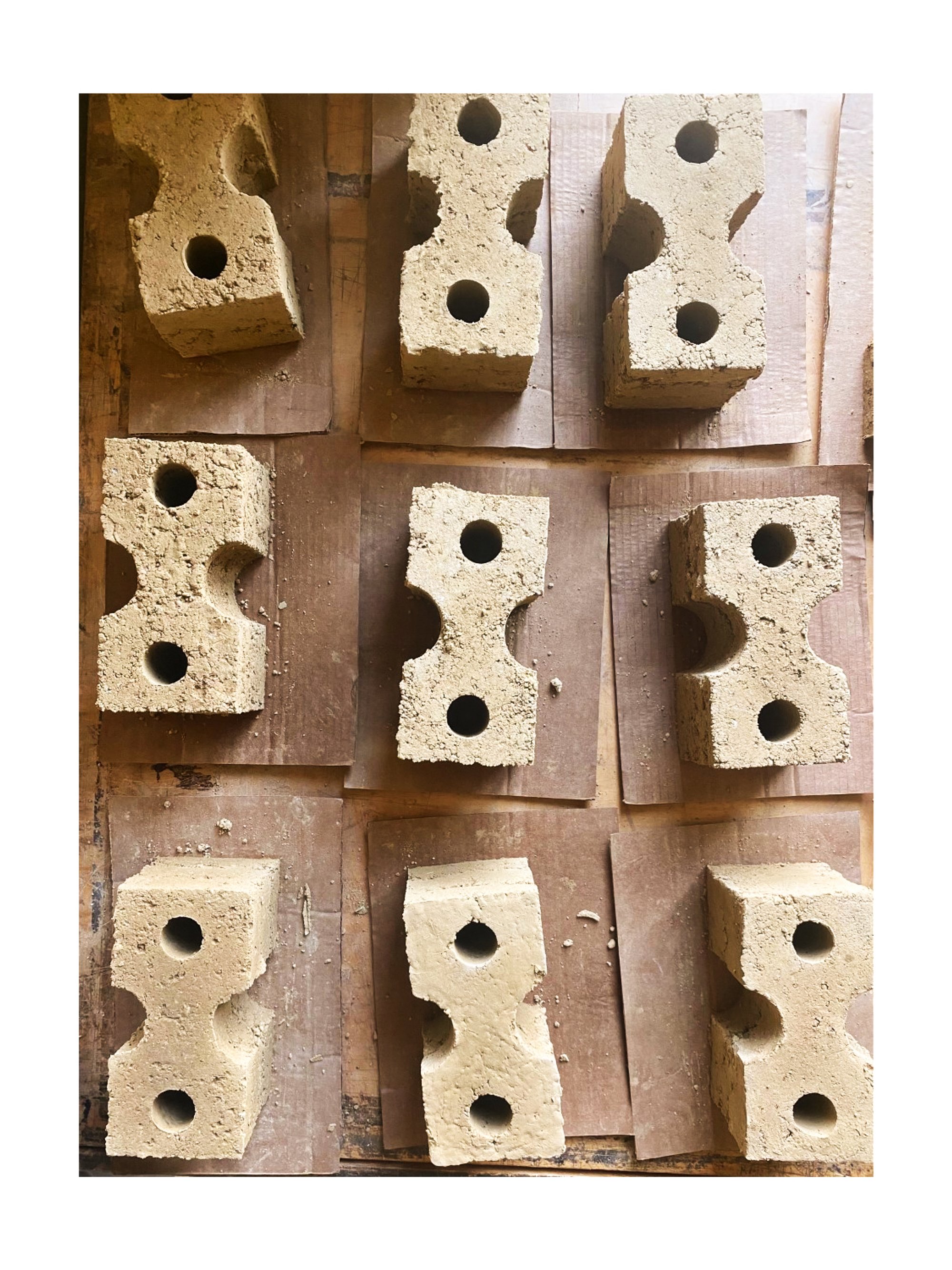
The main material of the project is the Earth block. This block is built by mixing dirt excavated from the site with additives, sand or straw, and protected with a mixture of limestone and cement for waterproofing and durability. The block unit is made by a customizable mold design that allows varied, modular stacking arrangements.
The Earth block makes up the architectural enclosure, partitioning, and structure. For structural reinforcement, the block design has openings that can be filled with steel pipes filled with concrete. In addition, determined by the boundaries of openness, solar orientation, and wind direction, the varied block stacking arrangements create different levels of porosity for natural lighting and ventilation. The market space includes walls with a high level of porosity to encourage social interactions whereas the walls of the bedrooms of the residential units have a low level of porosity for privacy.
As an environmental strategy, the project incorporates balconies for open-air circulation that connects the buildings on the upper floors, promotes social interactions among inhabitants, and functions as overhangs for shading. In response to heat and needs for solar protection, most openings and public spaces are oriented towards the North while a system of louvres and screens shade the Southwest façade of the building. The free form roof, raised and supported by a steel space-truss system, unifies the buildings into one cohesive complex, promotes natural air ventilation, and provides shading for sun protection. Last but not least, the stormwater collection system responds to water scarcity in Bolgatanga during the dry season. The collected rainwater is reused for agricultural irrigation and grey water usage.
Conclusion
The project...
1. Proposes housing that reflects Bolgatanga’s culture and lifestyle by incorporating spatial arrangements of the traditional compound houses and courtyards in the region.
2. Encourages social interactions between the residents and strengthens community bonds.
3. Responds to environmental conditions, such as natural lighting and ventilation, with varied stacking arrangements of the Earth blocks, a system of balconies louvres, and a freeform roof to optimize building energy performance and minimize costs.
4. Addresses water scarcity in Bolgatanga and incorporates green spaces.
5. Provides residents opportunities for employment by making and selling their crafts and surplus crops in the shops; food security by farming in the community garden; daycare for working parents; education and working spaces in library; health and wellness; and event for holidays and celebrations.