

line+ studio Anchors a Folded Concrete Canopy to the Shore of Yunnan's Erhai Lake
A 150-square-meter rest station near Dali fuses rubble masonry, low-carbon concrete, and recycled steel into a new lakeside topography.


Rest stops rarely earn the word architecture. Most are afterthoughts: a tin roof, a bench, a sign. The Dali Erhai Lake Ecological Rest Station by line+ studio treats the brief differently. Sited along the southwest edge of Erhai Lake's 129-kilometer scenic corridor near Xiaoyizhuang Village, this 150-square-meter structure folds itself out of the ground like a slab of local limestone that decided to tilt skyward. It contains only toilets, a small store, and a sheltered open platform, yet its ambition goes well beyond program. The building is part of a broader ecological corridor initiative to establish a healthy water-land buffer zone, and it behaves accordingly: minimal footprint, maximum landscape presence.
What makes the project genuinely interesting is its dual commitment. On one hand, the design philosophy of "anchoring and suspension" roots the structure to its terrain through heavy rubble masonry while lifting a dark folded-plate roof into the air, creating a gap through which wind, light, and views of Cangshan Mountain pass freely. On the other, the construction methodology is almost stubbornly low-tech: hand-laid stone, reduced-cement concrete tinted with natural dyes, recycled rebar turned into railings and stair treads. In a region where the Tea Horse Ancient Road once sustained a culture of roadside rest stations built to resemble local dwellings, line+ studio revives that tradition through a decidedly contemporary structural language.
A Roof That Becomes Landscape
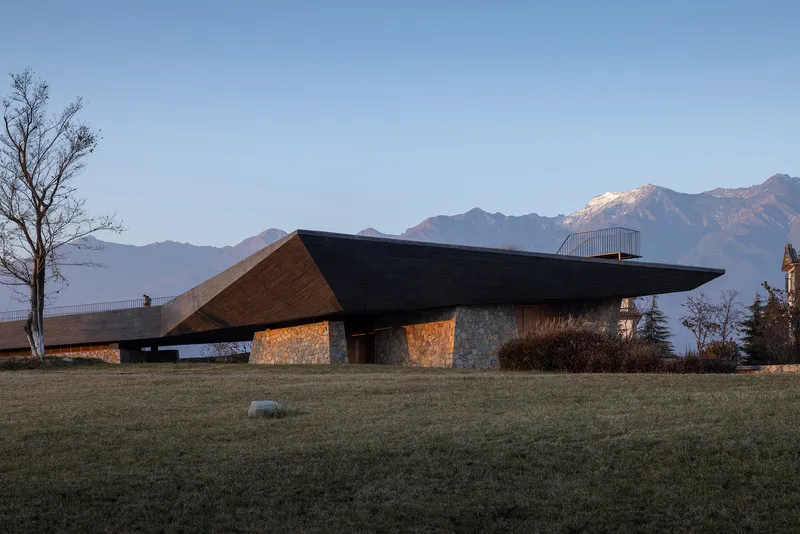
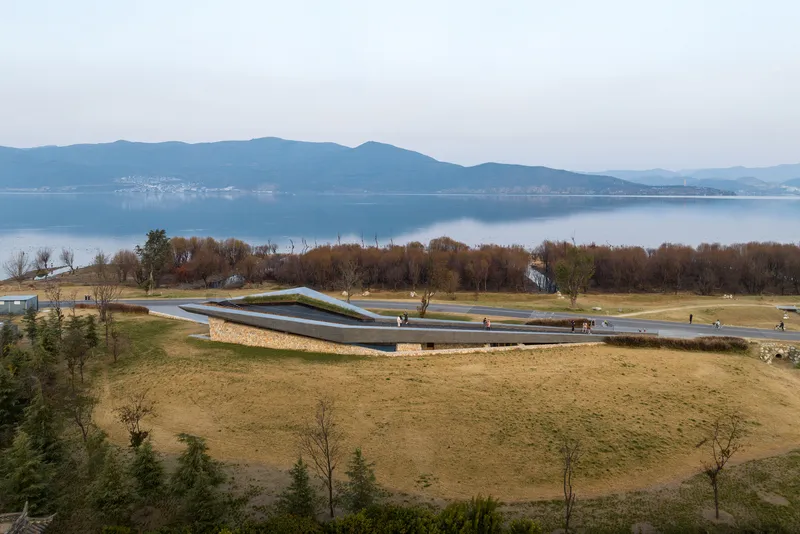
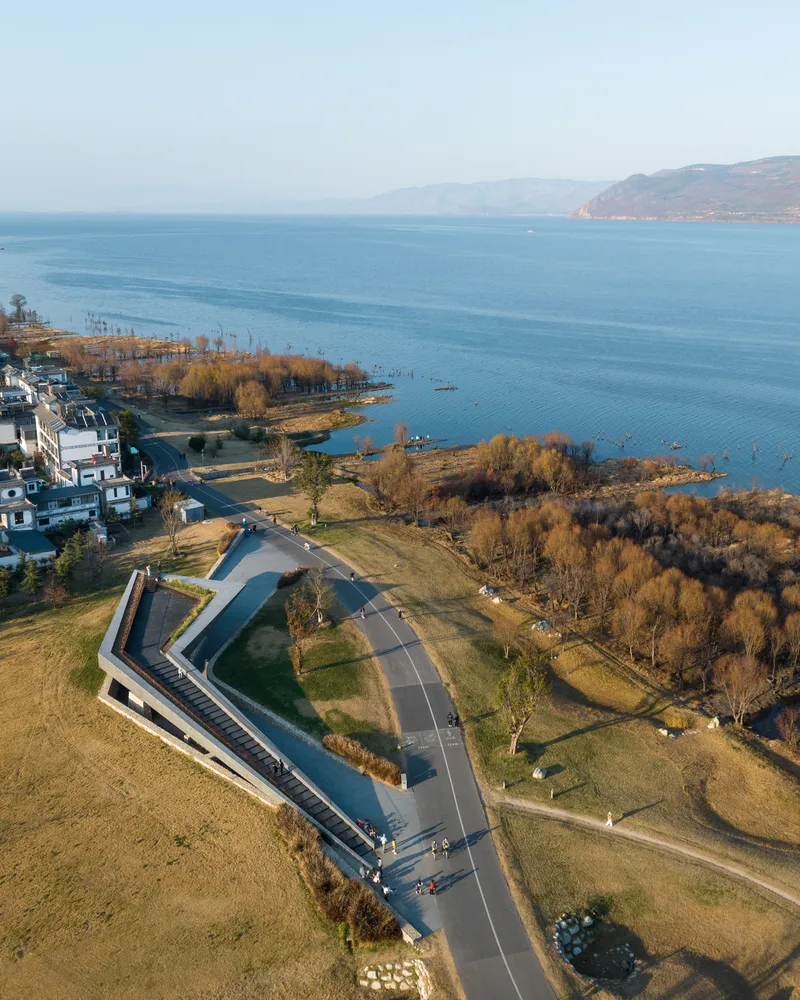
The folded-plate roof is the building's most legible gesture. Parametrically calculated to achieve a large-span cantilever, it was cast using a box-type structural system: a single pour combined with an upturned beam method, followed by a secondary casting for waterproofing and load-bearing refinement. The result is a dark, angular plane that appears to hover over the stone base, framing the snow-capped peaks of Cangshan to the west and the waters of Erhai Lake to the east. UHPC panels handle drainage, channeling rainwater to culverts via landscape supports that retain runoff space along the perimeter.
Seen from a drone, the roof reads less as shelter and more as a new piece of topography, a low ridge inserted among the lakefront trees. The orientation was driven by existing vegetation and the alignment of the bicycle promenade that runs along the ecological wetlands. That the building's east-facing stance emerged from tree positions rather than pure compositional logic gives it an incidental quality that feels right for a corridor designed to prioritize ecology over spectacle.
Stone Base, Open Threshold
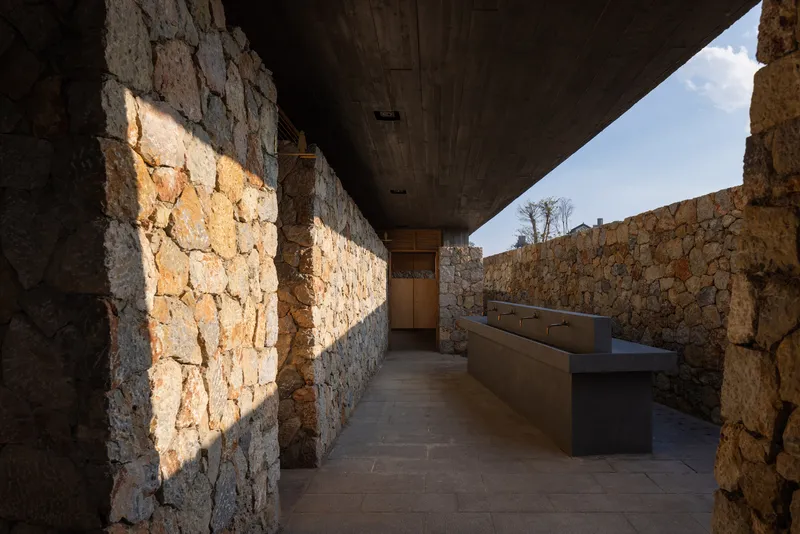
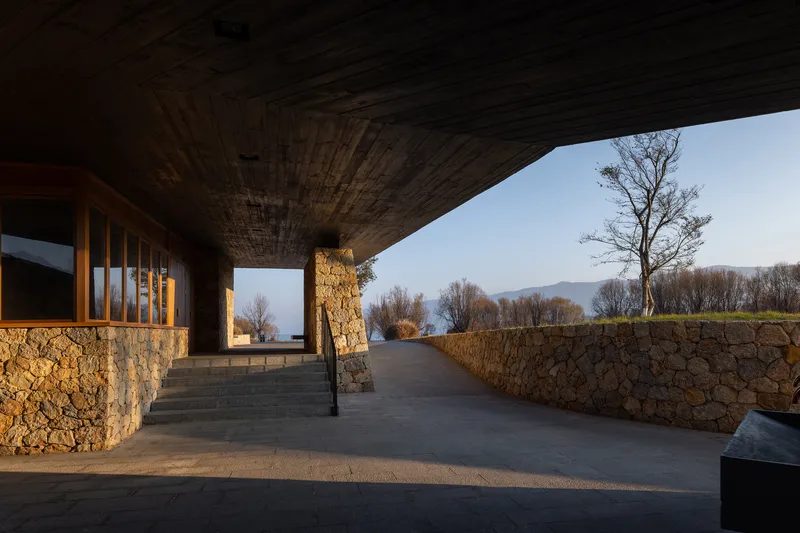
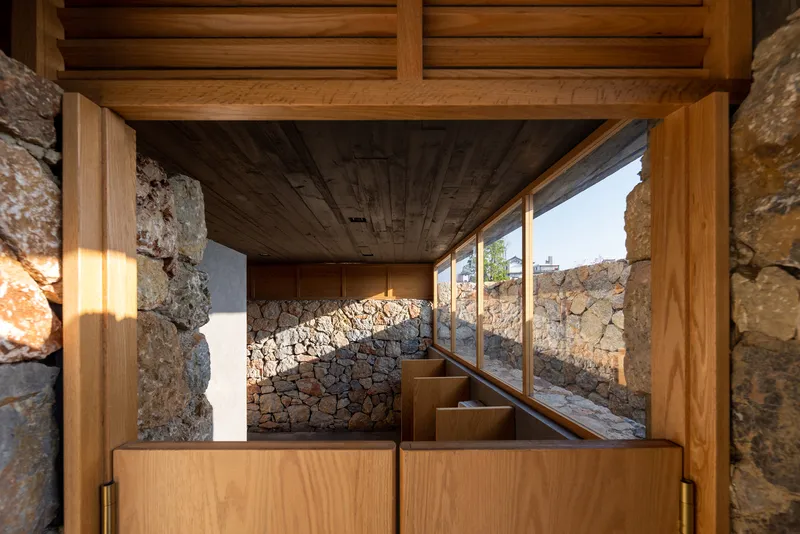
Below the roof, the building anchors itself with locally sourced Dali limestone, particle sizes ranging from 150 to 450 millimeters, laid as rubble masonry by hand. The technique is deliberately low-tech: galvanized steel angles are horizontally anchored within the stone walls, welded to threaded steel bars embedded inside the masonry so that no visible joints interrupt the surface. The walls read as geological strata rather than construction, their rough faces catching afternoon light in ways that shift throughout the day.
Narrow corridors flanked by dry-stacked stone walls compress the visitor's experience before releasing it into wider views. The stepped courtyard, visible through timber doorways, stages a sequence of thresholds that oscillate between enclosure and openness. It is a spatial rhythm borrowed from traditional Bai settlements in the region, where courtyard houses mediate between private life and the agricultural landscape beyond.
Timber, Concrete, and the In-Between
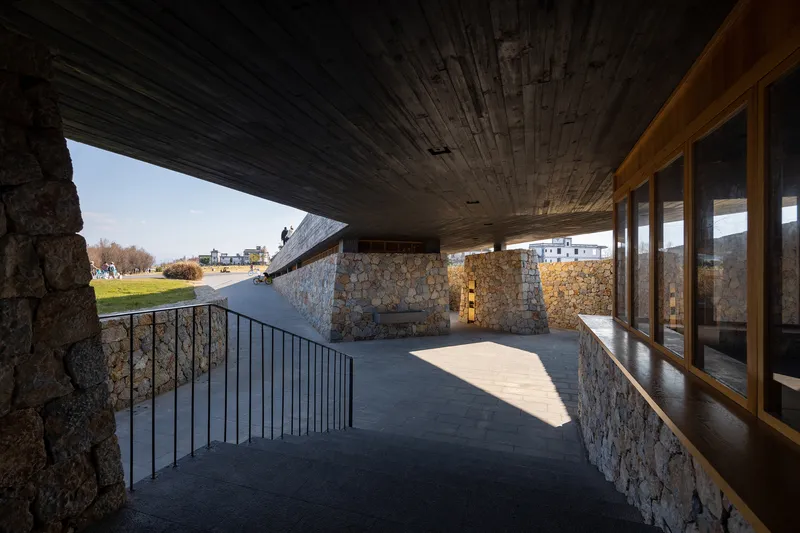
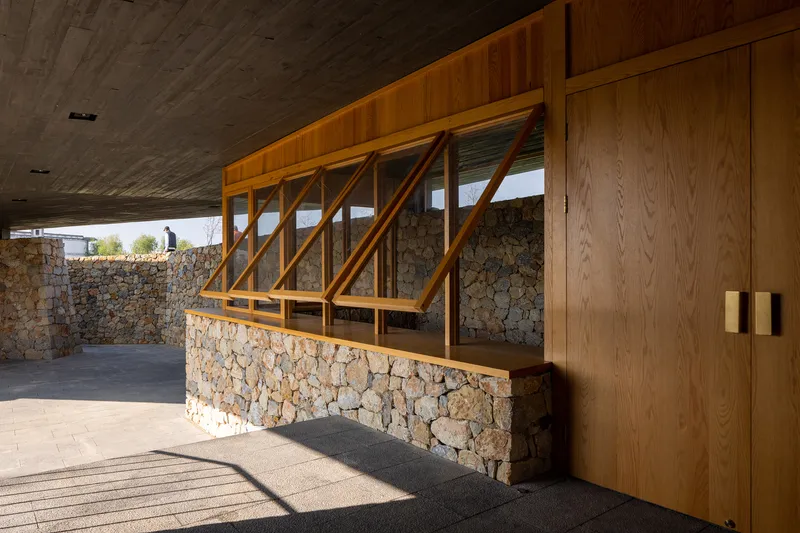
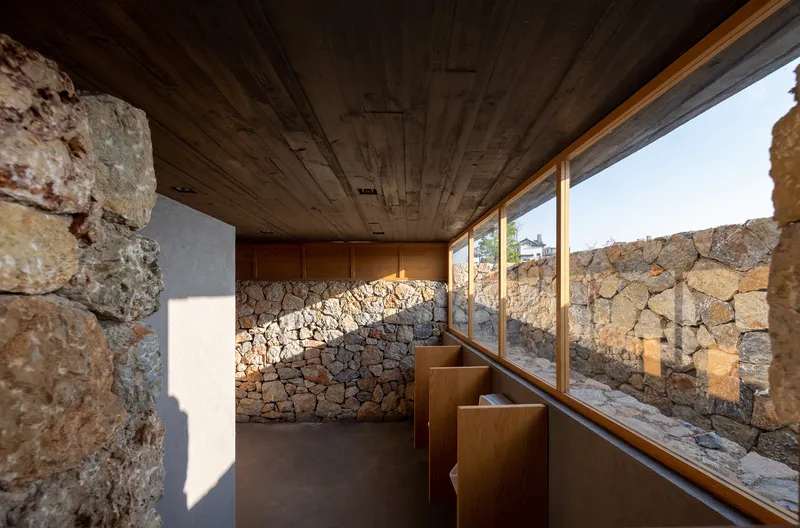
The covered terraces are where the building's material palette converges most clearly. Charred timber ceilings (the underside of wood formwork left exposed after concrete casting) sit above limestone walls and angled timber-framed glazing. Solid oak doors and windows provide a warmer register against the dark concrete overhead. The gap between roof and wall is not merely structural; it is the building's primary climate strategy, allowing cross-ventilation that eliminates the need for mechanical cooling in Dali's temperate highland climate.
High windows fitted with wooden louvers serve the bathrooms, balancing natural ventilation and privacy. A solid wood dwarf door on the bathroom entry is an unexpectedly domestic detail in what is otherwise a public building. These small decisions, the kind that rarely make it into renderings, reveal a design team thinking about inhabitation rather than image.
Recycled Steel and Low-Carbon Concrete
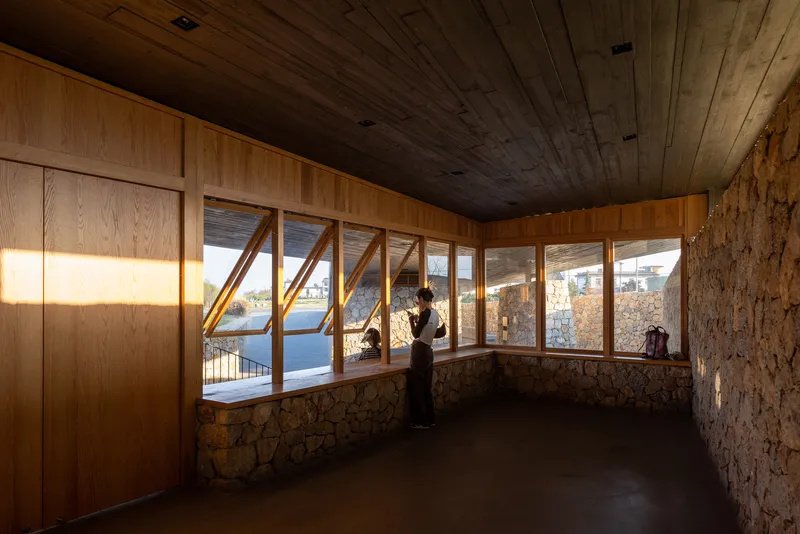
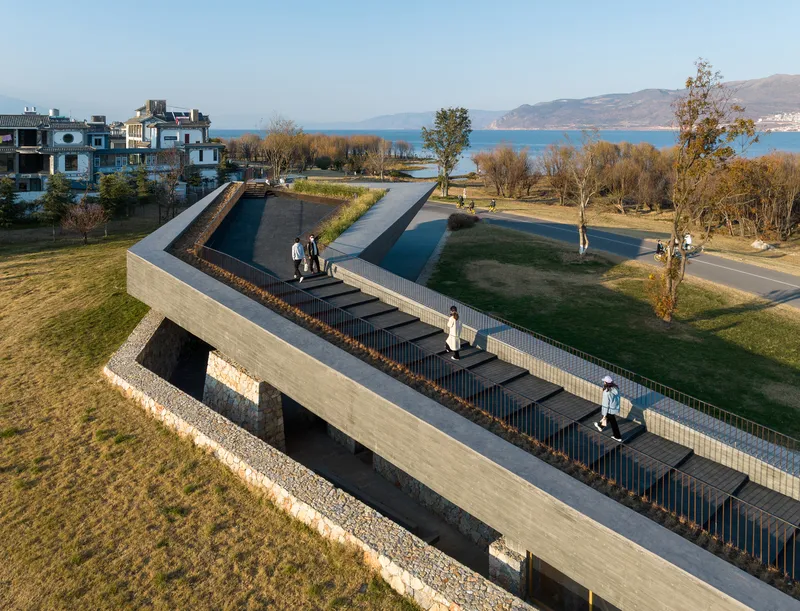
The project's sustainability argument rests on specifics, not slogans. Concrete mixes were formulated with reduced cement content, increased mineral aggregate, and natural dyes to achieve the dark tone visible in the roof. Experimental simulations and on-site mock-ups were conducted to control color and texture before full-scale casting. Reinforcement and steel plate scrap left over from the construction process were recycled into railings, stair treads, and grooves throughout the station, an honest acknowledgment that waste is a material resource, not a disposal problem.
The reflecting pools and central staircase seen from above complete the ground-level landscape strategy. Water features are not decorative: they participate in the site's stormwater management, holding and releasing runoff in coordination with the UHPC drainage panels above. Visitors walking along the water edges experience the building as an extension of the lakefront ecology, which is exactly the point.
Model and Method
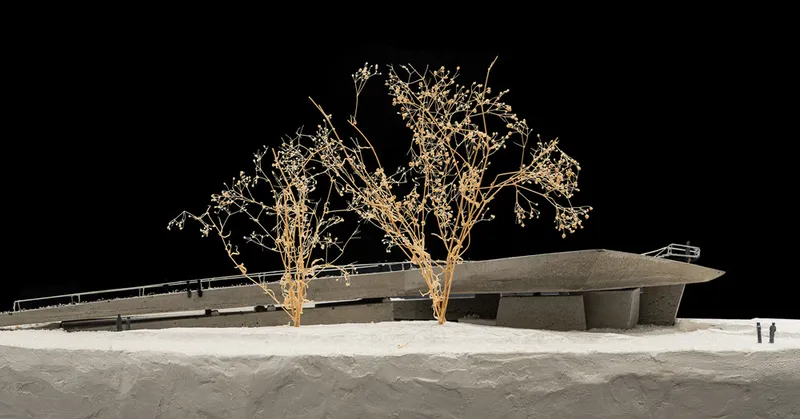
A physical model reveals the design's essential logic: a low-slung roof that defers to the existing tree canopy. The preserved trees are not a concession but a generative constraint. Their positions determined the building's orientation, its plan footprint, and the cantilever lengths required to shelter public space without removing a single trunk. In a region where ecological protection requirements govern construction in the Erhai Lake buffer zone, this kind of tree-first planning is not optional, but line+ studio turns the constraint into the project's strongest spatial quality.
Plans and Drawings
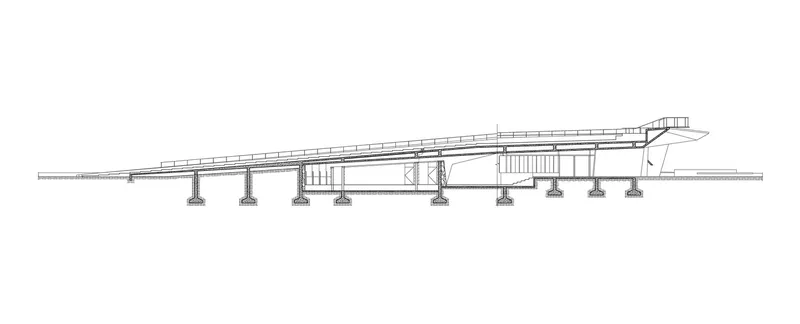
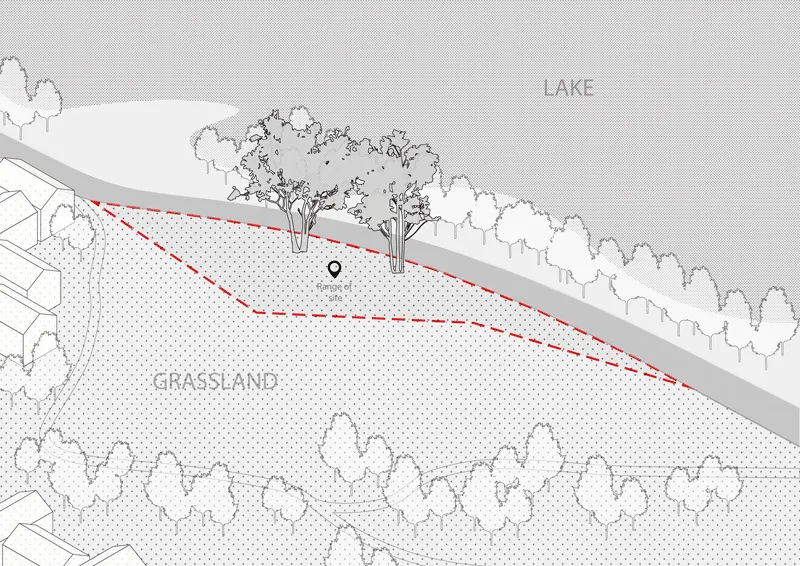
The section drawing clarifies the structural ambition: columns supporting the sloped roof rise from a central core, creating a clear span that allows the perimeter to remain open or lightly enclosed. The upturned beam is visible in the roof profile, its depth providing both structural capacity and the visual mass that grounds the canopy against the mountain backdrop. The site plan, meanwhile, maps the building's relationship to the curving bicycle path, the lakefront tree line, and the grassland buffer. The station occupies a remarkably small portion of the site, confirming that the project's real material is landscape, not concrete.
Why This Project Matters
Small public buildings in ecologically sensitive zones are often treated as negligible: too modest to warrant serious design attention, too constrained to allow architectural invention. The Erhai Lake Ecological Rest Station pushes back on both assumptions. At 150 square meters, it manages to advance a credible low-carbon construction methodology (hand-laid rubble masonry, reduced-cement concrete, recycled steel), demonstrate a climate-responsive section (the ventilated gap between roof and base), and contribute to the cultural continuity of Yunnan's historic rest-station tradition along the Tea Horse Road. That is a lot of work for a building whose program is essentially a toilet, a shop, and a covered bench.
More broadly, the project raises a useful question for the dozens of additional service stations planned along the 129-kilometer Erhai Lake corridor: can infrastructure be landscape? line+ studio's answer, a folded concrete canopy that reads as topography from the air and as shelter from the ground, suggests it can, provided the architects start from trees and stone rather than from form. In Dali's post-pandemic moment, as the city draws digital nomads and long-stay visitors in growing numbers, this modest rest station offers a template for public architecture that serves ecology first and human comfort as a direct consequence.
Dali Erhai Lake Ecological Rest Station by line+ studio. Located along the southwest edge of Erhai Lake near Xiaoyizhuang Village, Dali, Yunnan, China. 150 m². Completed 2022. Structural design by Shanghai Xie Yimin Structural Design Co., Ltd. MEP design by Shanghai Sanjiang Mechanical and Electrical Technology Co., Ltd.
About the Studio
Share Your Own Work on uni.xyz
If projects like this are the kind of work you want to make, uni.xyz is a place to publish your own, find collaborators, and enter design competitions.


Popular Articles
Popular articles from the community


Manzana Morphosis: Stretching Barcelona's Grid into a Living Landscape for 2050
A radical reworking of the Eixample manzana turns density into a tool for generous public space, vertical ecology, and environmental performance.


David Ortega Stacks a Two-Story Mexico City Penthouse Around a Steel Stair and a Pergola-Shaded Roof Terrace
In Colonia Roma, a 300 m² penthouse uses oak joinery, a planted steel stair and a slatted roof pergola to make a new-build apartment feel like a house.

Singing Woman: An Opera House That Performs Before the Curtain Rises
Ovidiu Cristian Pavel's conceptual opera house translates Estonia's choral identity into a sculpted waterfront landmark facing the Baltic Sea.

ETEH Reworks the Shared Spaces of São Domingos School in Brazil Around Timber, Color and Hanging Plants
At São Domingos School in Brazil, 436 m² of hall, refectory and library are recast with timber joinery, a yellow and blue code and trailing greenery.

Similar Reads
You might also enjoy these articles


Hodi-Mandai Geram
Project Function: Preservation and revitalization of the Intangible heritage and socio-spatial identity of the Hodi by Housing, Cultural Memory Center, Sacred Grove, landscape, local tourism economy


Olio Towers: A Mid-Rise for Performers That Fuses Housing, Rehearsal, and Stage
Located blocks from Houston's Theater District, this modular tower stacks living units around a central performance atrium.

Oasis: Modular Green Housing Carved into Dhaka's Urban Fabric
A shortlisted Plugin Housing entry reclaims unauthorized settlements in Dhaka with stepped concrete volumes, green roofs, and ventilation-driven design.

Black Hole: A Floating Megastructure for the Post-Physical Era
Emiliano Mazzarotto envisions a spherical, self-scaling arena where e-sports, digital hotels, and holographic stadiums replace traditional public space.

Explore Architecture Competitions
Discover active competitions in this discipline

Challenge to design locus for the upliftment of human rights

Challenge to reimagine the Iron Throne

Photograph architecture without architects

Illustrate the lost glory of Angkor Wat - Render Challenge
Comments (0)
Please login or sign up to add comments
No comments yet. Be the first to comment!