

Dehumidifier Core: Silica Gel Skins That Let a Building Breathe in the Tropics
A passive humidity regulation system in Paramaribo uses silicon dioxide and courtyard airflow to replace mechanical dehumidifiers entirely.


Nearly half the hours in Paramaribo, Suriname fall outside the human comfort zone for humidity. That statistic, 46.7 percent to be exact, is the kind of number that usually triggers a reflexive reach for mechanical HVAC systems. Dehumidifier Core rejects that reflex. Instead, it proposes an architectural envelope laced with silicon dioxide, the same silica gel you find in desiccant packets, and asks it to do the work of a machine. The result is a children's learning center that breathes, absorbs moisture, and self-regulates its interior climate through nothing more than material logic, orientation, and form.
Designed by Hamed Malekandeh, Parisa Khosravi, Parto Hedayati, and Hanieh Rahimbakhsh, the project was shortlisted in Form Follows Climate 2020. Sited in Paramaribo, a city classified as Tropical Rainforest Climate (Af) under the Köppen-Geiger system, with an average temperature of 26.8 °C and 2103 mm of annual rainfall, the project confronts one of the most persistently humid urban environments on the planet. Rather than treating humidity as an afterthought to be solved by engineers, the team made it the generative force behind every architectural decision.
A Triangulated Roof That Harvests Wind
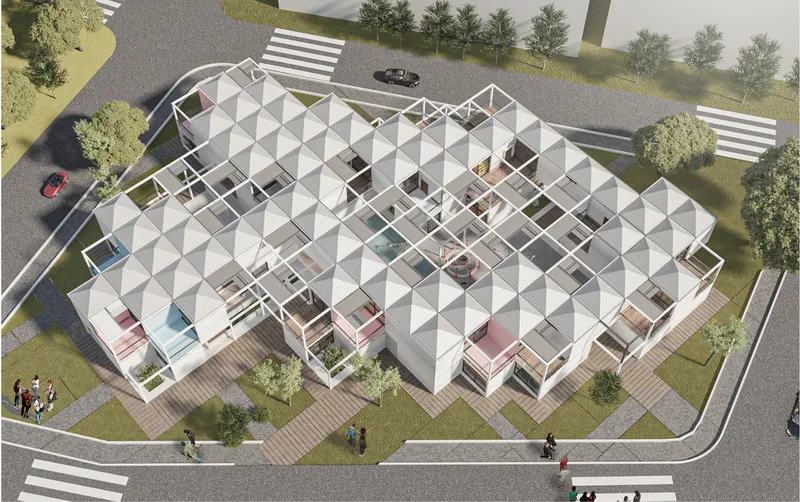
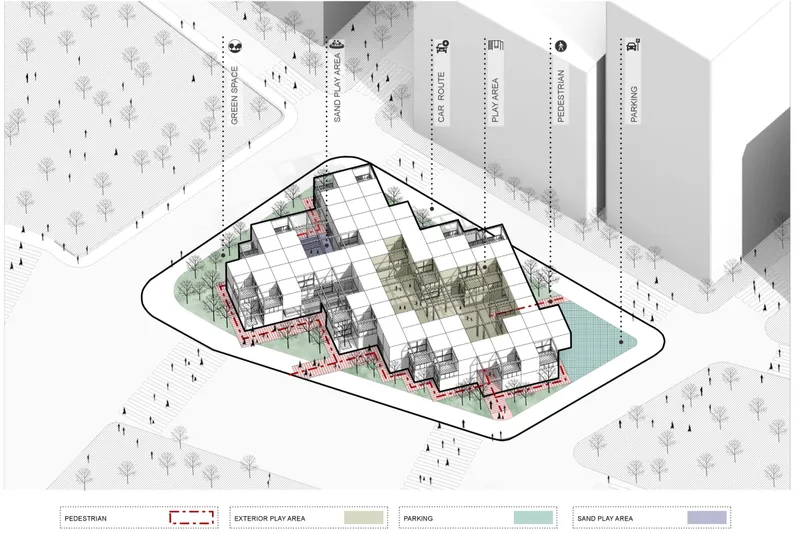
From above, the building reads as a triangulated grid of ridges and voids, each module functioning as a micro-climate cell. The aerial rendering reveals how alternating roof peaks channel prevailing breezes downward into the interior volumes below, while the voids between them release rising warm air. The entire building mass is rotated 45 degrees relative to the city's wind rose, a calculated alignment that maximizes exposure to dominant breezes and amplifies passive dehumidification across the envelope. Surrounding the structure, a landscape of trees, pedestrian crossings, play areas, and parking zones creates a permeable edge between the building and the city.
The isometric site diagram makes the logic legible: the footprint is not a single monolithic block but a constellation of volumes separated by courtyards. These gaps are not leftover space; they are the building's lungs. Cross-ventilation paths run through every interstitial void, pulling moist air across silica-gel-infused surfaces before exhausting it vertically. The translucent roofing materials admit diffused daylight without the associated heat gain, a critical move in a city where solar radiation compounds humidity discomfort.
Programmatic Layers Organized Around Airflow
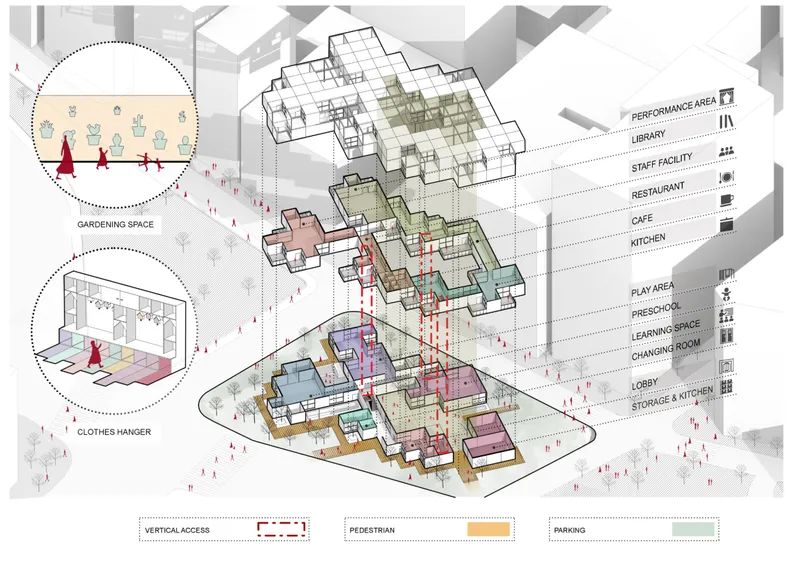
The exploded axonometric reveals a building that stacks its program vertically while threading circulation through it like a ventilation duct. A preschool, library, performance area, café, and play spaces are each arranged around semi-open corridors that the designers call "breathing voids." These corridors are not merely connective tissue; they are calibrated airflow channels. Ramps and stairwells double as vertical shafts where warm, moisture-laden air rises and escapes, pulling cooler air in from below. The programmatic zoning reflects a deliberate integration of function and climate strategy: spaces requiring the most comfort, like the preschool classrooms, sit in zones of maximum airflow exposure.
What makes this approach compelling is its refusal to separate the technical diagram from the human experience. Children do not inhabit a dehumidifier; they inhabit corridors, courtyards, and rooms scaled to their bodies. The climate strategy is embedded in the architecture rather than appended to it.
Timber Corridors Scaled for Children
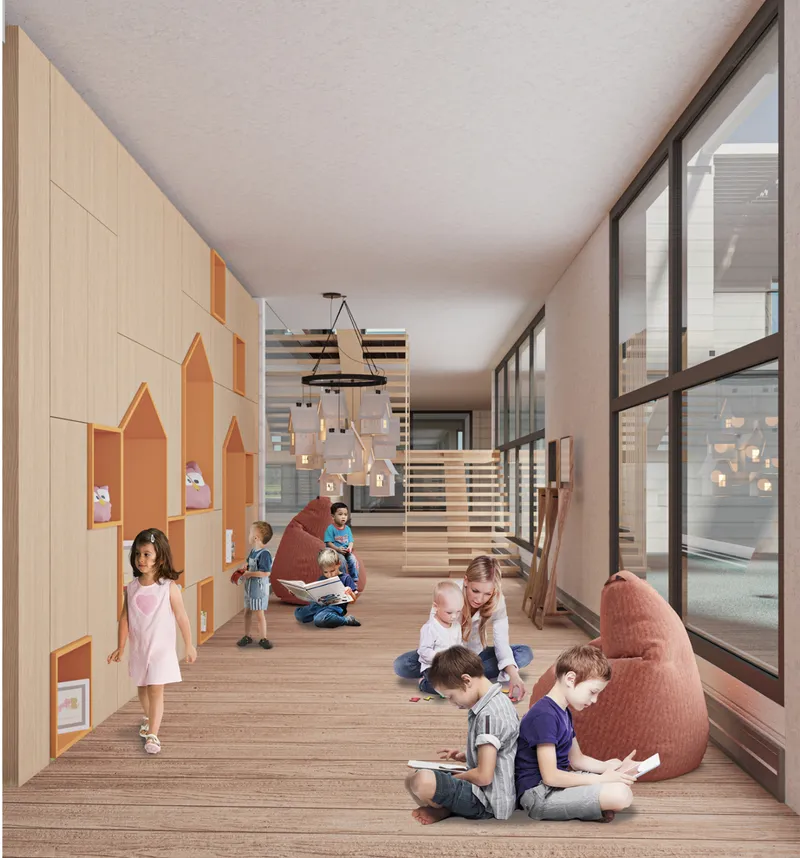
Inside the building, the atmosphere shifts from the technical rigor of the climate diagrams to something tactile and warm. Plywood wall panels and timber flooring create a material palette that absorbs sound and softens light. Children sit beneath pendant fixtures near glazed partitions that open views across the building's internal courtyards. The corridor shown here operates simultaneously as a gathering space, a circulation path, and an airflow channel. Its proportions are generous enough to avoid a tunnel effect but narrow enough to accelerate breeze movement along its length. The glazed partitions allow visual connectivity between programs while controlling airflow direction.
Courtyards as Social and Climatic Infrastructure
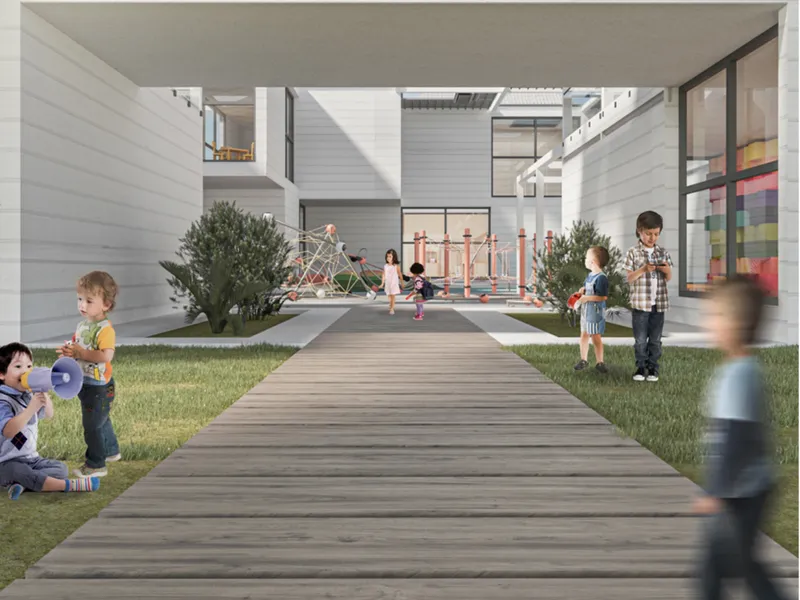
The courtyards are the project's most convincing move. In the central courtyard, a timber boardwalk leads children toward play equipment set among grass and mature trees, all framed by the white-clad building volumes that define the courtyard's edges. These are not decorative gardens; they are pressure differentials made spatial. Air entering the courtyards cools slightly as it passes over vegetation and shaded ground, then moves into the building interior at a lower temperature and humidity than the ambient exterior conditions.
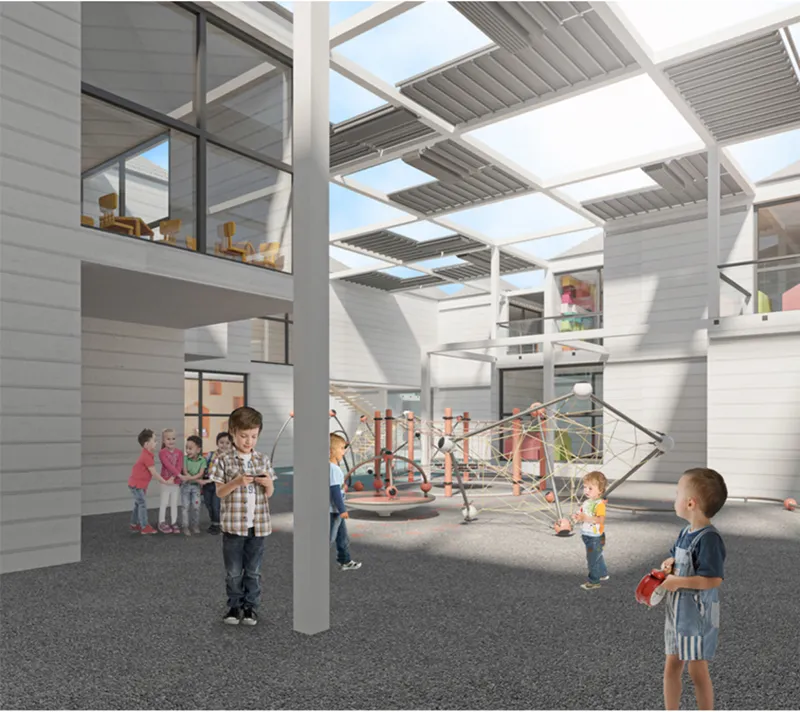
Beneath the slatted canopy grid, a second courtyard scene shows children climbing and playing on rubber surfacing. The canopy filters light into strips, reducing solar heat gain while maintaining the open-air quality that makes the space feel generous rather than enclosed. Together, these courtyards demonstrate that passive climate strategy and social programming are not competing agendas. The same voids that drive airflow across silica gel surfaces also provide the best spaces in the building for play, encounter, and rest.
Why This Project Matters
The team's laboratory experiments, conducted using a mechanized greenhouse and temperature-humidity loggers to simulate tropical conditions, demonstrated over 80 percent efficiency in maintaining indoor comfort through silica gel alone. When combined with the building's airflow strategy, stable humidity levels persisted even as external temperatures fluctuated. That kind of empirical rigor is rare in competition entries, and it elevates Dehumidifier Core from speculative provocation to testable prototype. The project proves that passive dehumidification is architecturally achievable without mechanical intervention, pointing toward low-energy building envelopes for equatorial cities worldwide.
More broadly, the project challenges a persistent bias in climate-responsive design discourse that privileges temperature over humidity. Shading strategies and cross-ventilation diagrams dominate the conversation, but moisture control, the factor most directly tied to comfort in tropical climates, is often left to the engineers. Dehumidifier Core argues that humidity is a design problem, not just a mechanical one, and that the architectural response can be simultaneously performative and beautiful in the fullest spatial sense: courtyards where children play, corridors flooded with filtered light, and envelopes that quietly absorb moisture from the air.
View the Full Project
About the Designers
Designers: Hamed Malekandeh, Parisa Khosravi, Parto Hedayati, Hanieh Rahimbakhsh
Enter a Design Competition on uni.xyz
uni.xyz runs architecture and design competitions year-round that reward proposals with spatial conviction and real site intelligence.
Project credits: Dehumidifier Core by Hamed Malekandeh, Parisa Khosravi, Parto Hedayati, Hanieh Rahimbakhsh Form Follows Climate 2020. (uni.xyz).


Popular Articles
Popular articles from the community


Architekt Andreas Gruber Scatters 23 Dark Timber Chalets Across a South Tyrolean Forest Edge
In Molini di Tures, Amonti Chalets breaks a resort into a hamlet of gabled timber houses, with parking, storage and services pushed into the slope.

longwave studio Reorganizes a 112 m² Tainan Apartment Around the Daily Routines of a Family and Two Cats
In Tainan, Taiwan, birch plywood, rust-red furniture and a freestanding plaster wall link arrival, storage, work and family life in one apartment.

U.GA Architects Wraps an Oval Rooftop Pool in Curved Board-Formed Concrete on Busan's Jeollidan-gil
In Busan's Jeonpo-dong, a 454 m² mixed-use block stacks a neighborhood facility, guest rooms and an oval rooftop pool inside spiraling concrete walls.

Juan García Correa, John González and Claudia Rueda Sink a Circular Amphitheater into a Manizales Engineering Building
On the La Nubia campus in Manizales, Colombia, the S1 Building folds labs and offices into a hillside of ramped lawns that double as a campus route.

Similar Reads
You might also enjoy these articles


Aquadapt: An Underwater Habitat That Rewrites Its Rooms by the Hour
Curved modules ring the seabed while one shell shifts from breakfast room to cinema, farm and football pitch as residents' needs change.

Play: Fragments of Their World: Remembered Architecture Rebuilt as a Modular Playground for Refugee Camps
Tom Gardner abstracts domes, arches and towers from the homelands of displaced families into a kit of child-scaled play parts for camp settlements.
REBIRTH: A Circular Settlement Where Afghan Widows and Their Children Rebuild Life Together
A shortlisted Resile entry turns the circle into a protective ring of timber and brick, gathering homes, classrooms and gardens around a shared landscape.
The Main Dream: A Recycled Plastic Kit That Lets Refugee Children Build Their Own Playground
Thirty-centimetre interlocking cubes that connect on three axes turn play into construction, letting children author the spaces they occupy.


Comments (0)
Please login or sign up to add comments
No comments yet. Be the first to comment!