
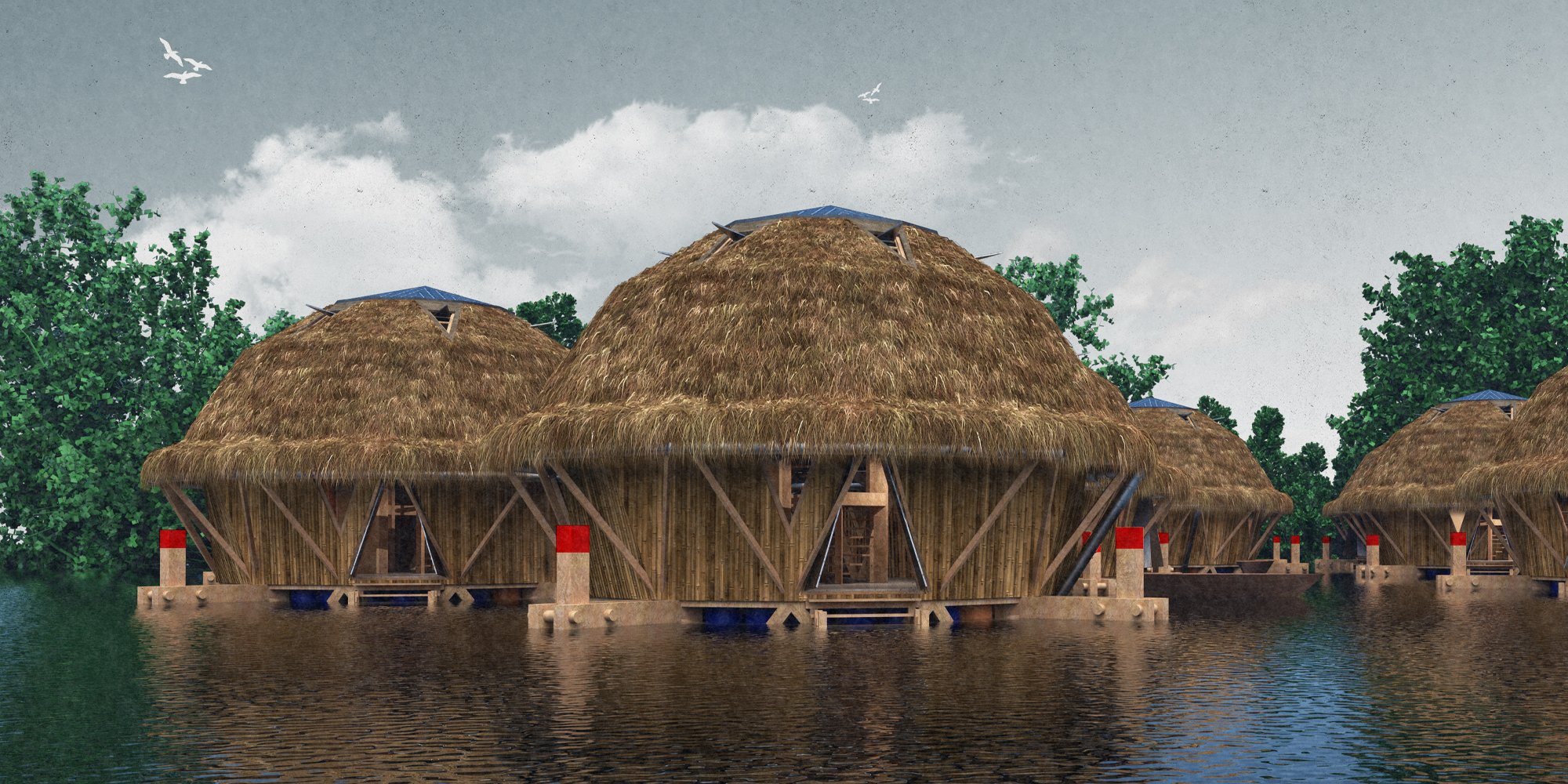
Deploy, FLOAT
Reinterpreting standard cyclone shelter typology for rural areas in Bangladesh

What was the concept behind the project?
The concept behind the project is to rethink standard cyclone shelter typology. Firstly, as cyclones become increasingly regular, should disaster relief be the response or should the standard for basic homes be increased? For that reason the structure I designed, although presented for disaster relief use, is a robust structure intended for long-term use. Secondly, cyclone resistant structures are often concrete, large public buildings, and elevated. Monolithic dome structures perform well against cyclones and high winds but concrete is not always readily available. Therefore, I chose to use local timber and a triangle panel system emulating a dome morphology instead. Thirdly, flooding in my chosen site of Bangladesh is inevitable with surges reaching 4-5m in a cyclone. Therefore, the structure must either be elevated or must adapt to floods. The Philippines Floating Finch homes are a reference for this, and I decided to incorporate their concept of simply using barrels to create buoyancy. Finally, the product is intended to be prefabricated and assembled onsite in a day, but there is also the possibility of disassembling the structure. The assembly time however makes it less suitable for immediate disaster relief but as stated earlier, it is a long-term response.
What was the intent behind the organization of elements across various levels?
The intent was to make a modular and vernacular piece of architecture that responds well to its environment and climate, and maintains a manageable indoor comfort. On a site scale, the community must be self-sufficient in an emergency. For that reason, rainwater is collected and filtered by each unit, each one has a PV panel and solar boiler system, all toilets are compost toilets using sawdust and must be changed once a year whilst the switched-out batch of toilet waste has to breakdown for another year before it is safe to use as soil. There is a single greenhouse unit, and there is a separate waste storage unit which is also used as a small-scale biodigestor for kitchen organic waste. Due to the frequency of flooding but variation in height, I opted for a structure that floats.
How many iterations were tried to arrive at the final outcome?
My starting point was a floating timber dome as an alternative to a fixed concrete dome. However I also wanted to take the tropical climate into consideration. A dome’s exterior walls would be heavily exposed to monsoon rains, and I looked at a tepee for a short while. The steep slope allows rain to fall off quickly but as tepees are tall, I worried about maintaining structural integrity in a high wind situation. Eventually I experimented with the shape seen in Figure 1 - 3.
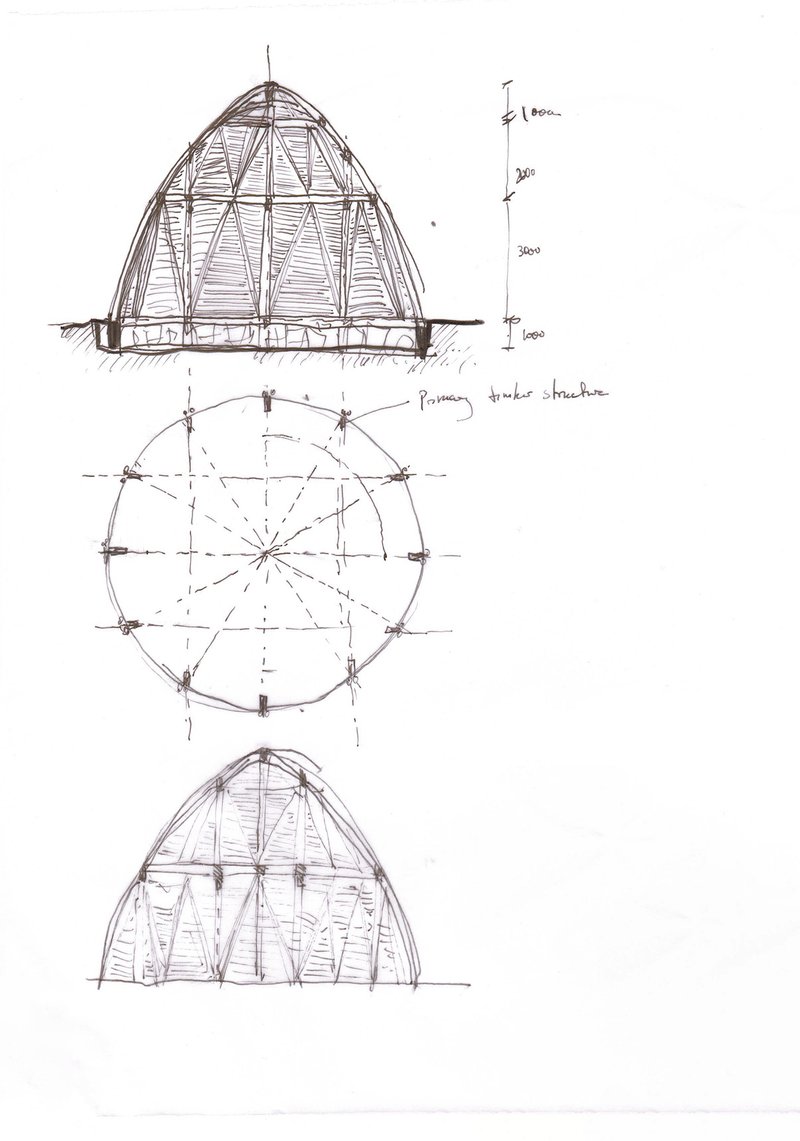 Figure 1
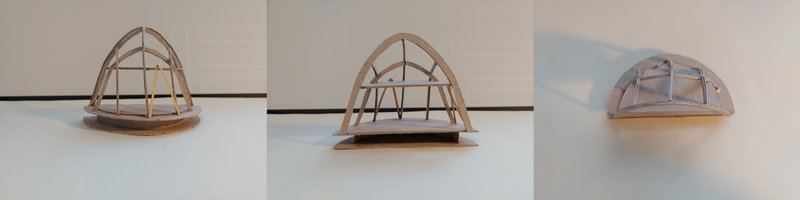
Figure 2
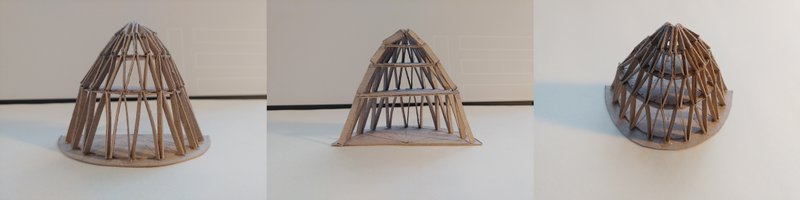
Figure 3
This is a 2 floor structure to separate the day and night functions, and its height allows for hot air to rise. If there are openings in the roof, that air can escape, cooling the building and allowing for natural ventilation. Two iterations were considered: one using long perpendicular curved columns and one using many small triangles. I favoured the triangle one because I assumed that whilst it is material intensive, it can allow for lower quality wood to be used and the source of wood can also be smaller, meaning the choice in material is less limited. Additionally the model felt very solid.
Because the exterior walls are still very exposed, the overhang would have to be larger to shield them and any openings from the sun, which is a risk in a cyclone zone. So I slanted the walls inward instead (Figure 4). And one final consideration is the number of panels per level. In a parametric model, I started with 20 panels of each kind and reduced this to 12 because the panel base length is comfortable enough for a door.
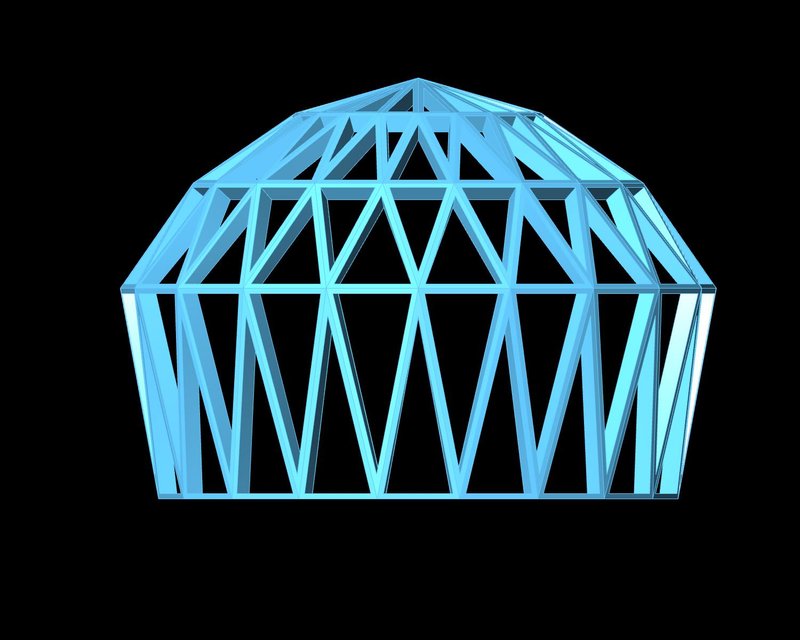
Figure 4
What/How were the materials chosen?
For the floating structure that is in contact with the ground, I chose palmyra palm which is known to do well in waterlogged areas. For the rest of the construction, I chose Goda, or Vitex Peduncularis. It is a less-used species of timber in Bangladesh but has a stiffness and bending strength. Goda is more commonly considered for its medicinal value, but is highlighted as a potential alternative source of lumbar in Bangladesh since much of the commonly used species face overconsumption (Chowdhury et. Al., 2013). Goda wood is also rot resistant, insect resistant, and fire resistant.
The façade cladding panels use bamboo which is readily available and fast-growing in Bangladesh. Palm thatch is used on the roof as various reports on cyclone damage in Vanuatu, India, and Bangladesh suggest that if done properly, palm thatch roof survives and protects against cyclones. In this case, a standard for woven palm thatch roofs can be set and then consistently met in the panel prefabrication process. I also decided that the panels should attach together using dowel systems and joinery, a concept I didn’t get to fully explore.
Chowdhury, M.Q., Sarker, S.K., Deb, J.C. et al. Timber species grouping in Bangladesh: linking wood properties. Wood Sci Technol 47, 797–813 (2013). https://doi.org/10.1007/s00226-013-0532-0

Popular Articles
Popular articles from the community

Louis Malle Cinema: A Limestone Cultural Landmark Revitalizing Community Life in Prayssac
Limestone cinema extension with public forecourt, blending heritage and modern design to create flexible cultural spaces and strengthen community interaction.
Atelier Macri Concept Store Interior Design by CASE-REAL
Atelier Macri store features a "ko" counter, walnut wood details, cork displays, blending retail, gallery, and seamless customer experiences.
An Miên Lumière Cafe by xưởng xép, Ho Chi Minh City, Vietnam
An industrial-inspired café where layered steel and warm light create a dynamic, immersive environment shaped by reflection, depth, and perception.
Treehouse Apartment: A Warm Timber Interior Blending Craft, Play, and Contemporary Living
Warm timber apartment with integrated treehouse, combining natural materials, craftsmanship, and playful design to create a flexible, family-oriented living environment.

Similar Reads
You might also enjoy these articles


The Ken Roberts Memorial Delineation Competition (Krob)
As the most senior architectural drawing competition currently in operation anywhere in the world, it draws hundreds of entries each year, awarding the very best submissions in a series of medium-based categories.
A Contemporary Take on Iranian Residential Architecture
A modern interior design in Mashhad that reinterprets brick, light, and spatial flow to create a warm, contemporary residential architecture.
Franche-Comté Advanced School of Engineering by Dominique Coulon & associés, Besançon
A flexible engineering school immersed in woodland, combining concrete minimalism, adaptable spaces, and natural light to support evolving educational environments.

Waterfront Redevelopment and Urban Revitalization in Mumbai: Forging a New Dawn for Darukhana
A transformative waterfront redevelopment project reimagining Darukhana’s shipbreaking heritage into an inclusive urban future.

Explore Architecture Competitions
Discover active competitions in this discipline




The International Standard for Design Portfolios


The Global Benchmark for Architecture Dissertation Awards


The Global Benchmark for Graduation Excellence


Challenge to reimagine the Iron Throne
Comments (0)
Please login or sign up to add comments
No comments yet. Be the first to comment!