Fire station as an inclusive element of space.
The network of fire stations around Krzesiński Landscape Park.

According to Eurostat, Poland is one of the most rural countries in the European Union. The population of villages on the Vistula is growing, and as much as 93% of the country's area is classified as rural. Despite this, the countryside is often underestimated, as evidenced by the negligible amount of public investment and the poor quality of architecture. These areas face many other problems, the most serious of which is climate change, including droughts. This leads to an increased number of fires.
The theme of the village is linked to the function of the fire station, which not only provides fire protection but also is a space for activating inhabitants. The inclusiveness, combined with the continuity of the institution of the volunteer fire brigade, makes it firmly rooted in the social consciousness.
The author's typology of Polish fire stations was inspired by Bernd and Hilla Becher's documentary photography of industrial structures, which highlighted the characteristic features of fire stations, such as the tower, the red garage door, and the village hall - a typical element of fire stations in communist Poland. The catalogue became a base for me during the design process.
The area covered by the project was selected after analyzing and superimposing two maps - areas of high natural and landscape value and a map showing insufficiently protected communes in terms of fire. The area that meets both conditions is the Krzesinski Landscape Park, near the border with Germany. It is also an important area because of identity problems in a region that was taken over due to resettlement after World War II.
The project involves the expansion of the existing network of fire stations in the villages surrounding the Krzesinski Landscape Park. The initiating element of the intervention is the tower - a characteristic element of the fire station. In the project, its vertical form was used to create the function of a viewing tower. In this way, new landmarks were obtained in the landscape and marked out on a new tourist route around the park.
The project focuses on one extended unit in the village of Połęcko. The village was chosen for its strategic location right next to the Oder River and its lack of necessary service and cultural functions.
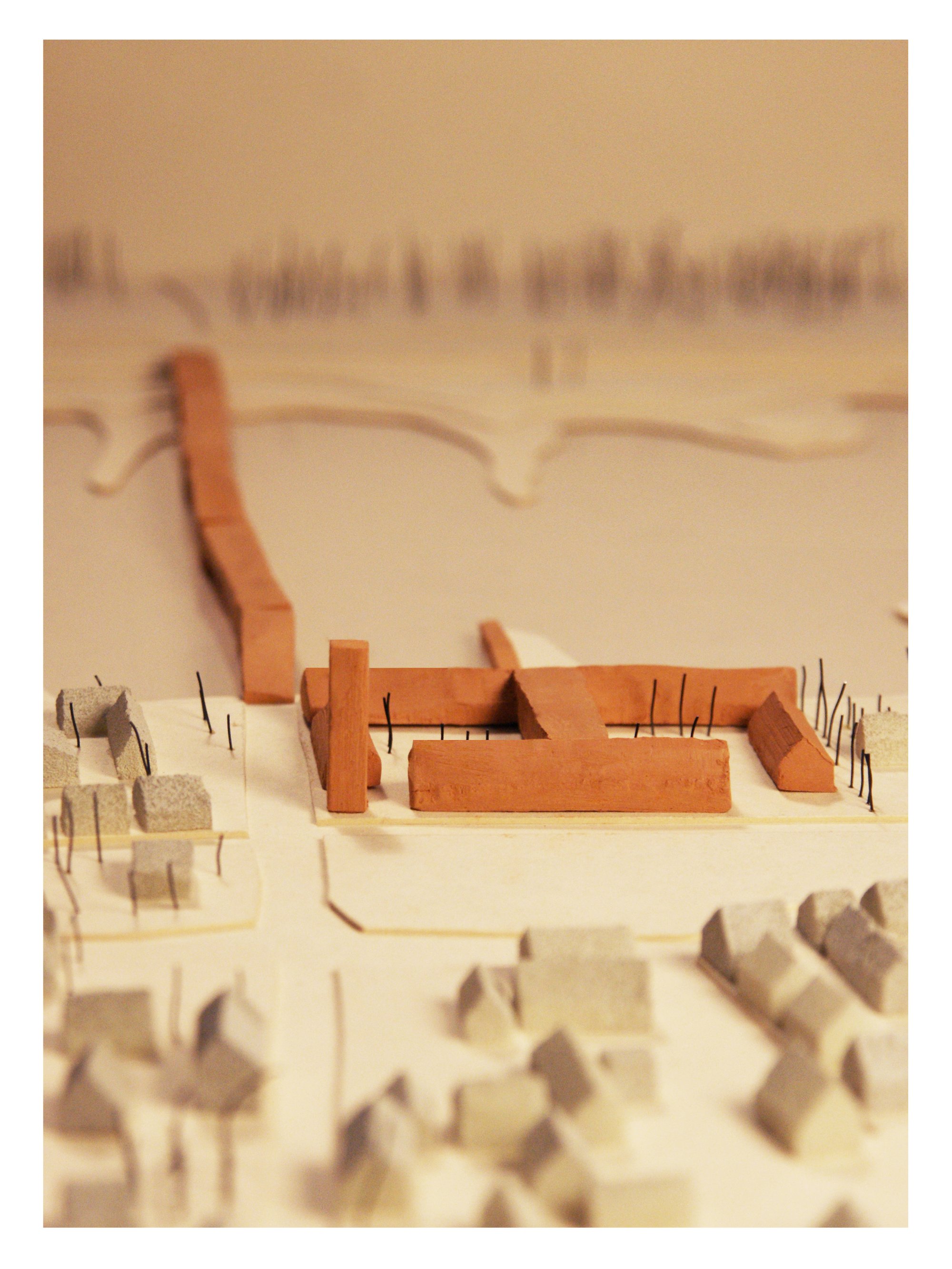
The plan of the building, while respecting the context, is based on the pattern of farm buildings. Formally it continues the rural character of the place through the use of pitched roofs and a volume adapted to the surrounding buildings. The layout consists of two separate squares, a public square and a fireman's square. Around the first one, social functions such as a village hall, restaurant, public toilets, orchestra and youth fire brigade rooms are located. The firemen's square serves as a manoeuvring space, but also as a place for training and firemen's ceremonies. It is surrounded by a technical and storage building, rooms used by firemen, sleeping rooms and a gym. A double-sided serviced garage in the centre of the layout connects the two squares. The fire station has been extended with rooms for the Water Rescue Unit and a canoe rental on floor -1 opening up entirely onto the river. The conglomerate of various functions allows the cultural and social offer to reach all residents of the village and provides income important for the economic functioning of the unit.
The underground part of the building is built from rammed earth from excavations, which in traditional construction would be treated as waste. The simple technology allows for communal construction, which will strengthen the existing human bond and attachment to the place. The material fits in with the trend for low-tech architecture. The rammed earth walls have a very low embodied energy value. The material is ecological and environmentally friendly and also creates a very good indoor climate by naturally absorbing and releasing moisture.
The final point of the project is the bridge. Its existence facilitates the functioning of the Volunteer Fire Department and the inhabitants and connects the banks of the Odra river to encourage greater integration of the population of the region. The assumption is held together by a brick coloured material which corresponds to the surrounding buildings and the fire brigade red.
An adequate budget is one of the pillars of a well-functioning firehouse. In the proposed fire station, maintenance costs have been minimised through the use of renewable energy. Designed float power turbines on the river, photovoltaic panels and solar collectors on the garage roof. The building is divided into independent zones, which allows heating only those parts of the building that are used at any given time. Adequate daylighting of the rooms and garage areas contributes to minimising running costs. The functions proposed in the fire station make it possible to obtain additional financial resources. The firefighters can earn money by renting out the rooms, and the village hall and by making the restaurant and canoe rental space on level -1 available to an external company. Construction costs have been minimised by using rammed earth technology in much of the building.
The fire station as an inclusive element of the space binds the neighbourhood together on several levels. An extensive, formally coherent network of fire stations forms the clear boundary of a tourist-attractive landscape park, protected by cooperating fire station units. An extensive and inclusive social and cultural offer integrates the inhabitants in the individual villages. The village acupuncture makes it possible to determine the direction of the repair of individual places in terms of architecture and urban planning.
The project is an attempt to restore the prestige of the volunteer rescue service and to highlight the role they play through their service. The developed network of fire stations may become a model to be applied in other locations.