
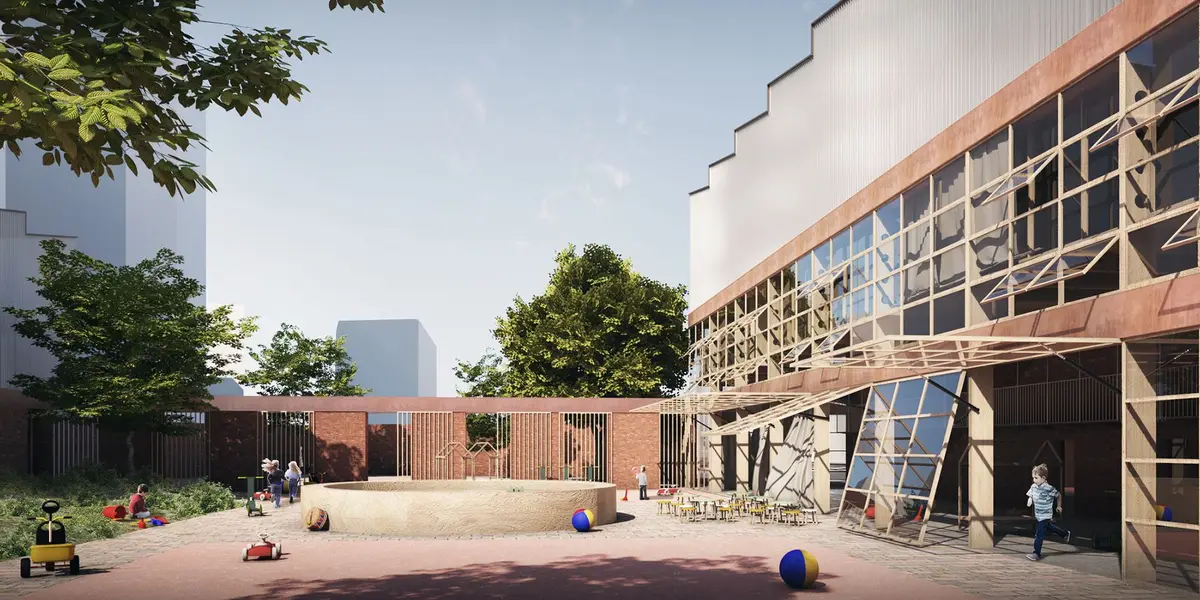
Form Follows: Function, Flexibility, Climate: A School as Urban Refuge
Julien Picard's bioclimatic school for children aged 0 to 7 transforms a constrained urban plot into a sheltered learning landscape.


What does it mean to build for the most vulnerable users on the most hostile site? Julien Picard answers that question with a school designed for children aged 0 to 7, sited on a narrow, irregular plot hemmed in by high-rise buildings and heavy traffic. Rather than fighting these constraints, the project absorbs them: two low-rise volumes act as acoustic buffers, courtyards trap controlled daylight, and the entire composition turns inward to create a micro-climate that prioritizes calm, comfort, and protection. The architecture does not shout; it shelters.
Awarded an Honorable Mention in the Form Follows Climate 2020 competition, the proposal merges bioclimatic design with early childhood pedagogy. Ground coverage is limited to 25% to preserve generous outdoor play areas, building height is capped at 12 meters to maintain a child-friendly scale, and east-west building alignment admits morning and evening light without excessive heat gain. The result is a school that reads as a dense urban sanctuary, function-driven in plan and climate-responsive in section.
A Brick Base and a Corrugated Crown: Reading the Street Facade
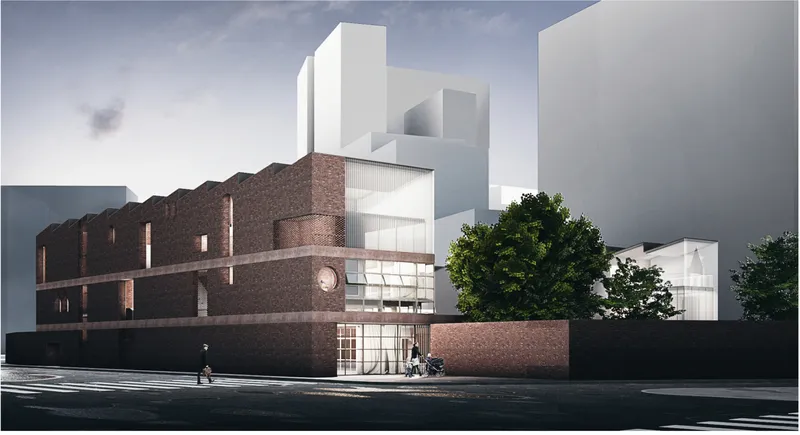
From the street, the school presents a deliberate split personality. The lower portion retains a renovated brick facade that anchors the building in the texture of its neighborhood, while a new white corrugated upper volume sits above, signaling a contemporary intervention. The contrast is not decorative; it separates the heavy, grounding thermal mass of the brick from the lighter, ventilated cladding above. Pedestrians pass at grade, unaware that behind this measured street wall lies a protected courtyard world scaled entirely for small children. The facade works as both urban participant and defensive screen, absorbing road noise and redirecting attention inward.
The Courtyard at the Heart: Play Between Two Volumes
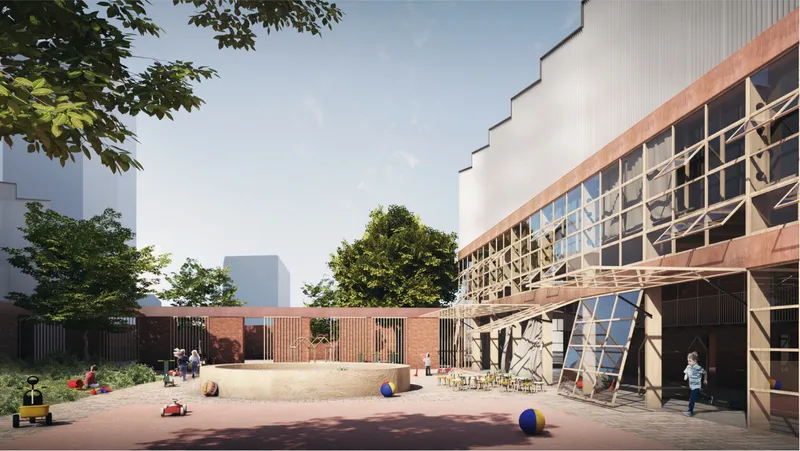
By placing the playground between the two building volumes rather than at the perimeter, Picard achieves three things simultaneously: continuous sunlight throughout the day, distance from noisy roadways, and a secure enclosed atmosphere. The courtyard is framed by an exposed timber structure overhead and a vertical brick screening wall along the perimeter, filtering light while maintaining a sense of openness. Children play within a space that feels both outside and held, a calibrated middle ground between the freedom of a garden and the safety of an interior room.
The courtyard also acts as the school's social spine. Visible from the crèche (0 to 3 years), the nursery (3 to 6 years), and the primary classrooms (6 to 7 years), it stitches the program together across age groups. Parents and visitors access gathering spaces from here too, making the courtyard simultaneously playground, circulation hub, and community threshold.
A Circular Window and the Power of Child-Scale Detail
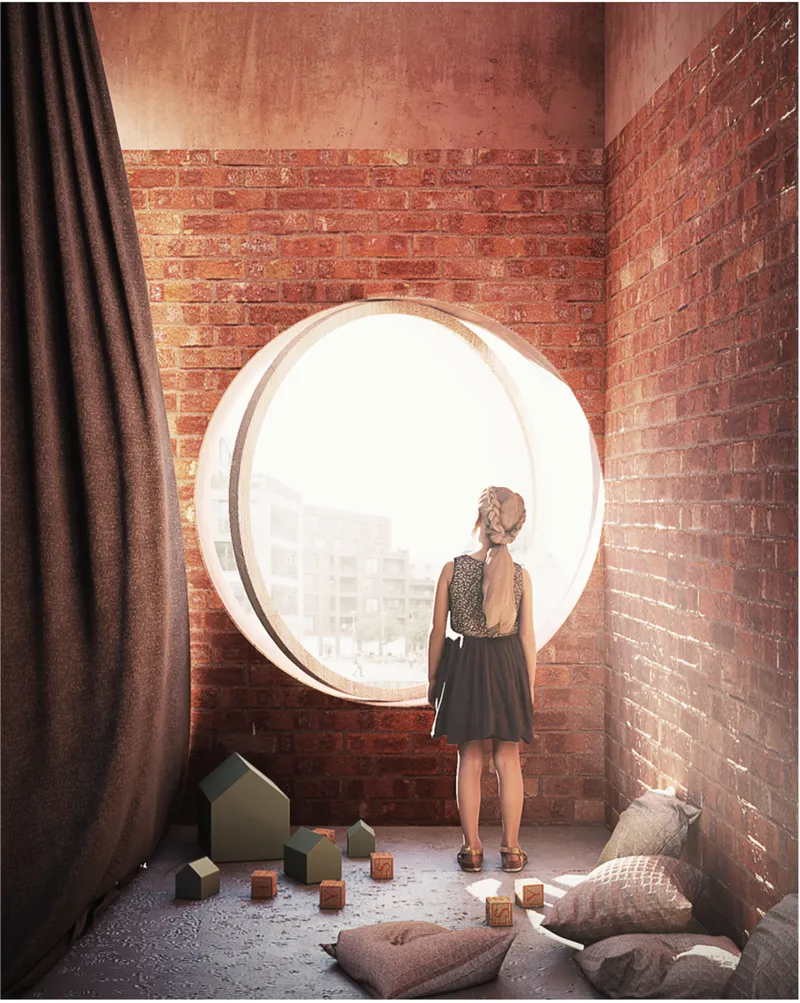
One image crystallizes the project's ethos: a child standing at a large circular window set into an exposed brick wall, looking out at daylight. The window is not at adult eye level. It is placed precisely for a small body to encounter the world beyond the school on its own terms. The exposed brick interior lends warmth and thermal mass, absorbing heat during the day and releasing it slowly, a material choice that is simultaneously atmospheric and performative. Moments like this reveal how the project operates at two scales: the urban strategy that buffers noise and manages solar gain, and the intimate detail that shapes a child's daily experience of light, texture, and enclosure.
Skylit Corridors and Flexible Interior Landscapes
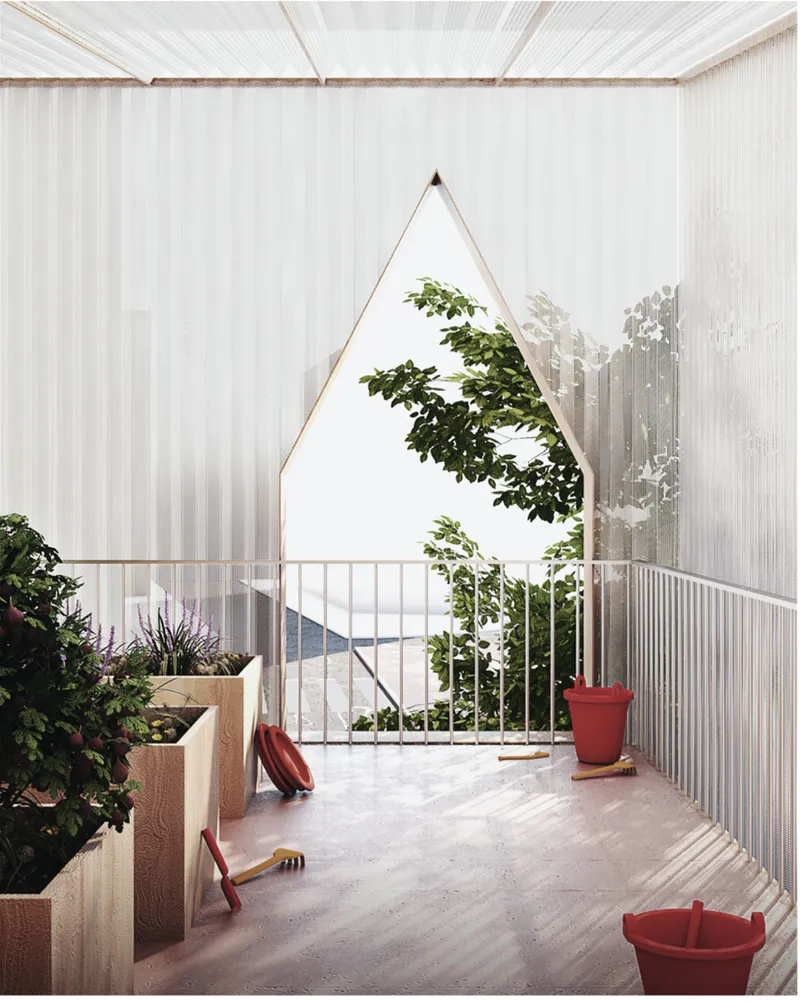
The interior corridor reveals yet another layer of the climate strategy. A triangular skylight runs overhead, washing corrugated white walls in natural light and eliminating the need for artificial illumination during daytime hours. Planted boxes and children's toys line the passage, blurring the boundary between circulation and activity. This is not dead space; it is inhabited infrastructure.
Throughout the school, functional flexibility defines the interior logic. Movable furniture enables sports events, acoustic curtains support silent activities like reading and sleeping, retractable partitions carve micro-classrooms from larger rooms, and open rearrangeable layouts accommodate celebrations. Services and staff facilities are consolidated along the perimeter for efficiency, freeing the brightest and most spacious central areas for children. The architecture does not prescribe a single mode of use; it provides a framework that teachers and children adapt daily.
Why This Project Matters
Schools in dense cities often treat climate performance and pedagogical quality as separate problems to be solved by separate consultants. Picard's proposal insists they are the same problem. The acoustic buffer that blocks traffic noise also defines the courtyard that enables outdoor play. The east-west orientation that limits solar heat gain also delivers the soft daylight that fills classrooms. The 25% ground coverage limit that preserves open space also creates the garden courtyards that regulate the micro-climate. Every constraint feeds every opportunity.
What makes this Honorable Mention compelling is its refusal to separate the diagram from the experience. The bioclimatic strategies are legible in section, but they are felt at the scale of a child's hand on a brick wall, a triangular slice of sky overhead, a circular frame of daylight at eye level. For young designers working at the intersection of sustainability and spatial generosity, this project offers a clear lesson: climate-responsive architecture does not have to be austere. It can be warm, playful, and precisely tuned to its smallest users.
View the Full Project
About the Designers
Designer: Julien Picard
Enter a Design Competition on uni.xyz
uni.xyz runs architecture and design competitions year-round that reward proposals with spatial conviction and real site intelligence.
Project credits: Form Follows: Function — Flexibility — Climate by Julien Picard Form Follows Climate 2020 (uni.xyz).


Popular Articles
Popular articles from the community


Play: Fragments of Their World
Familiar architecture becomes modular playground design, creating safe spaces where displaced children can learn, connect, imagine and play.

Little Red Riding Hood: Architectural Design as a Journey Through Fear, Light, and Storytelling
Little Red Riding Hood reimagines the fairy tale through architectural design shaped by fear, light, scale, memory, uncertainty, and choice.

The Ocean Hive: Sustainable Architecture for a Self-Sufficient Civilization at Sea
The Ocean Hive imagines sustainable architecture at sea, where modular habitats, algae, wave power and ocean waste sustain a growing colony.

Hill & Cross Opera: Sculptural Opera House Architecture Shaped by Tallinn’s Landscape and Identity
Hill & Cross Opera reimagines opera house architecture in Tallinn through its sculptural hill, civic plaza, glass wave and a luminous cross.

Similar Reads
You might also enjoy these articles

ALGAL REALM: A Bio-Integrated Lunar Habitat Design for Life Beyond Earth
ALGAL REALM reimagines lunar habitat design with algae-powered life support, 3D-printed regolith, and vertical living for a lunar future.

Cinema Futurismo: Futuristic Architecture Reimagining the Future of Cinema
Cinema Futurismo merges futuristic architecture, holographic projection, intimate seating, and landscape into a new social cinema.
Little Red Riding Hood: Architectural Design as a Journey Through Fear, Light, and Storytelling
Little Red Riding Hood reimagines the fairy tale through architectural design shaped by fear, light, scale, memory, uncertainty, and choice.

Playducation: Modular Architecture That Turns Play Into a Space for Learning
Playducation transforms modular architecture into a flexible world of play, learning, and healing for children in refugee settlements.


Comments (0)
Please login or sign up to add comments
No comments yet. Be the first to comment!