

Fusão
From staircase thinking to propose social problem solution in Brazil

Rethinking on "stairs"
Stairs are the most common part of our lives. We often forget that they have practical functions. When we see this competition, it reminds us to rethink the definition of stairs. At beginning, the appearance of stairs represents the connection between different classes. For example, the stairs of the Parthenon connect people and Olympians and the long stairs of the Chinese palace connect the monarchs and subjects.
The staircase is not only an element in architecture but also considered more possibilities. In terms of its function, it serves as an infrastructure, providing the possibility of vertical passage and stay for areas with high and low differences. On the spiritual part, it also serves as a connection between different groups of people or regions, increasing communication.
Reasons for site selection
Based on these aspects, we have selected the site in Rio, Brazil. First of all, because of the hilly terrain, the stairs should be provided. More importantly, based on Brazil's complex historical process and the collision of multi-culture, this is the reason why we can find obvious regional boundaries in the city. So we try to use a certain spatial method to alleviate this negative urban limitation.
Concept and spatial translation
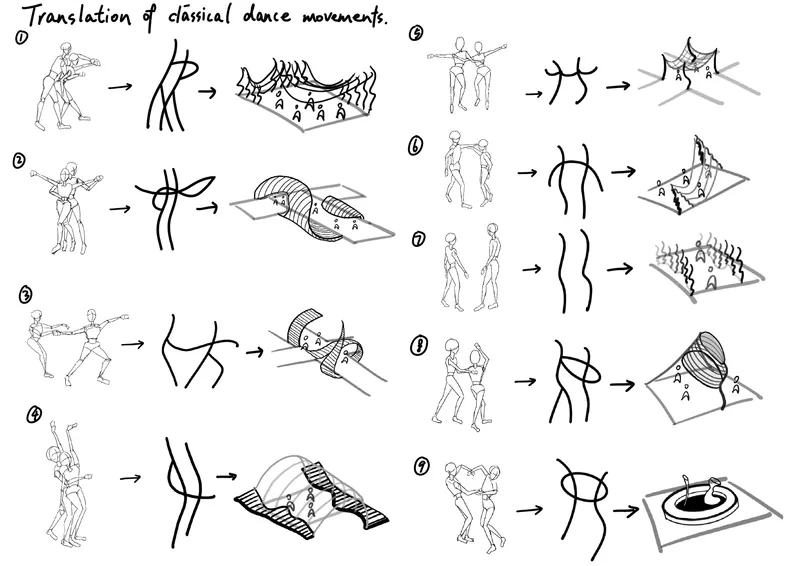
Samba is a typical element from Brazilian multicultural integration. We use its plane trajectory as the form to summarize the dance steps. The dancers’ steps have rhythmicity as intersection, separation, center symmetry, and scales as the stairs. The dance trajectory lines form a variety of symbols through different dance steps, and the symbol as the center guides the relationship between different spaces. The cross step is the most balanced and beautiful dance step in samba, so it is the most important functional channel. Separation, center symmetry, proportional zoom, and fixed-point rotation are the unique dance steps of Samba. Therefore, these elements are used as an ornamental and personalized space combined with the main functional channel to form two other different landscape platforms.


Based on the actual site conditions, the dance step trajectory is spatially translated, forming a symbiotic relationship in the entire traffic space. And according to the needs of staying and viewing, the stairs are changed to form their own unique sense of rhythm. First of all, take the volume of 30*30*30 meters as the largest unit. In the top view, the longest straight line is the diagonal. Therefore, corresponding to the 30*30 meter plan, the diagonal becomes the most direct and The main traffic ramp. The auxiliary ramp surrounds the diagonal on both sides.
The combined terrain gradually descends from the northwest to the southeast, with hills to the west, the city to the southeast, and the Atlantic Ocean to the far southeast. Therefore, the subsidiary ramp to the southwest is close to the hillside, which is convenient for viewing plants and can provide a viewing platform for people to stop. The ramp to the northeast is more suitable for viewing the sea due to its higher elevation, so the viewing platform here is mainly for enjoying the urban ocean. A vertical traffic box is placed in the southeast to adapt to the ups and downs of the terrain so that the bottom of the stairs can touch the ground.

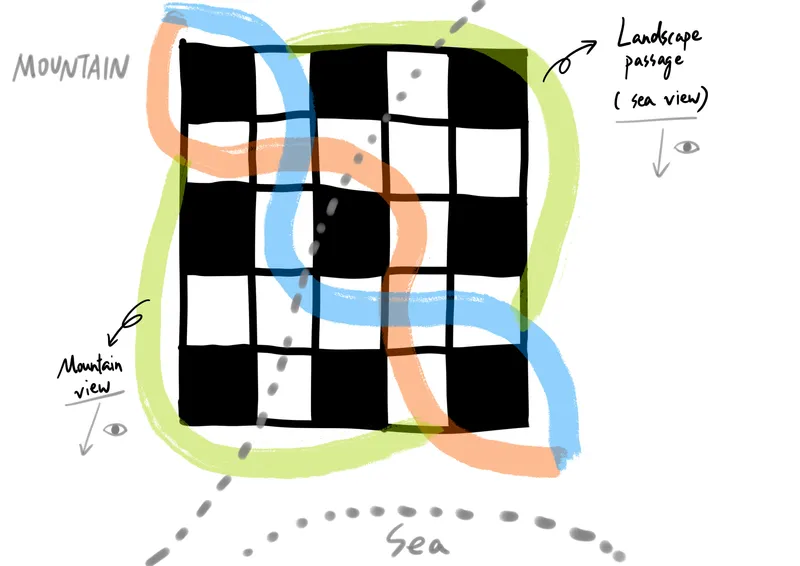

The samba-based dance steps are smooth curves, so at the beginning our vision for this traffic space was a curved ramp, so how to combine the curved ramp with the stairs became a big topic for us. We imagine that if each step of the stairs is like every beat, adjusting the size of the tread and the step surface can make people's steps change according to the changes in the size of the stairs, and finally can achieve a footwork frequency that simulates the rhythm of dance steps. Since the main passage requires the highest vertical traffic efficiency, it is the most normal stair step size. And the other two landscape trails-the ocean landscape route and the forest landscape route; the ocean landscape we believe that a quiet and elegant road is needed to allow people to watch the coastal scenery quietly. We have relaxed the width of the tread to make the frequency of the trail slow ; And the forest landscape has a large height difference, and the tropical forest landscape has different characteristic landscapes at different heights. Therefore, we take the frequency of the samba fast pace as the walking frequency of this landscape trail, and design the different heights according to the forest landscape. Viewing platform.
We have made many attempts on the handrails of the stairs, trying to combine different double samba dance poses with the various nodes of the stairs to form a lot of linear forms. Finally, we thought that combining the railings with the tassels of the samba dance costumes, a curved single rod was used to form a curved surface on the facade.
Details -- local color introduction
There are many tiles and graffiti with local characteristics in the local slums in Brazil. Therefore, the slums in Brazil have become a major feature of Brazil. We use the brightly colored tiles in the slums with unique patterns and patterns in Brazil as fast-track railings. The railing of the landscape passage serves as a virtual contrast. The graffiti attached to the surface can be displayed from different angles according to the change of the railing surface. The graffiti can be viewed not only from the plane but also in the three-dimensional space.
Reflection and conclusion
In this project, we tried to use staircase elements to propose solutions to social problems from the perspective of urban space. On the contrary, due to the unique cultural use of Brazil, the stairs themselves have become more interesting and become the design symbols of the city.

Popular Articles
Popular articles from the community


David Ortega Stacks a Two-Story Mexico City Penthouse Around a Steel Stair and a Pergola-Shaded Roof Terrace
In Colonia Roma, a 300 m² penthouse uses oak joinery, a planted steel stair and a slatted roof pergola to make a new-build apartment feel like a house.


The Amber Palace Opera: A Geological Fiction Surfaces on Tallinn's Baltic Waterfront
Pierre Brillard reimagines a Baltic legend as a public landscape, opera house, and waterfront promenade rooted in Tallinn's coastal identity.

Juan García Correa, John González and Claudia Rueda Sink a Circular Amphitheater into a Manizales Engineering Building
On the La Nubia campus in Manizales, Colombia, the S1 Building folds labs and offices into a hillside of ramped lawns that double as a campus route.

LT2A and OPEN Architectes Thread a Brick and Glass High School Through a Wooded Belgian Campus
In Braine-l'Alleud, a 3,000 m² wing for Collège Cardinal Mercier pairs pale brick with a glazed colonnade, deferring to a small chapel and a dense wood.

Similar Reads
You might also enjoy these articles
Juan García Correa, John González and Claudia Rueda Sink a Circular Amphitheater into a Manizales Engineering Building
On the La Nubia campus in Manizales, Colombia, the S1 Building folds labs and offices into a hillside of ramped lawns that double as a campus route.

Arealis Brasil Wraps a São Paulo Office for Everis's Creative Arm Around a Glowing Curved Counter
In Brooklin Paulista, a 300 m² office for the creative agency Chazz uses timber, metal mesh and ribbed green glass to blur workspace and pub.
LT2A and OPEN Architectes Thread a Brick and Glass High School Through a Wooded Belgian Campus
In Braine-l'Alleud, a 3,000 m² wing for Collège Cardinal Mercier pairs pale brick with a glazed colonnade, deferring to a small chapel and a dense wood.

Atelier Diving Bell Stitches a Hangzhou Food Court Together with a Louvered Steel Canopy
In Hangzhou's Liangzhu Culture Village, a 1,400 m² food court renewal uses canopies, tree benches and props to turn a passage into a place.


Comments (0)
Please login or sign up to add comments
No comments yet. Be the first to comment!