
GAME-UTOPIA:
ENVISIONING IT INSTITUTE IN PHY-GITAL WORLD

Architecture today stands at a critical threshold. Once rooted in hand-drawn processes, the discipline has continually adapted to revolutions from drafting boards to digital modeling. Now, the rise of artificial intelligence, computational algorithms, UI/UX design, and extended realities presents both opportunities and challenges. These technologies are reshaping labor, redefining design methodologies, and questioning the architect’s role itself. While AI promises efficiency and creativity, it also risks displacing established practices and blurring authorship. As Archigram stated in the 1960s, “The new world will demand new tools.” Today those tools are intelligent, immersive, and interactive, pressing architects to ask: What does it mean to be an architect in the 21st century? The challenge is to treat technologies not as replacements, but as catalysts for reimagining spatial experience, problem-solving, and professional identity.
Design processes reflect this evolution. Additive logic, rooted in drawing, built complexity through layering and judgment within constraints. Associative logic, introduced by digital tools, linked geometric components through parameters when one changed, others adapted. Algorithmic logic, the most advanced, enables architects to script precise instructions to generate geometry, simulate behavior, or optimize configurations. Thus, as tools shifted from additive to associative to algorithmic, schematic design, development, and outcomes were transformed.
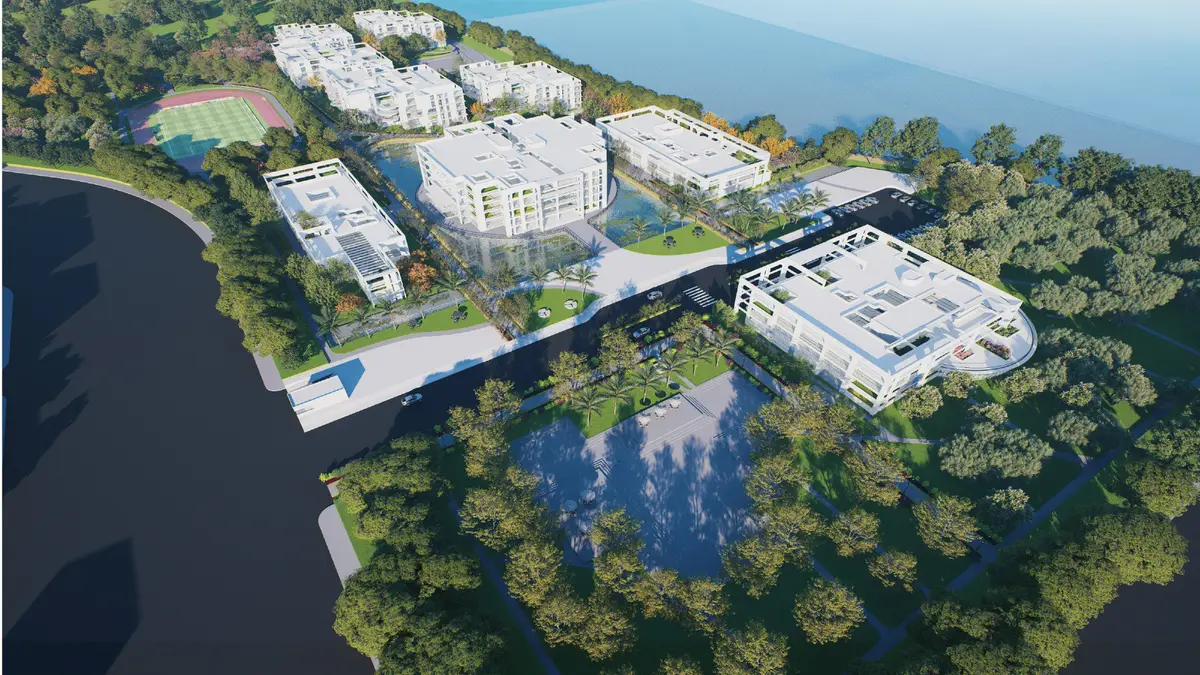
As proof of concept, an IT Institute was envisioned with dual presence: physically in Purbachal, Dhaka, and digitally in the metaverse. Site analysis and program definition initiated the design, beginning with procedural geometry inspired by games like Minecraft and No Man’s Sky. These demonstrated how algorithmic logic generates terrains and systems. A key method, the Wave Function Collapse (WFC) algorithm, arranges input tiles by rules of adjacency and context. Applied to architecture, rules were locally defined and tested. The project employs a generative design approach using the Wave Function Collapse (WFC) algorithm, originally developed for game development and adapted here via the Monoceros/Grasshopper plugin. This algorithm facilitates the rule-based procedural generation of architectural forms, moving beyond traditional additive methods to explore a vast range of design possibilities. The primary functional unit—the classroom module of 25’ x 25’, designed ergonomically for 30 students—serves as the basic building block. Using predefined spatial rules categorized as typed-in, explicit, and indifferent, over 70 design iterations have been generated. These iterations include innovative spatial configurations such as dynamically shifting corridors that break monotony by opening onto green spaces and gathering areas, improving circulation and social interaction while integrating natural elements like sunlight and ventilation.
The second idea introduced agents to simulate spatial experience, modeled after the Big Five Personality Traits openness, conscientiousness, extraversion, agreeableness, and neuroticism. Behavioral data collected from North South University students informed contextual relevance. A 25’×25’ classroom module (S scale) were tested for which size suits better for 30 students to accomodate. Then 6 classrooms with a linear corridors (M scale) were evaluated using agents. Heatmaps revealed that adding a break space after every third classroom increased interaction, forming a core spatial rule for WFC iterations. Then the (L scale) 5 academic blocks, recreational blocks, cafeteria, sports facility and admin block were evaluated in the same process to justify the best outcome among 70+ iterations. The best outcomes were placed onto the 25 acre site, over 100 agents were ran inside to evaluate the best arranged masterplan (XL scale). Dozens of variations in corridor shapes and scales (S, M, L, XL) were generated, tested, and refined. The most responsive layout was selected for development in technical architectural drawings.
The third idea was inspired by post-COVID realities, involved transferring spaces into the metaverse. In 2024 alone, educational institutions in Bangladesh shifted to online classes multiple times due to extreme cold, heat, monsoon flooding, and holiday-related travel congestion. However, existing platforms like Zoom or Google Meet are not optimized for interactive spatial experiences. Drawing from Patrik Schumacher’s theories, which predict that future architects will act as 3D UX/UI designers of the metaverse, I have developed a digital counterpart of the physical campus.Rather than designing entirely new digital environments, a replication of specific real-world spaces in the metaverse and layered them with UX/UI elements was made such as spatial navigation tools, information displays, and avatar communication zones. Since real-world spaces carry memory, nostalgia, and emotional connection a replication of the physical workd was valid. If a user’s avatar discovers familiar spatial elements in the metaverse enriched with digital interaction features they are more likely to engage meaningfully and socially within the environment. The designed metaverse is accessible through VR headset.
The generative design enables early-stage visualization of multiple layout iterations, allowing construction planning to be integrated with design decisions. This supports phased construction and modular prefabrication schedules, reducing overall project timelines and site disruptions. Simulation of occupant flow and interactions informs placement of critical access points and emergency exits to comply with safety standards. Using the Wave Function Collapse (WFC) algorithm, modules are spatially arranged under predefined rules to optimize adjacency and circulation. This modular grid-based layout supports prefabrication methods and reduces construction waste by standardizing components and limiting ad hoc on-site adjustments. The algorithm also dynamically designs corridors that incorporate direction changes every 15–20 meters to create visual breaks, improve natural ventilation, and introduce green pockets—enhancing both construction feasibility and occupant comfort.
A virtual twin of the physical campus is developed for the metaverse, which can also serve as a construction monitoring tool. Real-time updates from the site can be integrated into the digital model to track progress, foresee clashes, and coordinate logistics remotely. This enhances communication among architects, engineers, and contractors, enabling proactive problem-solving and minimizing delays.
The modular design, combined with algorithmic spatial optimization, supports adaptability to future needs and reduces material wastage. Incorporating natural ventilation and daylighting decreases reliance on mechanical systems, promoting energy efficiency.


Popular Articles
Popular articles from the community


Temporary Home for Dogs: A Reversed Zoo Rethinks Animal Shelter Architecture
In Bucharest, a sinuous corridor and freed landscape flip the logic of containment, designing a shelter that works to make itself unnecessary.

Opera on the Sea: Driftwood Logic Shapes a Timber Opera House on Estonia's Coast
Trevor Orgill's opera house translates the entangled drift of floating timber into a civic building where wood, water, and music converge.
Extended Shell: Retrofitting Kolkata's Balconies as Living Urban Thresholds
A modular retrofit system recovers the social and environmental intelligence of Kolkata's historic verandas for contemporary Park Street residents.
Opera by the Sea Estonia: Three Shells Dissolving Architecture into Tallinn's Coastline
A winning opera house proposal replaces monumental form with interconnected shells that blur the boundary between building, park and Baltic Sea.

Similar Reads
You might also enjoy these articles

The Rhythm of Seasons
A Farmers' Market Connecting Nature and the City


More Than a Building-Designing a Living System
More Than a Building-Designing a Living System
Base Beyond
DESERT COMPOUND ARID: TOURISM OF ABSENCE AND ABUNDANCE

Explore Interactive Architecture Competitions
Discover active competitions in this discipline


Challenge to reimagine the Iron Throne

Photograph architecture without architects

Illustrate the lost glory of Angkor Wat - Render Challenge

Design challenge to reuse E-waste
Comments (0)
Please login or sign up to add comments
No comments yet. Be the first to comment!