
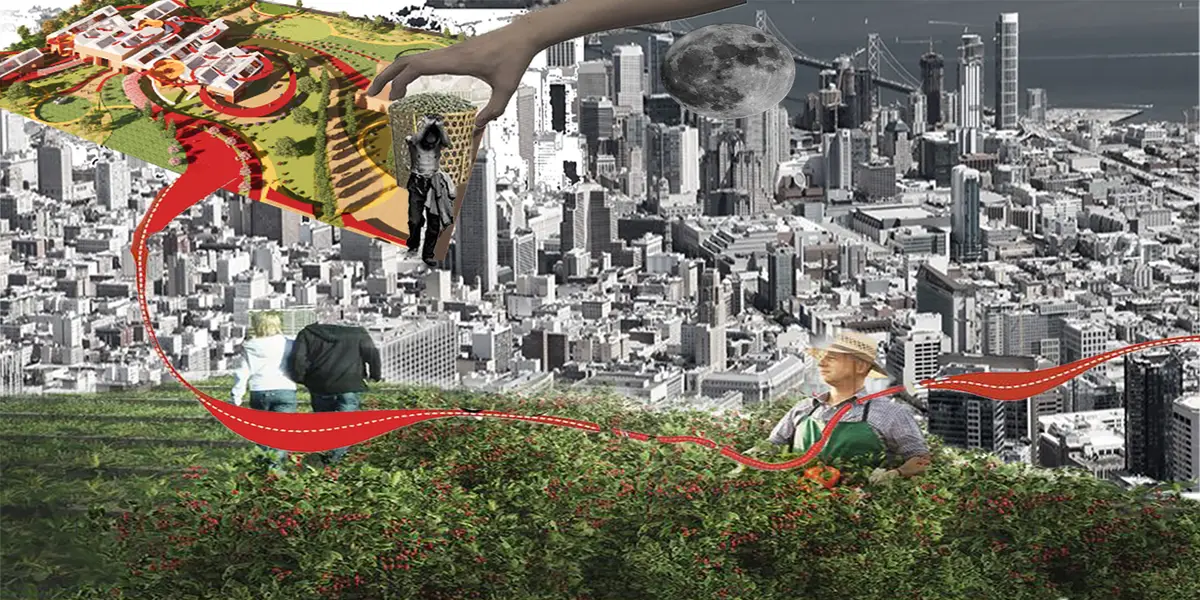
Green in the Rust
Adaptive reuse of Kahrizak Sugar Factory shows how industrial heritage, combined with agriculture and tourism, can become sustainable cultural and educational centers.

Abstract
With the expansion of cities and the rise of industrial thinking in Iran, many industries were established on the outskirts of urban areas. Over time, several of these units ceased operations due to environmental, social, and economic challenges. The deterioration of these sites also damaged surrounding agricultural and industrial spaces. This study explores the adaptive reuse of abandoned industrial sites as an opportunity for urban regeneration and cultural heritage preservation, with a specific focus on agritourism. The Kahrizak Sugar Factory serves as the case study, where industrial and agricultural elements are integrated into a sustainable tourism framework. The project demonstrates strategies for revitalizing heritage while contributing to ecological balance and socio-economic growth.Keywords: Adaptive Reuse, Industrial Heritage, Agritourism, Kahrizak Sugar Factory, Post-Industrial Landscape
Introduction
The Kahrizak Sugar Factory, situated along the Tehran–Qom highway, is an abandoned industrial heritage site with significant potential for redevelopment. Adaptive reuse with an agritourism approach provides a pathway to preserve cultural and agricultural heritage while enhancing community well-being and supporting economic development. By combining education, recreation, and heritage preservation, this project illustrates how post-industrial landscapes can be reimagined as dynamic community assets.
Problem Statement
Rapid urbanization and socio-economic change have transformed the use of industrial and agricultural spaces, leaving many facilities abandoned due to outdated infrastructure and economic shifts. Yet, these sites offer opportunities for adaptive reuse, balancing urban revitalization with the preservation of cultural and agricultural heritage.The Kahrizak Sugar Factory, once central to regional agricultural and industrial processes, now stands unused. Similarly, the surrounding farmlands, once productive, remain abandoned, despite their value as part of the area’s agricultural heritage. Together, they represent both a challenge and a potential for redevelopment. Adaptive reuse through a landscape-oriented and agritourism-focused strategy can create a multifunctional space that blends education, recreation, and heritage conservation. Such an approach not only restores industrial and agricultural settings but also engages communities, enhances socio-economic resilience, and supports sustainable development.This study investigates strategies for reimagining the Kahrizak Sugar Factory and its farmlands through agritourism to preserve heritage and foster regional growth.
SWOT Analysis
Strengths
- High factory potential → agritourism
- Proximity to farms and vacant lands
- Industrial and agricultural heritage value
Weaknesses
- Poor accessibility and lack of infrastructure
- Weak urban landscape and low security
- Waste accumulation and environmental degradation
- Social insecurity and increased crime
Opportunities
- Utilize factory potential as industrial heritage
- Create public and social spaces (due to strategic location)
- Proper agricultural education (especially for children and awareness-raising)
- Job creation
- Sustainable development and adaptive reuse
- Organize local and traditional markets, fresh produce, and fruit & vegetable markets
Threats
- Drought and water shortage
- Further degradation of natural resources
- Lack of sustainable management and improper use of space
Site Location
Iran, Tehran, Kahrizak.
Site Context
Area: approximately 30,000 m², with dimensions of 192 × 154 meter.
Surroundings
- Northeast & Southeast: residential areas (limited expansion)
- Southwest: service areas (restricted expansion)
- Northwest: commercial/agricultural zones and street frontage (expansion possible)
Scenario
Visitors are guided through a narrative journey: from soil preparation and planting to harvesting and food preparation, concluding with the industrial transformation of sugar beet into crystals and final products. This scenario ensures that participants not only learn about agriculture but also engage with cultural history, creating a holistic agritourism experience.
Experiences and Activity Stations
- Soil inspection tunnel
- Animal husbandry (cow milking, grazing, egg production)
- Plow-riding and crop cultivation (sugar beet, wheat, barley)
- Greenhouse and harvesting zones
- Flower and plant exhibitions
- Organic cooking and food workshops
- Factory tours demonstrating sugar production
- Organic market for local products
Design Guidelines
At the beginning, a scenario and sequence of activities were developed to introduce visitors to both traditional and modern urban agriculture. The aim was to familiarize them with the agricultural process, from soil preparation to planting, harvesting, food processing, and sales, as well as the transformation of sugar beet into sugar crystals.Initially, the project was intended for all age groups, but after further studies and considering the site’s proximity to schools and the lack of green and recreational spaces for children, the main focus shifted toward younger audiences.
As a result, the exploratory and educational walking path was designed according to children’s needs and interests, while diverse play and recreation areas were incorporated. This approach not only provided an attractive educational and leisure facility but also contributed to shaping a positive attitude toward sustainable agriculture and the environment.
Design Process
In the first stage, the required functions and land uses of the site were identified and mapped. Based on accessibility and entrances, the site was organized to allow visitors to engage with different stages of organic farming, with particular emphasis on sugar beet cultivation and harvesting.
Due to seasonal changes, when sugar beet production is not possible, alternative crops such as vegetables, wheat, rice, barley, cabbage, and alfalfa are introduced, highlighting the importance of seasonal diversity in agriculture. In addition, rural lifestyles and livestock activities, such as feeding animals, milking cows, and raising poultry, were included to enrich the visitor experience.Learning stations provide opportunities for hands-on activities, including soil testing, traditional plowing, planting, and harvesting. Visitors are also introduced to post-harvest processes such as storage, packaging, and sales. Considering the site’s historical link to sugar production, special focus was placed on explaining the industrial heritage of sugar factories and the process of converting sugar beet into sugar.
Conclusion
The adaptive reuse of the Kahrizak Sugar Factory showcases the potential of abandoned industrial heritage to become centers of culture, learning, and sustainability. By weaving together agriculture, tourism, and heritage, the project strengthens community ties, revitalizes the local economy, and sets a precedent for sustainable urban regeneration.


Popular Articles
Popular articles from the community


The Ocean Hive: Sustainable Architecture for a Self-Sufficient Civilization at Sea
The Ocean Hive imagines sustainable architecture at sea, where modular habitats, algae, wave power and ocean waste sustain a growing colony.

The Musturak Paradise: Senior Living Architecture for a Connected Future in Temara, Morocco
The Musturak Paradise reimagines senior living architecture in Temara via private homes, social spaces, culture, community, and shared care.

Lunar Spiral: Space Architecture Shaped by the Mathematics of the Universe
Lunar Spiral reimagines space architecture through Fibonacci geometry, lunar regolith, levitating habitats, and self-sustaining Moon living.

Play: Fragments of Their World
Familiar architecture becomes modular playground design, creating safe spaces where displaced children can learn, connect, imagine and play.

Similar Reads
You might also enjoy these articles
Sustainable Architecture Design: Embracing Nature and Modernity at Villa Solsidan
The article explores Villa Solsidan by AndrénFogelström, showcasing its sustainable architecture design and integration with the natural surroundings in Saltsjöbaden, Sweden.

Maya Harvest: A Cacao Resort Village Rooted in Mayan Tradition and Local Craft
Situated within a Tabasco cacao plantation, this shortlisted resort proposal merges vernacular materials with hands-on cultural immersion.
Harmonia: A River-Shaped Community That Grows Over Decades in Boa Vista
Curved pathways and modular grid structures along the Branco River create a phased settlement designed to evolve from 2030 to 2050.

The Architecture of Bathing: A Mughal Hammam Reimagined Across the Yamuna
Charlotte May's honorable mention entry for The Black Taj reinterprets Agra's bathing rituals through red sandstone, water, and framed views of the Taj Mah

Comments (0)
Please login or sign up to add comments
No comments yet. Be the first to comment!